


This grade 4 factors multiples lesson explains factors, multiples, primes and composites in one printable page, with definitions, a method and a worked example.
A factor of a number divides it exactly, and a multiple is what you get by multiplying it by a whole number. Factors come in pairs, such as 3 and 4 for 12. A prime number has exactly two factors, 1 and itself, while a composite number has more than two. For example, 13 is prime and 12 is composite.
Grade 4 Factors Multiples Lesson: key facts
- A factor pair is two whole numbers that multiply to give the number, such as 4 and 9 for 36.
- Multiples are found by skip counting: the multiples of 6 are 6, 12, 18, 24, and so on.
- A prime number has exactly two factors; a composite number has more than two.
- The number 1 is neither prime nor composite, and 2 is the only even prime.
- To list every factor pair, test 1, 2, 3, and so on until the numbers meet.
What are factors and factor pairs?
A factor of a number divides it exactly, with nothing left over. Two factors that multiply to give the number form a factor pair. Picture 12 dots in rows: 3 rows of 4 is one way, and it shows that 3 and 4 are factors of 12.
If \(a \times b = n\), then \(a\) and \(b\) are factors of \(n\), and \(n\) is a multiple of both \(a\) and \(b\). Example: \(4 \times 3 = 12\), so 4 is a factor of 12 and 12 is a multiple of 4.
What is a multiple?
A multiple of a number is what you get when you multiply that number by 1, 2, 3, and so on. You can list multiples by skip counting. The multiples of 4 are 4, 8, 12, 16, and they never stop. Every number is a multiple of itself and of 1.
How do you find all the factor pairs of a number?
- Write \(1 \times n\) first, because 1 and the number itself are always factors.
- Test 2, 3, 4, 5, and so on in order. Ask whether the number divides exactly.
- Each time it does, write the pair and divide to find the partner.
- Stop when the next number you would test is already used as a partner.
Example: find the factor pairs of 36. Test 1, 2, 3, 4 (works), 5 (no), 6 (works, and its partner is 6). The next number to test, 7, is bigger than its possible partner, so stop. The pairs are \(1 \times 36\), \(2 \times 18\), \(3 \times 12\), \(4 \times 9\), \(6 \times 6\). The factors in order are \(1, 2, 3, 4, 6, 9, 12, 18, 36\).
What are prime and composite numbers?
A prime number has exactly two factors: 1 and itself. A composite number has more than two factors. The number 1 is neither, because it has only one factor. The number 2 is the only even prime.
The number 13 is prime because only \(1 \times 13\) works. The number 15 is composite because \(3 \times 5 = 15\) gives extra factors.
How can you tell whether a number is a multiple of a one-digit number?
| Number | Quick test | Example |
|---|---|---|
| 2 | The ones digit is 0, 2, 4, 6, or 8 | 78 is a multiple of 2 |
| 5 | The ones digit is 0 or 5 | 85 is a multiple of 5 |
| 10 | The ones digit is 0 | 90 is a multiple of 10 |
| 3 or 9 | The digits add to a multiple of 3 or 9 | 72: 7 + 2 = 9, so 72 is a multiple of 9 |
| Any other | Skip count or divide | \(8 \times 7 = 56\) |
Factors, Multiples, Primes and Composites: frequently asked questions
What is the difference between a factor and a multiple?
A factor divides a number exactly and is never larger than it. A multiple is the number times a whole number and is never smaller. For 4 and 12, 4 is a factor of 12 and 12 is a multiple of 4.
How do you know when you have found all the factor pairs?
Test whole numbers in order starting at 1. Stop when the number you are testing is as large as its partner or larger. For 36, you stop after 6 because \(6 \times 6 = 36\).
Is 1 a prime number?
No. A prime number has exactly two different factors, and 1 has only one factor, itself. The number 1 is neither prime nor composite.
Is 2 a prime number?
Yes. The only factors of 2 are 1 and 2. It is the only even prime, because every other even number is also divisible by 2.
How can you check quickly if 63 is a multiple of 9?
Add the digits: 6 + 3 = 9, which is a multiple of 9. You can also skip count by 9 to \(9 \times 7 = 63\).
How to use this grade 4 factors multiples lesson
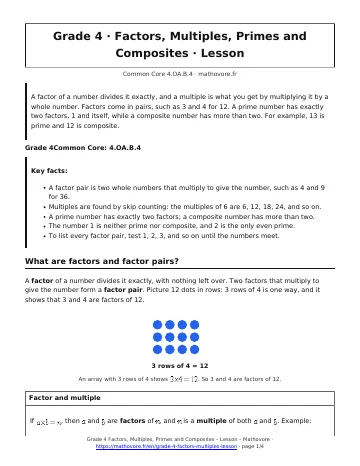
Use this grade 4 factors multiples lesson before the worksheet, then check what you learned with the quiz.

See every chapter on the Grade 4 math page.