


This grade 3 multiplication facts worksheet gives 25 problems on multiplication and division facts within 100, ordered from easy to hard, with a separate answer key.
These 25 problems build fluency with multiplication and division facts within 100, standard 3.OA.C.7. You will use fact families, skip counting, the 9s trick, and break-apart strategies. The first problems use pictures and easy facts. The last six are word problems about markets, bake sales, and school. Try to answer the facts from memory before you check.
Grade 3 Multiplication Facts Worksheet: problems 1–5
Problem 1: Fact family triangle
Use the numbers in the triangle to write two multiplication facts and two division facts.
Problem 2: Skip count by 5s
Fill in the missing numbers: 5, 10, ?, 20, ?, 30, ?, 40, ?, 50.
Problem 3: Double it
Multiply by 2. Think of doubles.
- \(2 \times 7\)
- \(2 \times 9\)
- \(2 \times 6\)
- \(2 \times 8\)
Problem 4: Multiply by 5
Find each product.
- \(5 \times 6\)
- \(5 \times 8\)
- \(5 \times 4\)
- \(5 \times 9\)
Problem 5: Tens, ones, and zero
Find each product.
- \(10 \times 7\)
- \(1 \times 9\)
- \(0 \times 8\)
- \(10 \times 4\)
Grade 3 Multiplication Facts Worksheet: problems 6–10
Problem 6: The 9s finger trick
Use your fingers to find \(9 \times 4\). Which finger do you fold down? How many tens and ones do you see?
Problem 7: Multiply by 9
Find each product. Check that the digits of each answer add to 9.
- \(9 \times 6\)
- \(9 \times 8\)
- \(9 \times 3\)
- \(9 \times 9\)
Problem 8: Square numbers
The array has the same number of rows and columns. Find each product.
- \(6 \times 6\)
- \(7 \times 7\)
- \(8 \times 8\)
- \(9 \times 9\)
Problem 9: Missing factor
Find the missing number.
- \(7 \times ? = 56\)
- \(6 \times ? = 42\)
- \(? \times 9 = 72\)
- \(4 \times ? = 32\)
Problem 10: Equal groups
Twenty-four dots are shared equally into 3 groups. How many dots are in each group? Write a division fact and a multiplication fact.
Grade 3 Multiplication Facts Worksheet: problems 11–15
Problem 11: Divide
Find each quotient.
- \(18 : 2\)
- \(35 : 5\)
- \(40 : 10\)
- \(27 : 9\)
Problem 12: Think multiplication
Think of a multiplication fact to find each quotient.
- \(56 : 7\)
- \(45 : 9\)
- \(36 : 6\)
- \(64 : 8\)
Problem 13: Finish the fact family
Write the other three facts in the fact family for \(5 \times 7 = 35\).
Problem 14: Break apart a square
Fill in the missing number. \(8 \times 8 = 8 \times 4 + 8 \times ?\) Then find the product.
Problem 15: Break apart with a picture
Find \(6 \times 8\) by finding the area of each part of the rectangle and adding.
Grade 3 Multiplication Facts Worksheet: problems 16–20
Problem 16: Use the table
Use the multiplication table to find \(7 \times 8\) and \(8 \times 7\). What do you notice?
Problem 17: Fact fluency mix
Find each product.
- \(3 \times 8\)
- \(4 \times 7\)
- \(6 \times 9\)
- \(9 \times 5\)
- \(8 \times 6\)
- \(7 \times 9\)
Problem 18: Division fluency mix
Find each quotient.
- \(42 : 6\)
- \(63 : 7\)
- \(81 : 9\)
- \(48 : 8\)
- \(72 : 9\)
- \(36 : 4\)
Problem 19: Compare the products
Answer each question.
- Which is greater, \(6 \times 8\) or \(7 \times 7\)?
- Are \(9 \times 4\) and \(6 \times 6\) equal?
Problem 20: Apple baskets
At a farmers market, Jamal packs 9 baskets with 4 apples in each basket. How many apples are there in all?
Grade 3 Multiplication Facts Worksheet: problems 21–25
Problem 21: Sticker pages
Sofia has 45 stickers. She puts 5 stickers on each page of her album. How many pages does she fill?
Problem 22: Muffin boxes
For a bake sale, Priya bakes 8 trays of 6 muffins. She packs all the muffins equally into 6 boxes. How many muffins are in each box?
Problem 23: Little League teams
There are 72 players in a Little League. They are split equally onto 9 teams. How many players are on each team?
Problem 24: Sticker packs
Diego has 4 packs of 8 stickers. Liam has 6 packs of 8 stickers. How many stickers do the two boys have together?
Problem 25: School store shopping
Mei buys 7 notebooks for $3 each and 9 pencils for $2 each at the school store. How much does she spend in all?

How to use this grade 3 multiplication facts worksheet
Print this grade 3 multiplication facts worksheet as a PDF, solve every problem on paper, then compare with the answer key.

Printable PDF · Worksheet
Grade 3 Multiplication and Division Facts Within 100 worksheet
Download the PDF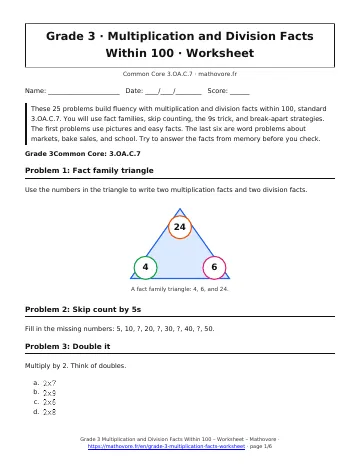
See every chapter on the Grade 3 math page.