


This grade 3 properties worksheet answer key solves all 24 problems of the properties of multiplication worksheet step by step.
Every problem below has a full worked solution with the final answer in bold. Compare each step with your own work, not just the answer. If a picture helps, redraw the array or the split rectangle and check the products again.
Grade 3 Properties Worksheet Answer Key: problems 1–5
Problem 1: Turn-around facts
The array has 4 rows with 6 dots in each row, so \(4 \times 6 = 24\). Turn the array. It has 6 rows with 4 dots in each row, so \(6 \times 4 = 24\).
Answer: \(4 \times 6 = 24\) and \(6 \times 4 = 24\).
Problem 2: Swap the factors
The commutative property lets you swap the factors, so \(7 \times 3 = 3 \times 7\). Both sides equal 21.
Answer: 7.
Problem 3: Missing factor
Swap the factors on the right side: \(5 \times 9 = 9 \times 5\). The missing number is 9. Check: \(9 \times 5 = 45\) and \(5 \times 9 = 45\).
Answer: 9.
Problem 4: Use a known fact
Swapping the factors does not change the product. So \(4 \times 6\) has the same product as \(6 \times 4\).
Answer: \(4 \times 6 = 24\).
Problem 5: Same product?
Find each product and compare.
- \(6 \times 4 = 24\) and \(4 \times 6 = 24\): same product
- \(7 \times 5 = 35\) and \(5 \times 7 = 35\): same product
- \(8 \times 3 = 24\) and \(8 \times 4 = 32\): different products
- \(9 \times 2 = 18\) and \(3 \times 6 = 18\): same product
Grade 3 Properties Worksheet Answer Key: problems 6–10
Problem 6: Group three factors
First way: \((2 \times 3) \times 4 = 6 \times 4 = 24\).
Second way: \(2 \times (3 \times 4) = 2 \times 12 = 24\).
The products match. Answer: 24 both ways.
Problem 7: Missing number in a group
The associative property keeps the same numbers in the same order and moves the parentheses. The numbers 3, 2, and 5 appear in that order, so the missing number is 2. Check: \((3 \times 2) \times 5 = 6 \times 5 = 30\) and \(3 \times (2 \times 5) = 3 \times 10 = 30\).
Answer: 2.
Problem 8: Choose a friendly group
Multiply 5 and 2 first: \(5 \times 2 = 10\). Then \(10 \times 7 = 70\).
So \((5 \times 2) \times 7 = 10 \times 7 = 70\).
Answer: 70.
Problem 9: Three factors
Group the first two: \(3 \times 2 = 6\). Then \(6 \times 4 = 24\). Another way: \(2 \times 4 = 8\) and \(3 \times 8 = 24\).
Answer: 24.
Problem 10: Two ways to group
\((2 \times 3) \times 5 = 6 \times 5 = 30\).
\(2 \times (3 \times 5) = 2 \times 15 = 30\).
Both products are 30, so the grouping does not change the answer.
Grade 3 Properties Worksheet Answer Key: problems 11–15
Problem 11: Split into two parts
Left part: \(4 \times 3 = 12\). Right part: \(4 \times 2 = 8\). Add: \(12 + 8 = 20\).
The whole rectangle has 4 rows and 5 columns, and \(4 \times 5 = 20\). Answer: 20 squares.
Problem 12: Break apart 7
Since \(7 = 5 + 2\), the missing number is 2. Now \(6 \times 5 = 30\) and \(6 \times 2 = 12\). Add: \(30 + 12 = 42\).
Answer: 2 and \(6 \times 7 = 42\).
Problem 13: Break apart 6
\(8 \times 6 = 8 \times (5 + 1)\). Multiply: \(8 \times 5 = 40\) and \(8 \times 1 = 8\). Add: \(40 + 8 = 48\).
Answer: \(8 \times 6 = 48\).
Problem 14: Split into equal parts
\(7 \times 8 = 7 \times (4 + 4)\). Multiply: \(7 \times 4 = 28\) and \(7 \times 4 = 28\). Add: \(28 + 28 = 56\).
Answer: \(7 \times 8 = 56\).
Problem 15: Break apart 9
\(7 \times 9 = 7 \times (5 + 4)\). Multiply: \(7 \times 5 = 35\) and \(7 \times 4 = 28\). Add: \(35 + 28 = 63\).
Answer: \(7 \times 9 = 63\).
Grade 3 Properties Worksheet Answer Key: problems 16–20
Problem 16: Check both sides
First: \(4 + 3 = 7\), so \(5 \times 7 = 35\).
Second: \(5 \times 4 = 20\) and \(5 \times 3 = 15\), and \(20 + 15 = 35\).
Both values are 35. The two expressions are equal, as the distributive property says.
Problem 17: Area model halves
Each half has 3 rows and 4 columns: \(3 \times 4 = 12\). Two halves: \(12 + 12 = 24\).
The whole rectangle has 3 rows and 8 columns: \(3 \times 8 = 24\).
Answer: \(3 \times 4 = 12\) for each half and \(3 \times 8 = 24\) for the whole.
Problem 18: Which split is correct?
Split 8 into 5 and 3. Choice a: \(6 \times 5 = 30\) and \(6 \times 3 = 18\), and \(30 + 18 = 48\), which equals \(6 \times 8 = 48\).
Choice b: \(30 + 3 = 33\), not 48. Choice c: \(6 + 5 + 3 = 14\), not 48.
Answer: choice a.
Problem 19: Rows of chairs
Maya: \(6 \times 7 = 42\). Jamal: \(7 \times 6 = 42\).
The factors are swapped, so the commutative property says the products match. Answer: Yes, both set up 42 chairs.
Problem 20: Pumpkin stands
Grouping 1: \((3 \times 2) \times 5 = 6 \times 5 = 30\).
Grouping 2: \(3 \times (2 \times 5) = 3 \times 10 = 30\).
Answer: 30 pumpkins.
Grade 3 Properties Worksheet Answer Key: problems 21–24
Problem 21: Bake sale trays
\(7 \times 9 = 7 \times (5 + 4)\). Then \(7 \times 5 = 35\) and \(7 \times 4 = 28\).
\(35 + 28 = 63\). Answer: 63 cookies.
Problem 22: Erasers in boxes
Group the first two factors: \((4 \times 3) \times 2 = 12 \times 2 = 24\).
Check another way: \(4 \times (3 \times 2) = 4 \times 6 = 24\).
Answer: 24 erasers.
Problem 23: School store pencils
Split 7 into 5 and 2. \(8 \times 5 = 40\) and \(8 \times 2 = 16\). Add: \(40 + 16 = 56\).
Answer: 56 pencils.
Problem 24: Garden plants
Priya: \(9 \times 6 = 9 \times (5 + 1)\). Then \(9 \times 5 = 45\) and \(9 \times 1 = 9\), and \(45 + 9 = 54\).
Diego: \(6 \times 9 = 54\). By the commutative property, he is right.
Answer: 54 plants; yes, Diego is right.
How to use this grade 3 properties worksheet answer key
Read this grade 3 properties worksheet answer key after trying each problem yourself, and redo any problem you missed.

Printable PDF · Worksheet Answer Key
Grade 3 Properties of Multiplication worksheet answer key
Download the PDF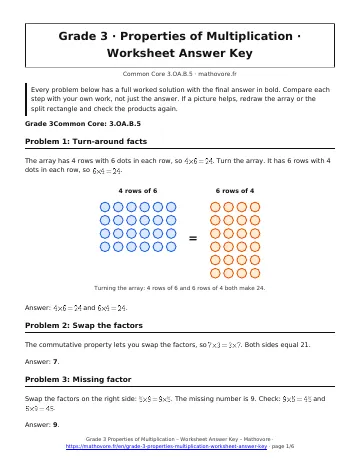
See every chapter on the Grade 3 math page.