


This algebra 2 inference test answer key gives the full solution and the scoring guide for each of the 9 test questions on statistical experiments, simulation and decisions.
Use this key to score the test out of 20 points. Each solution shows the full reasoning and a scoring note. Award the full point for a correct conclusion that is justified with the numbers, and give no credit for a bare conclusion with no evidence.
Algebra 2 Inference Test Answer Key: questions 1–5
Question 1: Spinner claim (2 points)
(a) \(40\cdot 0.2=8\) greens.
(b) Only \(2\) of the \(100\) simulated sets had \(15\) or more greens, about \(2\%\), below \(5\%\). The result is not consistent with the claim.
Scoring: 1 point for 8; 1 point for counting 2 of 100 and concluding the result is not consistent.
Question 2: Marbles with no red (2 points)
(a) \(P(\text{no red})=0.75\) on each draw, so for \(8\) draws \(0.75^{8}\approx 0.1001\).
(b) About \(10\%\) is above \(5\%\), so no red in \(8\) draws is not unusual. It is consistent with the claim.
Scoring: 1 point for \(0.75^{8}\approx 0.100\); 1 point for comparing with 5% and concluding consistent.
Question 3: Assign groups at random (2 points)
(a) Write each volunteer’s name on a card, shuffle the cards, and give the first \(7\) cards the music condition and the other \(7\) the silence condition. A random number generator that sorts the names also works.
(b) Chance spreads other differences, such as ability or mood, about evenly between groups. Then a large difference in scores is unlikely to come from the groups differing at the start.
Scoring: 1 point for a valid chance-based procedure with 7 and 7; 1 point for explaining that groups are comparable.
Question 4: Music and quiz scores (3 points)
(a) Music: \(\frac{102}{6}=17\). Silence: \(\frac{90}{6}=15\). Difference \(2\).
(b) \(\frac{37}{1000}=0.037\).
(c) This is below \(0.05\), so the difference is statistically significant. Because assignment was random, it is unlikely to be chance alone and music is the likely cause of the higher scores.
Scoring: 1 point for both means and the difference of 2; 1 point for 0.037; 1 point for significant with a correct interpretation.
Question 5: Kinds of studies (2 points)
(a) Experiment with random assignment. It can show cause and effect.
(b) Observational study, since students chose whether to play. It shows association only.
Scoring: 1 point each for the correct type and the matching cause-and-effect statement.
Algebra 2 Inference Test Answer Key: questions 6–9
Question 6: Doubling headline (2 points)
(a) \(\frac{44-42}{42}=\frac{2}{42}\approx 0.048\), about \(4.8\%\).
(b) The vertical axis starts at \(40\), so the 2023 bar has height \(4\) units and the 2022 bar has \(2\) units. The bars look like a doubling, but subscribers grew less than \(5\%\).
Scoring: 1 point for 4.8%; 1 point for identifying the truncated axis.
Question 7: Choose one of four (2 points)
(a) Faces \(1\), \(2\), \(3\) and \(4\) go to the four friends and faces \(5\) and \(6\) mean roll again. Each friend then has probability \(\frac{1}{4}\).
(b) The first roll decides when it shows \(1\) to \(4\): \(\frac{4}{6}=\frac{2}{3}\).
Scoring: 1 point for a fair assignment with a reroll rule; 1 point for \(\frac{2}{3}\).
Question 8: Carnival wheel (3 points)
(a) \(0.1\cdot 10+0.2\cdot 3+0.7\cdot 0=1+0.6=\$1.60\).
(b) \(1.60-2.00=-\$0.40\) per play.
(c) The expected net result is not \(0\), so the game is not fair. It would be fair at a price equal to the expected payout, \(\$1.60\).
Scoring: 1 point for 1.60; 1 point for -0.40; 1 point for not fair and a price of 1.60.
Question 9: Scanner flags (2 points)
(a) \(0.05\cdot 0.90+0.95\cdot 0.04=0.045+0.038=0.083\).
(b) \(\frac{0.045}{0.083}\approx 0.542\).
Scoring: 1 point for 0.083; 1 point for 0.045 divided by 0.083, about 0.542.
Scoring summary
20 points: add the points of every question of this algebra 2 inference test answer key.
How to use this algebra 2 inference test answer key
Use this algebra 2 inference test answer key to score the test fairly and to see which skills need more practice.

Printable PDF · Test Answer Key
Algebra 2 Statistical Experiments, Simulation and Decisions test answer key
Download the PDF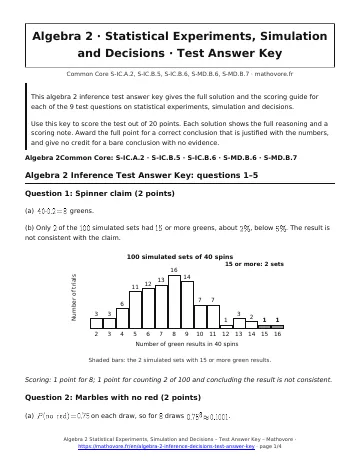
See every chapter on the Algebra 2 math page.