


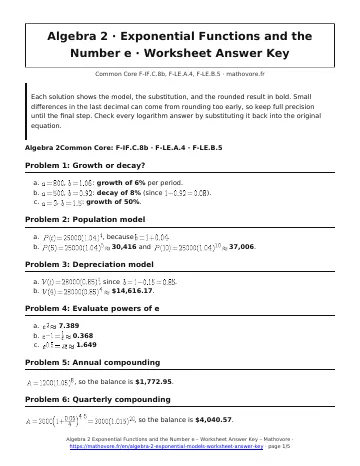
This algebra 2 exponential worksheet answer key solves all 24 problems of the exponential functions and the number e worksheet step by step.
Each solution shows the model, the substitution, and the rounded result in bold. Small differences in the last decimal can come from rounding too early, so keep full precision until the final step. Check every logarithm answer by substituting it back into the original equation.
Algebra 2 Exponential Worksheet Answer Key: problems 1–5
Problem 1: Growth or decay?
- \(a=800\), \(b=1.06\): growth of 6% per period.
- \(a=500\), \(b=0.92\): decay of 8% (since \(1-0.92=0.08\)).
- \(a=3\), \(b=1.5\): growth of 50%.
Problem 2: Population model
- \(P(t)=25000(1.04)^{t}\), because \(b=1+0.04\).
- \(P(5)=25000(1.04)^{5}\approx\) 30,416 and \(P(10)=25000(1.04)^{10}\approx\) 37,006.
Problem 3: Depreciation model
- \(V(t)=28000(0.85)^{t}\), since \(b=1-0.15=0.85\).
- \(V(4)=28000(0.85)^{4}\approx\) $14,616.17.
Problem 4: Evaluate powers of e
- \(e^{2}\approx\) 7.389
- \(e^{-1}=\frac{1}{e}\approx\) 0.368
- \(e^{0.5}=\sqrt{e}\approx\) 1.649
Problem 5: Annual compounding
\(A=1200(1.05)^{8}\), so the balance is $1,772.95.
Algebra 2 Exponential Worksheet Answer Key: problems 6–10
Problem 6: Quarterly compounding
\(A=3000(1+\frac{0.06}{4})^{4\cdot 5}=3000(1.015)^{20}\), so the balance is $4,040.57.
Problem 7: Monthly compounding
\(A=5000(1+\frac{0.036}{12})^{120}=5000(1.003)^{120}\), so the balance is $7,162.79.
Problem 8: Continuous compounding
\(A=4000e^{0.05\cdot 7}=4000e^{0.35}\), so the balance is $5,676.27.
Problem 9: Compare compounding methods
- Yearly: \(1000(1.08)\) = $1,080.00. Twice a year: \(1000(1.04)^{2}\) = $1,081.60. Monthly: \(1000(1+\frac{0.08}{12})^{12}\) = $1,083.00. Continuous: \(1000e^{0.08}\) = $1,083.29.
- $1,083.29 − $1,080.00 = $3.29 (using unrounded balances).
Problem 10: Interpret the parameters
- The account starts with $1,500 and grows 8% per year since \(1.08=1+0.08\). Each year the balance is multiplied by 1.08.
- The dose starts at 240 mg/L and the concentration falls 15% each hour, since \(0.85=1-0.15\).
Algebra 2 Exponential Worksheet Answer Key: problems 11–15
Problem 11: Find the rate from data
Let \(b\) be the yearly factor. Then \(400b^{2}=441\), so \(b^{2}=\frac{441}{400}\) and \(b=\frac{21}{20}=1.05\). The rate is 5% per year. Check: \(400(1.05)^{2}=441\).
Problem 12: Model from two points
- \(f(0)=a=6\). Then \(6b^{3}=48\), so \(b^{3}=8\) and \(b=2\) (so \(a=6\)).
- \(f(t)=6\cdot 2^{t}\), and \(f(5)=6\cdot 32=\)192.
Problem 13: Equivalent forms of a rate
- \(1.08^{t}=(1.08^{1/12})^{12t}\), so \(b=1.08^{1/12}\approx\) 1.00643.
- The monthly rate is \(b-1\approx\) 0.64% per month. This is less than \(\frac{8\%}{12}\approx 0.67\%\) because interest on interest builds up.
Problem 14: Solve with logarithms
Divide by 3: \(2^{t}=\frac{50}{3}\). Take the natural log: \(t\ln 2=\ln\frac{50}{3}\). So \(t=\frac{\ln(50/3)}{\ln 2}\approx\) 4.06.
Problem 15: Time to reach a goal
\(1.05^{t}=\frac{5}{3}\), so \(t=\frac{\ln(5/3)}{\ln 1.05}\approx\) 10.47 years. Check: \(1200(1.05)^{10.47}\approx 2000\).
Algebra 2 Exponential Worksheet Answer Key: problems 16–20
Problem 16: Doubling time
Solve \(1.04^{t}=2\): \(t=\frac{\ln 2}{\ln 1.04}\approx\) 17.67 years. The starting amount does not matter, because \(a\cdot 1.04^{t}=2a\) reduces to \(1.04^{t}=2\).
Problem 17: Half-life model
- \(A(18)=80(\frac{1}{2})^{3}=80\cdot\frac{1}{8}=\)10 mg.
- \(A(15)=80(\frac{1}{2})^{2.5}\approx\) 14.14 mg. This lies between 20 mg (12 h) and 10 mg (18 h).
Problem 18: Decay time with logs
Solve \(100(\frac{1}{2})^{t/12}=20\): \((\frac{1}{2})^{t/12}=\frac{1}{5}\), so \(\frac{t}{12}\ln\frac{1}{2}=\ln\frac{1}{5}\) and \(\frac{t}{12}=\frac{\ln 5}{\ln 2}\). Then \(t=12\cdot\frac{\ln 5}{\ln 2}\approx\) 27.86 days.
Problem 19: Continuous growth model
- \(500e^{6k}=2000\), so \(e^{6k}=4\) and \(k=\frac{\ln 4}{6}\approx\) 0.2310.
- \(N(10)=500e^{10k}=500\cdot 4^{10/6}\approx\) 5,040 bacteria.
Problem 20: Read a half-life from a graph
- The amount drops from 64 to 32 between \(t=0\) and \(t=3\), so the half-life is 3 hours.
- \(A(t)=64(\frac{1}{2})^{t/3}\).
- \(A(15)=64(\frac{1}{2})^{5}=\)2 mg. For 1 mg, \((\frac{1}{2})^{t/3}=\frac{1}{64}=(\frac{1}{2})^{6}\), so \(t=\)18 hours.
Algebra 2 Exponential Worksheet Answer Key: problems 21–24
Problem 21: Compare two accounts
Diego: \(2000(1+\frac{0.052}{12})^{120}\approx\) $3,360.28. Priya: \(2000e^{0.0525\cdot 10}=2000e^{0.525}\approx\) $3,380.92. Priya has more, by $20.64.
Problem 22: Tripling time
Solve \(Pe^{0.06t}=3P\): \(e^{0.06t}=3\), so \(0.06t=\ln 3\) and \(t=\frac{\ln 3}{0.06}\approx\) 18.31 years.
Problem 23: Savings goal
Solve \(6000(1.00375)^{12t}=10000\): \((1.00375)^{12t}=\frac{5}{3}\), so \(12t\ln 1.00375=\ln\frac{5}{3}\). Then \(t=\frac{\ln(5/3)}{12\ln 1.00375}\approx\) 11.37 years. Check: \(6000(1.00375)^{12(11.35)}\approx 10000\).
Problem 24: Shrinking town
- \(P(t)=40000(0.975)^{t}\).
- Solve \(40000(0.975)^{t}=30000\): \(0.975^{t}=0.75\), so \(t=\frac{\ln 0.75}{\ln 0.975}\approx\) 11.36. Check: \(P(11)\approx\) 30,277 is still above 30,000, and \(P(12)\approx\) 29,520 is below. The answer is 12 years.
How to use this algebra 2 exponential worksheet answer key
Read this algebra 2 exponential worksheet answer key after trying each problem yourself, and redo any problem you missed.

See every chapter on the Algebra 2 math page.