



This algebra 2 polynomial worksheet answer key solves all 24 problems of the polynomial functions and their graphs worksheet step by step.
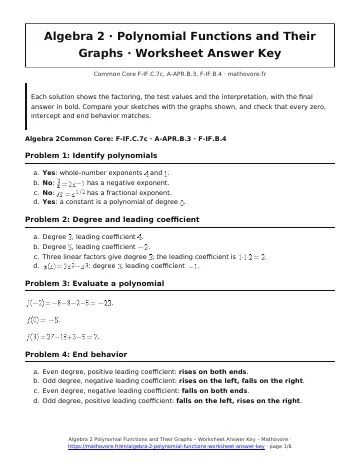
Each solution shows the factoring, the test values and the interpretation, with the final answer in bold. Compare your sketches with the graphs shown, and check that every zero, intercept and end behavior matches.
Algebra 2 Polynomial Worksheet Answer Key: problems 1–5
Problem 1: Identify polynomials
- Yes: whole-number exponents \(4\) and \(1\).
- No: \(\frac{2}{x}=2x^{-1}\) has a negative exponent.
- No: \(\sqrt{x}=x^{1/2}\) has a fractional exponent.
- Yes: a constant is a polynomial of degree \(0\).
Problem 2: Degree and leading coefficient
- Degree \(3\), leading coefficient \(4\).
- Degree \(5\), leading coefficient \(-2\).
- Three linear factors give degree \(3\); the leading coefficient is \(1\cdot 1\cdot 2=\) \(2\).
- \(p(x)=3x^{2}-x^{3}\): degree \(3\), leading coefficient \(-1\).
Problem 3: Evaluate a polynomial
\(f(-2)=-8-8-2-5=\) \(-23\).
\(f(0)=\) \(-5\).
\(f(3)=27-18+3-5=\) \(7\).
Problem 4: End behavior
- Even degree, positive leading coefficient: rises on both ends.
- Odd degree, negative leading coefficient: rises on the left, falls on the right.
- Even degree, negative leading coefficient: falls on both ends.
- Odd degree, positive leading coefficient: falls on the left, rises on the right.
Problem 5: Zeros from factored form
- \(x=4\) and \(x=-1\).
- \(x=0\), \(5\) and \(-3\).
- \(2x-6=0\) gives \(x=3\); the other zero is \(x=-7\).
- \(x=0\), \(2\) and \(-6\).
Algebra 2 Polynomial Worksheet Answer Key: problems 6–10
Problem 6: Multiplicity
- \(x=0\) (multiplicity \(1\), crosses), \(x=-3\) (multiplicity \(2\), touches), \(x=1\) (multiplicity \(3\), flattens and crosses). Degree \(1+2+3=\) \(6\).
- \(x=5\) (multiplicity \(4\), touches) and \(x=-2\) (multiplicity \(1\), crosses). Degree \(4+1=\) \(5\).
Problem 7: Factor to find zeros
- \(x(x-3)(x+3)\): zeros \(0,\ 3,\ -3\).
- \(x(x^{2}+2x-8)=x(x+4)(x-2)\): zeros \(0,\ -4,\ 2\).
- \(x^{2}(x-4)(x+4)\): zeros \(0\) (multiplicity 2), \(4,\ -4\).
- Group: \(x^{2}(x-5)-4(x-5)=(x-5)(x^{2}-4)=(x-5)(x-2)(x+2)\): zeros \(5,\ 2,\ -2\).
Problem 8: Write a polynomial from its zeros
- \((x+2)(x-1)=x^{2}+x-2\), and \((x^{2}+x-2)(x-4)=x^{3}-4x^{2}+x^{2}-4x-2x+8\). \(f(x)=x^{3}-3x^{2}-6x+8\)
- \(2x(x-3)^{2}=2x(x^{2}-6x+9)\). \(f(x)=2x^{3}-12x^{2}+18x\)
Problem 9: Find the y-intercept
- \(f(0)=2(-3)(1)(-4)=\) \(24\).
- \(g(0)=-(4)(-5)=\) \(20\).
- \(h(0)=\) \(6\), the constant term.
Problem 10: Where is the function positive?
The zeros \(-3\), \(1\) and \(4\) split the line into four intervals. Test points: \(f(-4)=-40\), \(f(0)=12\), \(f(2)=-10\), \(f(5)=32\).
\(f(x)>0\) on \((-3, 1)\) and \((4, \infty)\); \(f(x)< 0\) on \((-\infty, -3)\) and \((1, 4)\).
Algebra 2 Polynomial Worksheet Answer Key: problems 11–15
Problem 11: Turning points
- 3 turning points (two relative minimums and one relative maximum).
- At most \(n-1\) turning points, so \(n-1\ge 3\) and the least degree is 4.
- Both ends rise, so the degree is even and the leading coefficient is positive.
- \(7-1=\) \(6\).
Problem 12: Equation from a graph
The zero at \(1\) is a touch point, so its multiplicity is even: \(2\). Write \(f(x)=a(x+2)(x-1)^{2}(x-3)\). Use \(f(0)=-3\): \(a(2)(1)(-3)=-6a=-3\), so \(a=\frac{1}{2}\).
\(f(x)=\frac{1}{2}(x+2)(x-1)^{2}(x-3)\). Check: \(f(2)=\frac{1}{2}(4)(1)(-1)=-2\), a point below the axis, as the graph shows.
Problem 13: Sketch a cubic
Zeros: \(-3\), \(0\) and \(2\), all multiplicity \(1\), so the graph crosses at each. The y-intercept is \(f(0)=0\). Degree \(3\) with positive leading coefficient: falls on the left, rises on the right. Test points: \(f(-2)=8\) and \(f(1)=-4\), so the graph is above the axis between \(-3\) and \(0\) and below it between \(0\) and \(2\).
Problem 14: Sketch with a double zero
Zeros: \(-1\) (multiplicity \(2\), touches) and \(2\) (multiplicity \(1\), crosses). Degree \(3\) with negative leading coefficient: rises on the left, falls on the right. The y-intercept is \(g(0)=-(1)(-2)=2\). Also \(g(1)=-(4)(-1)=4\).
Problem 15: Degree 5 with a negative leading coefficient
Odd degree with negative leading coefficient: rises on the left and falls on the right. At most \(5-1=\) 4 turning points and at most 5 real zeros. Because the ends go in opposite directions, the graph must cross the x-axis at least once: at least 1 real zero.
Algebra 2 Polynomial Worksheet Answer Key: problems 16–20
Problem 16: Factor a quartic
Treat \(x^{2}\) as one unit: \(x^{4}-5x^{2}+4=(x^{2}-1)(x^{2}-4)=(x-1)(x+1)(x-2)(x+2)\).
Zeros: \(-2,\ -1,\ 1,\ 2\). Y-intercept: \(f(0)=4\). Even degree, positive leading coefficient: rises on both ends.
Problem 17: Equation from zeros and a point
\(f(x)=a(x-2)^{2}(x+3)\). Then \(f(0)=a(4)(3)=12a=-24\), so \(a=-2\).
\(f(x)=-2(x-2)^{2}(x+3)\). Check: \(f(1)=-2(1)(4)=-8\) and \(f(0)=-2(4)(3)=-24\).
Problem 18: Read a table
- \(f(x)=0\) at \(x=-2\) and \(x=1\).
- Increasing from \(x=-3\) to \(x=-1\) (values \(-16, 0, 4\)); decreasing from \(x=-1\) to \(x=1\) (\(4, 2, 0\)); increasing from \(x=1\) to \(x=3\) (\(0, 4, 20\)). Increasing on \((-3,-1)\) and \((1,3)\); decreasing on \((-1,1)\).
- The values rise to \(4\) and then fall: relative maximum \((-1, 4)\). They fall to \(0\) and then rise: relative minimum \((1, 0)\).
Problem 19: Open-top box
- The width \(10-2x\) must be positive, so \(0 < x < 5\).
- \(V(1)=1(8)(14)=112\), \(V(2)=2(6)(12)=144\), \(V(3)=3(4)(10)=120\), \(V(4)=4(2)(8)=64\). \(112,\ 144,\ 120,\ 64\)
- \(x=2\) inches, with a volume of \(144\) cubic inches.
- \(x=0,\ 5,\ 8\). Only \(0\) and \(5\) bound the domain; at \(x=8\) the dimensions would be negative.
Problem 20: Shipping crate
- \(x(x^{2}+2x-8)=\) \(x^{3}+2x^{2}-8x\).
- The height \(x-2\) must be positive, so \(x>2\); at \(x=2\) the volume is \(0\).
- \(V(4)=4(8)(2)=\) \(64\) cubic feet.
Algebra 2 Polynomial Worksheet Answer Key: problems 21–24
Problem 21: Hiking trail
- \(E(x)=0\) at \(0,\ 3\) and \(6\) miles.
- \(E(4)=4(1)(-2)=-8 < 0\), so between \(3\) and \(6\) miles.
- \(7(4)(1)=\) \(28\) feet above the trailhead.
- \(E(1)=10\), \(E(2)=8\), \(E(4)=-8\), \(E(5)=-10\). The lowest whole-mile point is mile \(5\) at \(-10\) feet.
Problem 22: Bake sale profit
- \(x=0\), \(10\) and \(30\) dozen: \(10\) and \(30\) dozen are the real break-even amounts (the zero at \(0\) means no baking).
- \(P(15)=\$562.50\), \(P(20)=\$1{,}000\), \(P(22)=-0.5(22)(12)(-8)=\$1{,}056\), \(P(25)=-0.5(25)(15)(-5)=\$937.50\).
- \(22\) dozen, with a profit of \$1,056.
- \(P(5)=-0.5(5)(-5)(-25)=-312.5\), so she loses \$312.50.
Problem 23: Drone flight
- \(d(4)=4(4)=\) \(16\) feet; \(d(5)=5(1)=\) \(5\) feet.
- \(d(1)=25\), \(d(2)=32\), \(d(3)=27\), \(d(4)=16\), \(d(5)=5\). The greatest is \(32\) feet at \(2\) seconds.
- The even multiplicity means the graph touches zero without crossing: the drone comes down gently and just reaches the ground at \(6\) seconds.
Problem 24: Skate ramp
- \(h(4)=a(4)(-8)^{2}=256a=8\), so \(a=\frac{1}{32}\). \(h(x)=\frac{1}{32}x(x-12)^{2}\)
- \(h(6)=\frac{6(36)}{32}=\) \(6.75\) feet.
- \(h(3)=\frac{243}{32}\approx 7.59\), \(h(4)=8\), \(h(5)=\frac{245}{32}\approx 7.66\). The ramp is highest at \(x=4\) feet, \(8\) feet tall.
How to use this algebra 2 polynomial worksheet answer key
Read this algebra 2 polynomial worksheet answer key after trying each problem yourself, and redo any problem you missed.

See every chapter on the Algebra 2 math page.