This algebra 2 real worksheet answer key solves all 24 problems of the real and complex numbers worksheet step by step.
Every problem from the worksheet is solved step by step below. Final answers are in bold, and graph problems show the finished picture. Check each answer against your own work and look for the typical mistake: forgetting to replace i² with −1.
Algebra 2 Real Worksheet Answer Key: problems 1–5
Problem 1: Classify numbers
Natural numbers start at 1. A number is rational if it can be written as a quotient of integers.
a) natural, integer, rational, real b) integer, rational, real c) rational, real d) irrational, real e) integer, rational, real (0 is not natural)
Problem 2: True or false
a) An integer \(n\) equals \(\frac{n}{1}\). b) The real numbers include all irrational numbers. c) \(\sqrt{49}=7\), which is rational. d) \(0.125=\frac{1}{8}\). e) \(\sqrt{2}\) is real but not rational.
a) True b) True c) False d) False e) False
Problem 3: Match points on a number line
Estimate: \(\sqrt{5}\approx 2.24\) and \(\sqrt{7}\approx 2.65\). The order from left to right is \(-2.24\), \(-0.5\), \(1.5\), \(2.65\).
A = \(-\sqrt{5}\), B = \(-\frac{1}{2}\), C = \(\frac{3}{2}\), D = \(\sqrt{7}\). The rational numbers are \(-\frac{1}{2}\) and \(\frac{3}{2}\).
Problem 4: Regions of the number diagram
The innermost region holds the natural numbers, the next the integers, the next the rational numbers. The region outside the rational numbers, still inside the real numbers, holds the irrational numbers.
\(12\) is natural; \(-5\) is an integer but not natural; \(\frac{2}{7}\) is rational but not an integer; \(\sqrt{11}\) is irrational.
A natural, B integers, C rational, D irrational. \(12\) is in A, \(-5\) in B, \(\frac{2}{7}\) in C, \(\sqrt{11}\) in D.
Problem 5: Square roots of negative numbers
Use \(\sqrt{-a}=i\sqrt{a}\).
a) \(\sqrt{-49}=7i\). b) \(\sqrt{-18}=i\sqrt{9\cdot 2}=3i\sqrt{2}\). c) \(\sqrt{-75}=i\sqrt{25\cdot 3}=5i\sqrt{3}\). d) \(-\sqrt{-81}=-9i\).
a) \(7i\) b) \(3i\sqrt{2}\) c) \(5i\sqrt{3}\) d) \(-9i\)
Algebra 2 Real Worksheet Answer Key: problems 6–10
Problem 6: Equations with imaginary solutions
a) \(x=\pm\sqrt{-64}=\pm 8i\). b) \(x^{2}=-45\), so \(x=\pm i\sqrt{45}=\pm 3i\sqrt{5}\). c) \(2x^{2}=-50\), \(x^{2}=-25\), \(x=\pm 5i\).
a) \(x=\pm 8i\) b) \(x=\pm 3i\sqrt{5}\) c) \(x=\pm 5i\)
Problem 7: Real and imaginary parts
Write each number as \(a+bi\). The imaginary part is the real number \(b\), without the \(i\).
a) 6 and 9 b) \(-4\) and \(-7\) c) 0 and 12 d) 15 and 0 e) \(\frac{1}{2}\) and \(-1\)
Problem 8: Read points in the complex plane
Read the real part across the horizontal axis, then the imaginary part up or down.
P = \(4+2i\), Q = \(-3+i\), R = \(-2-4i\), S = \(3-3i\)
Problem 9: Plot complex numbers
Move across the real axis by the real part and up or down by the imaginary part. A is 3 right and 2 up, B is 4 left and 1 up, C is 2 left and 3 down, D is 5 right and 1 down.
The points are plotted as shown.
Problem 10: Add complex numbers
a) \(3+2=5\) and \(5i-8i=-3i\). b) \(-4+6=2\) and \(i+9i=10i\). c) \(7-7=0\) and \(-2i+2i=0\).
a) \(5-3i\) b) \(2+10i\) c) \(0\)
Algebra 2 Real Worksheet Answer Key: problems 11–15
Problem 11: Subtract complex numbers
Distribute the minus sign to both parts of the second number.
a) \(9-3=6\), \(4i-6i=-2i\). b) \(2+3=5\), \(-5i-i=-6i\). c) \(-1+1=0\), \(8i-3i=5i\).
a) \(6-2i\) b) \(5-6i\) c) \(5i\)
Problem 12: Add arrows in the plane
The arrow \(z_1\) ends at 4 across and 1 up. The arrow \(z_2\) ends at 1 left and 3 up.
Sum: \((4+i)+(-1+3i)=3+4i\). Difference: \((4+i)-(-1+3i)=5-2i\).
\(z_1=4+i\), \(z_2=-1+3i\), \(z_1+z_2=3+4i\), \(z_1-z_2=5-2i\)
Problem 13: Multiply by an imaginary number
a) \(6i+15i^{2}=6i-15\). b) \(-8i+6i^{2}=-8i-6\). c) \(7i-i^{2}=7i+1\).
a) \(-15+6i\) b) \(-6-8i\) c) \(1+7i\)
Problem 14: Multiply two binomials
a) \(3+i+6i+2i^{2}=3+7i-2\). b) \(5+20i-2i-8i^{2}=5+18i+8\). c) \(9-3i-3i+i^{2}=9-6i-1\).
a) \(1+7i\) b) \(13+18i\) c) \(8-6i\)
Problem 15: Multiply conjugates
The middle terms cancel, leaving the real number \(a^{2}+b^{2}\).
a) \(16-9i^{2}=16+9=25\). b) \(36-i^{2}=37\). c) \(1-3i^{2}=1+3=4\).
a) 25 b) 37 c) 4
Algebra 2 Real Worksheet Answer Key: problems 16–20
Problem 16: Powers of i
Divide each exponent by 4 and use the remainder.
- 6 = 4(1) + 2, so \(i^{6}=i^{2}=-1\).
- 13 = 4(3) + 1, so \(i^{13}=i\).
- 30 = 4(7) + 2, so \(i^{30}=-1\).
- 47 = 4(11) + 3, so \(i^{47}=-i\).
- 64 = 4(16) + 0, so \(i^{64}=1\).
a) \(-1\) b) \(i\) c) \(-1\) d) \(-i\) e) \(1\)
Problem 17: Simplify with powers of i
a) \(2(-i)+5(-1)-1+6=-2i-5-1+6\), which is \(-2i\). b) \(9i^{2}=-9\). c) \((-2)^{3}i^{3}=-8(-i)=8i\).
a) \(-2i\) b) \(-9\) c) \(8i\)
Problem 18: Verify a solution
Substitute: \((1+2i)^{2}=1+4i+4i^{2}=-3+4i\). Then \(-2(1+2i)=-2-4i\).
Add: \((-3+4i)+(-2-4i)+5=0\).
The left side equals 0, so \(1+2i\) is a solution.
Problem 19: Impedance in a circuit
Add real parts: \(3+2=5\). Add imaginary parts: \(4i-i=3i\).
\(5+3i\) ohms
Problem 20: Voltage across a circuit
\((2+i)(3-2i)=6-4i+3i-2i^{2}=6-i+2\).
\(8-i\) volts
Algebra 2 Real Worksheet Answer Key: problems 21–24
Problem 21: Find the error
The rule \(\sqrt{a}\cdot\sqrt{b}=\sqrt{ab}\) does not work when both numbers under the roots are negative. Noah must rewrite each root with \(i\) first.
\(\sqrt{-4}=2i\) and \(\sqrt{-9}=3i\), so \(2i\cdot 3i=6i^{2}=-6\).
The correct value is \(-6\).
Problem 22: Moving on a game map
After the first move: \((3+2i)+(-5+4i)=-2+6i\). After the second move: \((-2+6i)+(2-7i)=0-i\).
The character ends at \(-i\), which is the point \((0,-1)\).
Problem 23: Rotating a drone
One time: \(i(4+3i)=4i+3i^{2}=-3+4i\). Two times : \(i(-3+4i)=-3i+4i^{2}=-4-3i\). Three times : \(i(-4-3i)=-4i-3i^{2}=3-4i\).
\(-3+4i\), \(-4-3i\), \(3-4i\). Each multiplication by \(i\) turns the point a quarter turn (\(90^{\circ}\)) counterclockwise about the origin.
Problem 24: Make a product real
Expand: \(2k-ki+6i-3i^{2}=(2k+3)+(6-k)i\). The product is real when the imaginary part is zero: \(6-k=0\), so \(k=6\).
Then the real part is \(2(6)+3=15\).
\(k=6\), and the product is 15.
How to use this algebra 2 real worksheet answer key
Read this algebra 2 real worksheet answer key after trying each problem yourself, and redo any problem you missed.

Printable PDF · Worksheet Answer Key
Algebra 2 Real and Complex Numbers worksheet answer key
Download the PDF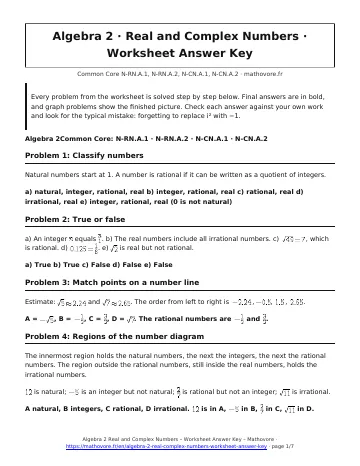
See every chapter on the Algebra 2 math page.