This geometry reasoning proof worksheet answer key solves all 23 problems of the logic and two-column proofs worksheet step by step.
Each solution names the statement, the reason or the counterexample. For proofs, check that every reason is Given, a definition, a postulate, a property or a theorem, and that the last statement is the Prove.
Geometry Reasoning Proof Worksheet Answer Key: problems 1–5
Problem 1: Hypothesis and conclusion
Hypothesis (after if): it rains on Saturday. Conclusion (after then): the Little League game is canceled.
Problem 2: Writing if-then form
If a number is divisible by both 2 and 3, then it is divisible by 6. The hypothesis is “a number is divisible by both 2 and 3.” The words after if in the original sentence form the hypothesis.
Problem 3: Rewriting a statement
If a figure is a square, then it has four congruent sides.
Problem 4: Writing a converse
Converse: If a figure is a rectangle, then it is a square. It is false.
Counterexample: a rectangle that measures 5 cm by 3 cm has four right angles but its sides are not equal.
Problem 5: Inverse and contrapositive
Inverse (negate both parts): If a polygon is not a square, then it does not have four sides.
Contrapositive (swap and negate): If a polygon does not have four sides, then it is not a square.
Geometry Reasoning Proof Worksheet Answer Key: problems 6–10
Problem 6: Truth values of related statements
- Statement: true (every multiple of 4 is even).
- Converse: “If a number is even, then it is a multiple of 4.” False; counterexample 6.
- Inverse: “If a number is not a multiple of 4, then it is not even.” False; counterexample 6.
- Contrapositive: “If a number is not even, then it is not a multiple of 4.” True, matching the statement.
Problem 7: Counterexample with primes
The number 2 is prime, because its only factors are 1 and 2, but it is even. The hypothesis is true and the conclusion is false, so the statement is false.
Problem 8: Counterexample with squares
Let \(x=-7\). Then \((-7)^{2}=49\), so the hypothesis is true, but \(x\neq 7\). \(x=-7\) is a counterexample.
Problem 9: Counterexample with angles
\(100+80=180\), so the angles are supplementary and the hypothesis is true. They do not share a side, so they are not a linear pair and the conclusion is false.
The two angles in the figure are a counterexample.
Problem 10: Inductive pattern of dots
Counts: 2, 6, 12, 20. The differences are 4, 6, 8, so the next differences are 10 and 12.
Pattern 5: \(20+10=30\). Pattern 6: \(30+12=42\).
Pattern n is a rectangle with n rows and n + 1 columns: \(n(n+1)\). Check: \(5\times 6=30\) and \(6\times 7=42\).
Geometry Reasoning Proof Worksheet Answer Key: problems 11–15
Problem 11: Inductive or deductive?
- Inductive: it generalizes from a pattern of cases.
- Deductive: it applies a general fact to a specific case.
- Inductive: three measured cases suggest a rule but do not prove it.
- Deductive: it applies a known theorem to a specific triangle.
Problem 12: Making a conjecture
Every sum is even. Conjecture: the sum of two odd numbers is even. This is inductive reasoning, so it is a conjecture until it is proven.
Problem 13: Disproving a conjecture
Try a negative number: \(-3+5=2\) and \(2 < 5\). The sum 2 is not greater than 5. The numbers \(-3\) and 5 are a counterexample.
Problem 14: Naming properties of equality
- Symmetric Property.
- Transitive Property.
- Reflexive Property.
- Division Property of Equality (divide both sides by 3).
Problem 15: Supplying reasons
| Statements | Reasons |
|---|---|
| 1. \(3x+7=22\) | 1. Given |
| 2. \(3x=15\) | 2. Subtraction Property of Equality (subtract 7 from both sides) |
| 3. \(x=5\) | 3. Division Property of Equality (divide both sides by 3) |
Check: \(3(5)+7=22\).
Geometry Reasoning Proof Worksheet Answer Key: problems 16–20
Problem 16: Supplying statements
| Statements | Reasons |
|---|---|
| 1. \(\angle 1\) and \(\angle 2\) are complementary; \(m\angle 1=35^{\circ}\) | 1. Given |
| 2. \(m\angle 1+m\angle 2=90^{\circ}\) | 2. Definition of complementary angles |
| 3. \(35^{\circ}+m\angle 2=90^{\circ}\) | 3. Substitution Property of Equality |
| 4. \(m\angle 2=55^{\circ}\) | 4. Subtraction Property of Equality |
Check: \(35+55=90\).
Problem 17: Midpoint proof
| Statements | Reasons |
|---|---|
| 1. M is the midpoint of \(\overline{ST}\); \(ST=24\) | 1. Given |
| 2. \(SM=MT\) | 2. Definition of midpoint |
| 3. \(SM+MT=ST\) | 3. Segment Addition Postulate |
| 4. \(SM+SM=24\) | 4. Substitution Property of Equality |
| 5. \(2(SM)=24\) | 5. Combining like terms |
| 6. \(SM=12\) | 6. Division Property of Equality |
Problem 18: Vertical angles proof
| Statements | Reasons |
|---|---|
| 1. Lines ℓ and m intersect | 1. Given |
| 2. \(\angle 2\) and \(\angle 3\) are a linear pair; \(\angle 3\) and \(\angle 4\) are a linear pair | 2. Definition of linear pair |
| 3. \(\angle 2\) and \(\angle 3\) are supplementary; \(\angle 3\) and \(\angle 4\) are supplementary | 3. Linear Pair Postulate |
| 4. \(m\angle 2+m\angle 3=180^{\circ}\); \(m\angle 3+m\angle 4=180^{\circ}\) | 4. Definition of supplementary angles |
| 5. \(m\angle 2+m\angle 3=m\angle 3+m\angle 4\) | 5. Transitive Property of Equality (both sums equal 180) |
| 6. \(m\angle 2=m\angle 4\) | 6. Subtraction Property of Equality (subtract \(m\angle 3\)) |
| 7. \(\angle 2\) ≅ \(\angle 4\) | 7. Definition of congruent angles |
Problem 19: Paragraph proof
Because \(\angle A\) and \(\angle B\) are complementary, \(m\angle A+m\angle B=90^{\circ}\). Because \(\angle C\) and \(\angle B\) are complementary, \(m\angle C+m\angle B=90^{\circ}\). Both sums equal \(90^{\circ}\), so \(m\angle A+m\angle B=m\angle C+m\angle B\) by the Transitive Property of Equality. Subtracting \(m\angle B\) from both sides gives \(m\angle A=m\angle C\). Angles with equal measures are congruent, so \(\angle A\) ≅ \(\angle C\).
Problem 20: Contrapositive in context
Contrapositive: “If a student does not have a GPA of at least 3.5, then the student is not on the honor roll.” Since \(3.2 < 3.5\), Priya’s GPA is below 3.5.
Priya is not on the honor roll. The contrapositive is true because the original rule is true.
Geometry Reasoning Proof Worksheet Answer Key: problems 21–23
Problem 21: Chaining conditionals
Link the conclusion of the first rule to the hypothesis of the second: If it snows more than 6 inches, then the bake sale moves to Sunday.
Eight inches is more than 6 inches, so the hypothesis is true. Therefore the bake sale moves to Sunday.
Problem 22: Solve and justify
1. \(3x+14=5x-6\): Vertical Angles Theorem (\(\angle 1\) ≅ \(\angle 3\)).
2. \(20=2x\): Addition and Subtraction Properties of Equality. 3. \(x=10\): Division Property of Equality.
4. \(m\angle 1\)\(=3(10)+14=44^{\circ}\): Substitution. 5. \(\angle 1\) and \(\angle 2\) are a linear pair, so they are supplementary: \(m\angle 2\)\(=180-44=136^{\circ}\). 136°.
Problem 23: Writing a biconditional
Converse: If a polygon has exactly three sides, then it is a triangle. It is true by the definition of a triangle.
Biconditional: A polygon is a triangle if and only if it has exactly three sides.
How to use this geometry reasoning proof worksheet answer key
Read this geometry reasoning proof worksheet answer key after trying each problem yourself, and redo any problem you missed.

Printable PDF · Worksheet Answer Key
Geometry Logic and Two-Column Proofs worksheet answer key
Download the PDF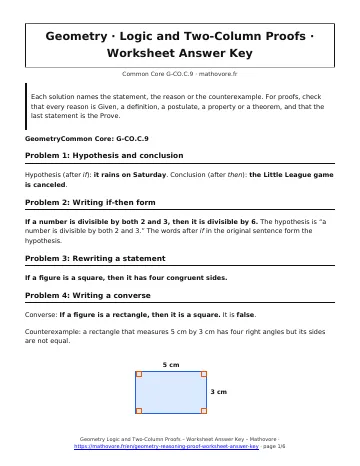
See every chapter on the Geometry math page.