


This algebra 1 solving quadratics lesson explains solving quadratic equations in one printable page, with definitions, a method and a worked example.
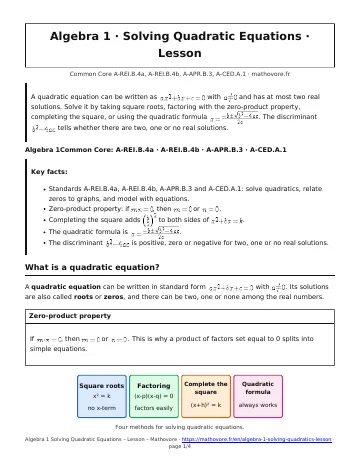
A quadratic equation can be written as \(ax^{2}+bx+c=0\) with \(a\neq 0\) and has at most two real solutions. Solve it by taking square roots, factoring with the zero-product property, completing the square, or using the quadratic formula \(x=\frac{-b\pm\sqrt{b^{2}-4ac}}{2a}\). The discriminant \(b^{2}-4ac\) tells whether there are two, one or no real solutions.
Algebra 1 Solving Quadratics Lesson: key facts
- Standards A-REI.B.4a, A-REI.B.4b, A-APR.B.3 and A-CED.A.1: solve quadratics, relate zeros to graphs, and model with equations.
- Zero-product property: if \(mn=0\), then \(m=0\) or \(n=0\).
- Completing the square adds \((\frac{b}{2})^{2}\) to both sides of \(x^{2}+bx=k\).
- The quadratic formula is \(x=\frac{-b\pm\sqrt{b^{2}-4ac}}{2a}\).
- The discriminant \(b^{2}-4ac\) is positive, zero or negative for two, one or no real solutions.
What is a quadratic equation?
A quadratic equation can be written in standard form \(ax^{2}+bx+c=0\) with \(a\neq 0\). Its solutions are also called roots or zeros, and there can be two, one or none among the real numbers.
If \(m\cdot n=0\), then \(m=0\) or \(n=0\). This is why a product of factors set equal to 0 splits into simple equations.
Which method should you use?
Pick the quickest method that fits the equation. If \(x\) appears only squared, take square roots. If the trinomial factors, use the zero-product property. Otherwise complete the square or use the quadratic formula, which works for every quadratic equation.
Zeros also help you sketch a graph. The vertex lies halfway between the two zeros, and the y-intercept is \(c\). Always check each solution in the original equation, because a rearranging mistake can hide in the middle steps.
How do you solve by factoring?
- Move every term to one side so the other side is 0.
- Factor the quadratic.
- Set each factor equal to 0 and solve.
- Check each answer in the original equation.
Example. Solve \(x^{2}-2x-3=0\). Factor: \((x-3)(x+1)=0\), so \(x=3\) or \(x=-1\). On the graph, these are the x-intercepts.
How do you solve by completing the square?
Solve \(x^{2}+6x-7=0\). Move the constant: \(x^{2}+6x=7\). Add \((\frac{6}{2})^{2}=9\) to both sides: \((x+3)^{2}=16\). Then \(x+3=\pm 4\), so \(x=1\) or \(x=-7\).
What is the quadratic formula?
For \(ax^{2}+bx+c=0\), the solutions are \(x=\frac{-b\pm\sqrt{b^{2}-4ac}}{2a}\). For \(2x^{2}+3x-5=0\), \(b^{2}-4ac=9+40=49\), so \(x=\frac{-3\pm 7}{4}\), which gives \(x=1\) or \(x=-\frac{5}{2}\).
The formula comes from completing the square on the general equation, so both methods always agree. Simplify a radical when you can: \(\sqrt{28}=2\sqrt{7}\).
What does the discriminant tell you?
The expression \(D=b^{2}-4ac\) sits under the square root.
| Discriminant | Real solutions | Graph |
|---|---|---|
| \(D > 0\) | two | crosses the x-axis twice |
| \(D=0\) | one | touches the x-axis at the vertex |
| \(D < 0\) | none | stays above or below the axis |
Solving Quadratic Equations: frequently asked questions
How many solutions can a quadratic equation have?
A quadratic equation has at most two real solutions. It has two when the discriminant is positive, one when it is zero, and none when it is negative.
When should you use the quadratic formula?
Use it when the quadratic does not factor easily or when the numbers are awkward. It works for every quadratic equation, so it is a reliable fallback.
Why must one side equal zero before factoring?
The zero-product property only works when a product equals 0. For example, \((x-2)(x-3)=6\) does not mean \(x-2=6\) or \(x-3=6\).
Why do square roots give a plus and minus answer?
Both a positive and a negative number square to the same value. For \(x^{2}=25\), both \(5\) and \(-5\) work, so write \(x=\pm 5\).
How do you handle a solution that does not make sense in a word problem?
Solve the equation, then check each answer against the situation. A negative length or a negative time is rejected, and the other solution is kept.
How to use this algebra 1 solving quadratics lesson
Use this algebra 1 solving quadratics lesson before the worksheet, then check what you learned with the quiz.

See every chapter on the Algebra 1 math page.