


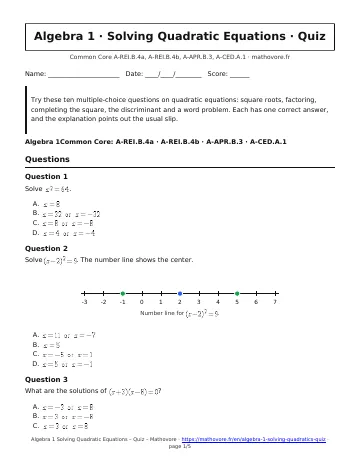
Try these ten multiple-choice questions on quadratic equations: square roots, factoring, completing the square, the discriminant and a word problem. Each has one correct answer, and the explanation points out the usual slip.
Algebra 1Common Core: A-REI.B.4a · A-REI.B.4b · A-APR.B.3 · A-CED.A.1
🎯 Solving Quadratic Equations – Algebra 1 math quiz
Question 1
Solve \(x^{2}=64\).
A
\(x=8\)
B
\(x=32\text{ or }x=-32\)
C
\(x=8\text{ or }x=-8\)
D
\(x=4\text{ or }x=-4\)
Question 2
Solve \((x-2)^{2}=9\). The number line shows the center.Number line for \((x-2)^{2}=9\).
A
\(x=11\text{ or }x=-7\)
B
\(x=5\)
C
\(x=-5\text{ or }x=1\)
D
\(x=5\text{ or }x=-1\)
Question 3
What are the solutions of \((x+3)(x-8)=0\)?
A
\(x=-3\text{ or }x=8\)
B
\(x=3\text{ or }x=-8\)
C
\(x=3\text{ or }x=8\)
D
\(x=-3\text{ or }x=-8\)
Question 4
Solve \(x^{2}-x-12=0\).
A
\(x=-4\text{ or }x=3\)
B
\(x=4\text{ or }x=-3\)
C
\(x=4\text{ or }x=3\)
D
\(x=6\text{ or }x=-2\)
Question 5
The graph of \(y=x^{2}-6x+5\) is shown. What are the solutions of \(x^{2}-6x+5=0\)?Graph of \(y=x^{2}-6x+5\).
A
\(x=1\text{ or }x=5\)
B
\(x=3\)
C
\(x=5\text{ or }x=-1\)
D
\(x=-1\text{ or }x=-5\)
Question 6
What number completes the square in \(x^{2}+14x\)?
A
\(14\)
B
\(49\)
C
\(7\)
D
\(196\)
Question 7
What is the discriminant of \(2x^{2}-3x+5=0\)?
A
\(31\)
B
\(-31\)
C
\(49\)
D
\(-11\)
Question 8
How many real solutions does \(x^{2}-4x+4=0\) have? The graph is shown.Graph of \(y=x^{2}-4x+4\).
A
Exactly two
B
No real solutions
C
Infinitely many
D
Exactly one
Question 9
Which are the solutions of \(2x^{2}+x-3=0\)?
A
\(x=-1\text{ or }x=\frac{3}{2}\)
B
\(x=1\text{ or }x=\frac{3}{2}\)
C
\(x=1\text{ or }x=-\frac{3}{2}\)
D
\(x=-1\text{ or }x=-\frac{3}{2}\)
Question 10
A rectangle is 4 feet longer than it is wide, and its area is 45 square feet. What is its width?Rectangle model for the problem.
A
\(5\text{ ft}\)
B
\(9\text{ ft}\)
C
\(-9\text{ ft}\)
D
\(11.25\text{ ft}\)
🎉 Quiz complete!
0 / 10
Remember:
- Standards A-REI.B.4a, A-REI.B.4b, A-APR.B.3 and A-CED.A.1: solve quadratics, relate zeros to graphs, and model with equations.
- Zero-product property: if \(mn=0\), then \(m=0\) or \(n=0\).
- Completing the square adds \((\frac{b}{2})^{2}\) to both sides of \(x^{2}+bx=k\).
- The quadratic formula is \(x=\frac{-b\pm\sqrt{b^{2}-4ac}}{2a}\).
- The discriminant \(b^{2}-4ac\) is positive, zero or negative for two, one or no real solutions.
See every chapter on the Algebra 1 math page.