Key takeaway: This algebra 1 solving quadratics test has nine questions worth 20 points. Students solve by taking roots, factoring, rewriting squares, and applying the formula. They also read a graph, use the discriminant, and model a banner and a ball flight. A calculator is allowed, and the key explains each point split.
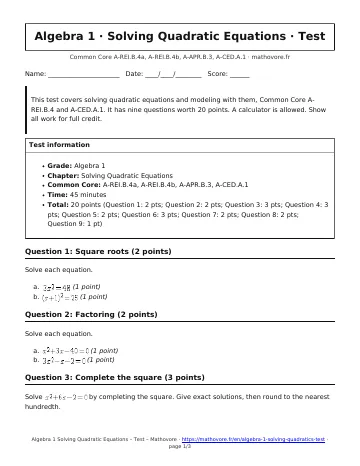
This test covers solving quadratic equations and modeling with them, Common Core A-REI.B.4 and A-CED.A.1. It has nine questions worth 20 points. A calculator is allowed. Show all work for full credit.
- Grade: Algebra 1
- Chapter: Solving Quadratic Equations
- Common Core: A-REI.B.4a, A-REI.B.4b, A-APR.B.3, A-CED.A.1
- Time: 45 minutes
- Total: 20 points (Question 1: 2 pts; Question 2: 2 pts; Question 3: 3 pts; Question 4: 3 pts; Question 5: 2 pts; Question 6: 3 pts; Question 7: 2 pts; Question 8: 2 pts; Question 9: 1 pt)
Algebra 1 Solving Quadratics Test: questions 1–5
1. Square roots (2 points)
Solve each equation.
- \(3x^{2}=48\) (1 point)
- \((x+1)^{2}=25\) (1 point)
2. Factoring (2 points)
Solve each equation.
- \(x^{2}+3x-40=0\) (1 point)
- \(3x^{2}-x-2=0\) (1 point)
3. Complete the square (3 points)
Solve \(x^{2}+6x-2=0\) by completing the square. Give exact solutions, then round to the nearest hundredth.
4. Quadratic formula (3 points)
Solve \(2x^{2}-3x-4=0\) using the quadratic formula. Give exact solutions, then round to the nearest hundredth.
5. Discriminant (2 points)
Answer each part.
- Find the discriminant of \(3x^{2}-6x+4=0\) and state how many real solutions it has. (1 point)
- Find the value of \(k\) for which \(x^{2}-8x+k=0\) has exactly one real solution. (1 point)
Algebra 1 Solving Quadratics Test: questions 6–9
6. Use a graph (3 points)
The graph of \(y=x^{2}-4x-5\) is shown.
- Use the graph to solve \(x^{2}-4x-5=0\). (1 point)
- Name the vertex and the axis of symmetry. (1 point)
- For which values of \(x\) is \(y < 0\)? (1 point)
7. Rectangle (2 points)
A rectangular banner is 5 feet longer than it is wide, and its area is 84 square feet. Find its width and length.
8. Ball flight (2 points)
A ball is hit upward and its height in feet after \(t\) seconds is \(h(t)=-16t^{2}+40t+24\). The graph is shown.
- After how many seconds does the ball hit the ground? (1 point)
- Explain why one solution of the equation is not used. (1 point)
9. No real solution (1 point)
A student says that \(x^{2}=-9\) has the solutions \(x=3\) and \(x=-3\). Explain the error.

What does the algebra 1 solving quadratics test measure?
Question 1 checks square roots with \(3x^{2}=48\) and \((x+1)^{2}=25\). Question 2 checks factoring, including \(3x^{2}-x-2=0\). Next, questions 3 and 4 carry 3 points each. They ask for exact answers and then decimals, so show both forms.
How should you plan time on a quadratic equations test?
Give about 12 minutes to questions 1 and 2, because they are quick. Then keep 20 minutes for questions 3, 4 and 6. Question 6 uses the graph of \(y=x^{2}-4x-5\), so read the x-intercepts first and verify by factoring.
Which mistakes lose points?
- Writing only the positive root in question 1.
- Forgetting that question 7 asks for width and length.
- Claiming in question 9 that \(x^{2}=-9\) has real roots.
How can you prepare for the quadratics test?
First, solve one equation per method. Then redo a ball-flight problem with \(h(t)=-16t^{2}+40t+24\). Finally, explain out loud why a negative discriminant means no real answer.

See every chapter on the Algebra 1 math page.