
Key takeaway: Use this algebra 1 linear functions worksheet to practice 22 problems on slope, equation forms, graphs, parallel and perpendicular lines, and linear models. The first problems find slopes from points, and the last six turn gyms, trips and savings into equations.
The set follows the F-IF, F-LE and A-CED standards. Keep a ruler and graph paper nearby, because three problems ask you to graph. Write the formula before you substitute, and simplify fractions at the end. Worked answers wait on a companion page.
These twenty-two problems practice Common Core standards F-IF.C.7a, F-LE.A.1a, F-LE.A.2 and A-CED.A.2. Find slopes from two points, switch between slope-intercept, point-slope and standard form, graph lines, and write equations of parallel and perpendicular lines.
The last six are word problems that ask for a linear model, a prediction and an interpretation. Work from easiest to hardest and check each equation with a point.
Algebra 1 Linear Functions Worksheet: problems 1–5
1. Slope from two points
Find the slope of the line through \((-4,9)\) and \((6,-6)\).
2. A negative slope
Find the slope of the line through \((-3,5)\) and \((1,-7)\).
3. A fractional slope
Find the slope of the line through \((-4,-1)\) and \((2,1)\). Write it as a fraction in simplest form.
4. Horizontal and vertical lines
Find the slope of each line, or write undefined.
- The line through \((2,5)\) and \((9,5)\)
- The line through \((3,-2)\) and \((3,6)\)
5. Read slope and intercept
The equation of a line is \(y=-\frac{3}{4}x+5\).
- State the slope and the y-intercept.
- Find \(y\) when \(x=8\).
Algebra 1 Linear Functions Worksheet: problems 6–10
6. Equation from a graph
Write the equation of the line shown in slope-intercept form.
7. Slope and a point
A line has slope \(\frac{4}{5}\) and passes through \((10,3)\). Write its equation in slope-intercept form.
8. Point-slope form
Write an equation in point-slope form for the line with slope 3 that passes through \((2,-1)\). Then rewrite it in slope-intercept form.
9. Line through two points
Write the equation of the line through \((1,3)\) and \((5,11)\) in slope-intercept form.
10. Standard to slope-intercept
Rewrite \(3x+4y=12\) in slope-intercept form and name the slope and y-intercept.
Algebra 1 Linear Functions Worksheet: problems 11–15
11. Slope-intercept to standard
Write \(y=-\frac{2}{5}x+4\) in standard form \(Ax+By=C\) with integer coefficients and \(A>0\).
12. Intercepts and graph
Find the x-intercept and y-intercept of \(4x-6y=24\), then graph the line.
13. Graph from slope-intercept
Graph \(y=-\frac{2}{3}x+1\).
14. Graph from point-slope
Graph the line \(y-2=\frac{1}{2}(x+3)\).
15. Parallel line
Write, in slope-intercept form, the equation of the line through \((3,-2)\) that is parallel to \(y=4x+1\).
Algebra 1 Linear Functions Worksheet: problems 16–20
16. Perpendicular line
Write the equation of the line through \((4,1)\) that is perpendicular to \(y=2x-5\).
17. Gym membership
A gym charges a one-time sign-up fee of $25 plus $18 per month. Let \(C\) be the total cost after \(m\) months.
- Write an equation for \(C\) in terms of \(m\).
- Find the cost after 9 months.
- After how many months has Maya paid a total of $277?
18. Data plan table
The table shows the monthly cost \(y\) in dollars of a data plan for \(x\) gigabytes.
- Show that the relationship is linear.
- Write an equation for \(y\).
- Find the cost for 15 gigabytes.
19. Road trip
On a road trip, Jamal’s car is 55 miles from his home after 1 hour and 145 miles from home after 3 hours. The car drives at a constant speed. Let \(d\) be the distance from home in miles after \(t\) hours.
- Find the speed of the car.
- Write an equation for \(d\).
- Find the distance after 5 hours.
20. Temperature conversion
Water freezes at \(0^{\circ}\text{C}\) (\(32^{\circ}\text{F}\)) and boils at \(100^{\circ}\text{C}\) (\(212^{\circ}\text{F}\)). Assume Fahrenheit temperature \(F\) is a linear function of Celsius temperature \(C\).
- Write an equation for \(F\) in terms of \(C\).
- Convert \(25^{\circ}\text{C}\) to Fahrenheit.
- Convert \(77^{\circ}\text{F}\) to Celsius.
Algebra 1 Linear Functions Worksheet: problems 21–22
21. Notebooks and binders
Sofia has $60 to spend at the school store. Notebooks cost $3 each and binders cost $5 each. The equation \(3x+5y=60\) describes the purchases that use all $60, where \(x\) is the number of notebooks and \(y\) is the number of binders.
- Find both intercepts and explain what each means.
- If Sofia buys 5 notebooks, how many binders can she buy?
22. Two savings plans
Priya has $20 saved and adds $8 each week. Ethan has $50 saved and adds $5 each week. Let \(w\) be the number of weeks and \(s\) the savings in dollars.
- Write an equation for each person.
- After how many weeks do they have the same amount, and how much is it?

What does this algebra 1 linear functions worksheet contain?
Problems 1 to 4 find slopes, including a fraction and a horizontal or vertical line. Next, problems 5 to 9 read and write equations from graphs, a point and two points. Then problems 10 to 14 convert forms and graph lines.
After that, problems 15 and 16 write parallel and perpendicular lines. Finally, problems 17 to 22 model stories about a gym, a data plan, a road trip, temperature, a store budget and two savings plans.
Which problems need extra care?
Problem 3 asks for a slope in simplest form, so reduce \(\frac{2}{6}\) to \(\frac{1}{3}\). Problem 4 includes an undefined slope, which is not the same as zero. In problem 8, write point-slope form first and convert second. Problem 11 requires integer coefficients with \(A>0\), so clear the fraction by multiplying.
Also, problem 16 uses an opposite reciprocal, so flip the fraction and change the sign.
How do the story problems use slope?
Jamal’s car in problem 19 is 55 miles from home after 1 hour and 145 miles after 3 hours. Meanwhile, problem 20 links Celsius and Fahrenheit through the freezing and boiling points of water. In problem 22, Priya saves $8 a week from $20, while Ethan saves $5 a week from $50.
Therefore, name what m and b mean in each story, and include the units.
What routine speeds up equation writing?
First, find the slope. Next, choose a point. Then plug both into point-slope form. After that, distribute and solve for y. Also, check by testing the other point. Finally, graph two points to confirm that the line looks right.
How can you avoid the most common slope mistakes?
First, keep the same subtraction order in numerator and denominator. Next, watch negative signs, because \(9-(-6)\) is 15, not 3. Then simplify the fraction. If the line rises, the slope is positive. Otherwise, it is negative. For instance, the line through \((-3,5)\) and \((1,-7)\) falls, so its slope is -3. Besides, a quick sketch confirms the sign. Because two points determine a line, any two points give the same slope.
Similarly, check an equation with a point. First, substitute x. Next, compute y. If it matches, the equation fits. For example, \(y=2x+1\) passes through \((1,3)\) and \((5,11)\), since 2 plus 1 is 3 and 10 plus 1 is 11. Therefore, the check takes seconds. Finally, practice converting forms both ways, so that you can pick the easiest form for each task.
Which form should you choose for each task?
Choose slope-intercept form when you want to graph from the y-intercept. Pick point-slope form when a problem gives a point and a slope. Reach for standard form when you need both intercepts quickly. For example, \(4x-6y=24\) crosses at 6 and -4. Therefore, setting each variable to zero finds the intercepts in two steps. Meanwhile, parallel and perpendicular problems favor slope-intercept form, because the slope is visible at once. As a result, converting early saves time later. Finally, write the answer in the form the question requests.
What is a useful follow-up?
Compare your equations with the key and fix any sign you missed. Next, redo problem 16 using a different line, such as \(y=3x-2\). Finally, take the quiz to see whether choosing the right form now feels automatic.

Printable PDF · Worksheet
Algebra 1 Linear Functions: Slope-Intercept, Point-Slope and Standard Form worksheet
Download the PDF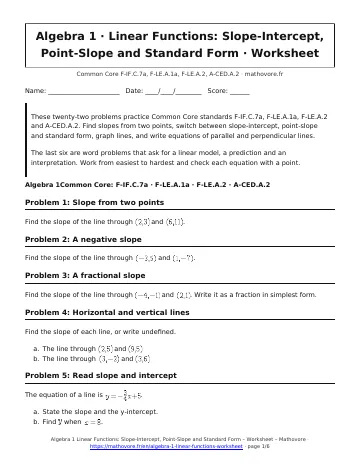
See every chapter on the Algebra 1 math page.