Key takeaway: Nine questions share 20 points on the algebra 1 exponents radicals test below. The paper covers integer exponent rules, rational exponents, rewriting radicals and simplifying square roots for the N-RN domain. Calculators stay in the bag until the last two items.
Write every answer in simplest form, and show your work so partial credit is possible. Use a calculator only for decimal approximations. Plan on roughly 40 minutes, and keep a ruler handy for the graph question. Scoring notes stay on their own page, so nobody sees them mid-test.
This test covers Common Core standards N-RN.A.1 and N-RN.A.2: integer exponent rules, rational exponents, radicals and simplifying square roots. Nine questions are worth 20 points in total. Show your work, write answers in simplest form, and use a calculator only for decimal approximations.
- Grade: Algebra 1
- Chapter: Exponent Rules, Radicals and Rational Exponents
- Common Core: N-RN.A.1, N-RN.A.2
- Time: 45 minutes
- Total: 20 points (Question 1: 2 pts; Question 2: 2 pts; Question 3: 2 pts; Question 4: 2 pts; Question 5: 2 pts; Question 6: 3 pts; Question 7: 2 pts; Question 8: 3 pts; Question 9: 2 pts)
Algebra 1 Exponents Radicals Test: questions 1–5
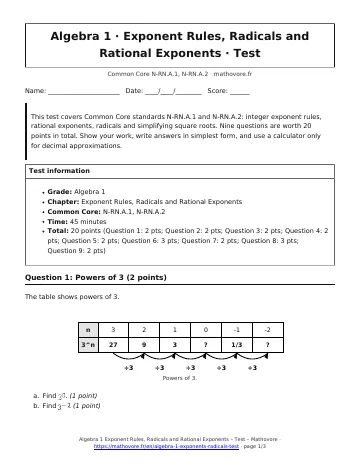
1. Powers of 3 (2 points)
The table shows powers of 3.
- Find \(3^{0}\). (1 point)
- Find \(3^{-2}\). (1 point)
2. Monomial products and quotients (2 points)
Simplify. Assume no variable equals 0.
- \((4x^{3}y)(-2x^{2}y^{4})\) (1 point)
- \(\dfrac{18a^{7}b^{2}}{6a^{2}b}\) (1 point)
3. Combining power rules (2 points)
Simplify and write each answer with positive exponents.
- \((x^{4})^{-2}\cdot x^{11}\) (1 point)
- \((2x^{-2}y)^{3}\) (1 point)
4. Rational exponent values (2 points)
Evaluate.
- \(25^{3/2}\) (1 point)
- \(32^{-2/5}\) (1 point)
5. Radical and exponent forms (2 points)
Rewrite each expression in the other form.
- Write \(\sqrt[3]{x^{4}}\) with a rational exponent. (1 point)
- Write \(y^{5/2}\) as a radical. (1 point)
Algebra 1 Exponents Radicals Test: questions 6–9
6. Simplify square roots (3 points)
Write each expression in simplest form. Assume \(x>0\).
- \(\sqrt{45}\) (1 point)
- \(\sqrt{80}\) (1 point)
- \(\sqrt{12x^{5}}\) (1 point)
7. Exponent rules with fractions (2 points)
Simplify. Assume \(x>0\).
- \((x^{3/4})^{8}\) (1 point)
- \(\dfrac{x^{7/3}}{x^{1/3}}\) (1 point)
8. Graph of a rational power (3 points)
The graph shows \(y=x^{1/2}\).
- Find \(y\) when \(x=16\). (1 point)
- Write the equation using a radical. (1 point)
- Does the point (25, 5) lie on the graph? Show why. (1 point)
9. Square frame (2 points)
A square picture frame has an area of 150 square inches. Find its side length in simplest radical form (1 point) and to the nearest tenth of an inch (1 point).

What does the algebra 1 exponents radicals test ask?
Question 1 reads a table of powers of 3 and asks for \(3^{0}\) and \(3^{-2}\). Next, question 2 multiplies and divides monomials such as \((4x^{3}y)(-2x^{2}y^{4})\). Then question 3 combines rules, for example \((x^{4})^{-2}\cdot x^{11}\).
Questions 4 and 5 move to rational exponents like \(25^{3/2}\) and \(32^{-2/5}\), and then to converting \(\sqrt[3]{x^{4}}\) into exponent form.
How are the longer questions arranged?
Question 6 is worth 3 points and simplifies \(\sqrt{45}\) and \(\sqrt{80}\). After that, question 7 applies the exponent rules to fractional powers. Question 8 reads the graph of \(y=x^{1/2}\), where \(x=16\) gives \(y=4\). Finally, question 9 asks for the side of a square frame with area 150 square inches.
Therefore, expect to leave an exact radical for the last item and approximate only if asked.
What mistakes cost points?
First, many students add exponents in a power of a power. Next, some drop the negative sign on \(3^{-2}\) and write -9. Instead, remember that the sign flips the base. Also, check that no square factor is left under a radical.
How should you review before sitting this test?
Cover the answers on three practice items, one per skill: exponent rules, rational powers and radicals. Solve each one aloud. Then explain which rule you used and why. If any step feels shaky, revisit the lesson example that matches it before test day.

See every chapter on the Algebra 1 math page.