Key takeaway: This algebra 1 linear worksheet answer key lays out the setup, the arithmetic and a check for each of the 22 problems. Compare your slopes, equations and graphs with these, and look for the step where a sign or a fraction went astray if an answer differs.
Many errors start with the order of subtraction. A flipped sign in the slope changes every later line, so check it first.
Every solution below shows the setup, the arithmetic and a check. Compare your slopes, equations and graphs with these, and look for the step where a sign or a fraction went astray if an answer differs.
Algebra 1 Linear Worksheet Answer Key: problems 1–5
1. Slope from two points
\(m=\frac{-6-9}{6-(-4)}=\frac{-15}{10}=-\frac{3}{2}\). The slope is \(-\frac{3}{2}\).
2. A negative slope
\(m=\frac{-7-5}{1-(-3)}=\frac{-12}{4}=-3\). The slope is \(-3\). The line falls from left to right.
3. A fractional slope
\(m=\frac{1-(-1)}{2-(-4)}=\frac{2}{6}=\frac{1}{3}\). The slope is \(\frac{1}{3}\).
4. Horizontal and vertical lines
- \(m=\frac{5-5}{9-2}=\frac{0}{7}=0\). The slope is 0 (horizontal line, \(y=5\)).
- \(m=\frac{6-(-2)}{3-3}=\frac{8}{0}\), and division by zero is not defined. The slope is undefined (vertical line, \(x=3\)).
5. Read slope and intercept
- The slope is \(-\frac{3}{4}\) and the y-intercept is \(5\), the point \((0,5)\).
- \(y=-\frac{3}{4}(8)+5=-6+5=-1\). So \(y=-1\).
Algebra 1 Linear Worksheet Answer Key: problems 6–10
6. Equation from a graph
The line crosses the y-axis at \((0,2)\), so \(b=2\). From \((0,2)\) to \((2,5)\), the rise is 3 and the run is 2, so \(m=\frac{3}{2}\).
Check with \((-2,-1)\): \(\frac{3}{2}(-2)+2=-1\). The equation is \(y=\frac{3}{2}x+2\).
7. Slope and a point
Substitute into \(y=mx+b\): \(3=\frac{4}{5}(10)+b\), so \(3=8+b\) and \(b=-5\).
The equation is \(y=\frac{4}{5}x-5\).
8. Point-slope form
Point-slope form: \(y+1=3(x-2)\).
Distribute: \(y+1=3x-6\). Subtract 1: \(y=3x-7\).
9. Line through two points
Slope: \(m=\frac{11-3}{5-1}=2\). Use point-slope with \((1,3)\): \(y-3=2(x-1)\).
Distribute and add 3: \(y=2x-2+3\), so \(y=2x+1\). Check \((5,11)\): \(2(5)+1=11\).
10. Standard to slope-intercept
Subtract \(3x\): \(4y=-3x+12\). Divide by 4: \(y=-\frac{3}{4}x+3\).
The slope is \(-\frac{3}{4}\) and the y-intercept is 3.
Algebra 1 Linear Worksheet Answer Key: problems 11–15
11. Slope-intercept to standard
Multiply every term by 5: \(5y=-2x+20\). Add \(2x\) to both sides: \(2x+5y=20\).
Check \((0,4)\): \(2(0)+5(4)=20\).
12. Intercepts and graph
Let \(y=0\): \(4x=24\), so \(x=6\). Let \(x=0\): \(-6y=24\), so \(y=-4\).
The intercepts are \((6,0)\) and \((0,-4)\). Draw the line through them.
13. Graph from slope-intercept
Plot the y-intercept \((0,1)\). The slope \(-\frac{2}{3}\) means down 2, right 3: plot \((3,-1)\). Going the other way (up 2, left 3) gives \((-3,3)\).
14. Graph from point-slope
The equation is in point-slope form with \((x_{1},y_{1})=(-3,2)\) and \(m=\frac{1}{2}\). Plot \((-3,2)\), then go up 1 and right 2 to \((-1,3)\), and again to \((1,4)\).
15. Parallel line
Parallel lines have equal slopes, so \(m=4\). Point-slope form: \(y+2=4(x-3)\).
Distribute: \(y+2=4x-12\). Subtract 2: \(y=4x-14\).
Algebra 1 Linear Worksheet Answer Key: problems 16–20
16. Perpendicular line
The slope of the given line is 2. The negative reciprocal is \(-\frac{1}{2}\). Point-slope form: \(y-1=-\frac{1}{2}(x-4)\).
Distribute: \(y-1=-\frac{1}{2}x+2\). Add 1: \(y=-\frac{1}{2}x+3\).
17. Gym membership
- The rate is $18 per month and the starting amount is $25: \(C=18m+25\).
- \(C=18(9)+25=162+25=187\). The cost is $187.
- \(18m+25=277\), so \(18m=252\) and \(m=14\). It takes 14 months.
18. Data plan table
- When \(x\) increases by 2, \(y\) increases by 11 each time (31, 42, 53, 64). The rate of change is constant at \(\frac{11}{2}=5.5\), so the relationship is linear.
- \(m=5.5\). Use \((2,31)\): \(31=5.5(2)+b\), so \(b=20\). The equation is \(y=5.5x+20\).
- \(y=5.5(15)+20=82.5+20=102.5\). It costs $102.50.
19. Road trip
- \(\frac{145-55}{3-1}=\frac{90}{2}=45\). The speed is 45 miles per hour.
- \(d=45t+b\). Using \((1,55)\): \(55=45+b\), so \(b=10\). The equation is \(d=45t+10\) (Jamal starts 10 miles from home).
- \(d=45(5)+10=235\). The distance is 235 miles.
20. Temperature conversion
- \(m=\frac{212-32}{100-0}=\frac{180}{100}=\frac{9}{5}\). The y-intercept is 32 (the point \((0,32)\)), so \(F=\frac{9}{5}C+32\).
- \(F=\frac{9}{5}(25)+32=45+32=77\). That is \(77^{\circ}\text{F}\).
- \(77=\frac{9}{5}C+32\), so \(45=\frac{9}{5}C\) and \(C=45\cdot\frac{5}{9}=25\). That is \(25^{\circ}\text{C}\).
Algebra 1 Linear Worksheet Answer Key: problems 21–22
21. Notebooks and binders
- If \(y=0\): \(3x=60\), so \(x=20\): the intercept \((20,0)\) means 20 notebooks and no binders. If \(x=0\): \(5y=60\), so \(y=12\): the intercept \((0,12)\) means 12 binders and no notebooks.
- \(3(5)+5y=60\), so \(5y=45\) and \(y=9\). She can buy 9 binders.
22. Two savings plans
- Priya: \(s=8w+20\). Ethan: \(s=5w+50\).
- Set them equal: \(8w+20=5w+50\), so \(3w=30\) and \(w=10\). Then \(s=8(10)+20=100\). After 10 weeks each has $100.
How should you work with the algebra 1 linear worksheet answer key?
Hide the answer, rework the problem, and then compare. Slopes first: problem 1 gives \(-\frac{3}{2}\), problem 2 gives -3, and problem 3 gives \(\frac{1}{3}\). The horizontal line in problem 4 has slope 0, whereas the vertical line has an undefined slope.
Which equations are easy to miss?
Problem 7 gives \(y=\frac{4}{5}x-5\), since \(3=\frac{4}{5}(10)+b\) leaves \(b=-5\). Next, problem 8 gives \(y+1=3(x-2)\), which becomes \(y=3x-7\). Problem 9 gives \(y=2x+1\). Then problem 10 gives \(y=-\frac{3}{4}x+3\), and problem 11 gives \(2x+5y=20\).
Parallel and perpendicular answers follow. Problem 15 gives \(y=4x-14\), and problem 16 gives \(y=-\frac{1}{2}x+3\). In problem 12, the intercepts are 6 and -4.
What do the model answers say?
Meanwhile, the gym in problem 17 follows \(C=18m+25\). The road trip in problem 19 follows \(d=45t+10\), which means the car started 10 miles from home and moved at 45 miles per hour. The temperature rule in problem 20 is \(F=\frac{9}{5}C+32\).
In problem 22, the savings plans tie when \(20+8w=50+5w\), so after 10 weeks both have $100. Afterward, Priya is ahead.
How can you learn from a miss?
First, find the earliest line that differs. Next, decide whether the slip was a sign, a fraction or a form. Then redo it with a fresh pair of points. Also, write a one-line reminder. As a result, the same error is less likely next time.
How do the checks in the key work?
First, each check substitutes a known point into the new equation. Next, the key compares both sides. For instance, \(y=2x+1\) gives 3 at \(x=1\) and 11 at \(x=5\), which matches the two given points. Then the key confirms the slope with a second pair. Therefore, a correct check means the equation is right, not just plausible. Meanwhile, graphs get a similar test: the line must pass through both plotted points. Besides, the intercepts must agree with the equation. For example, \(4x-6y=24\) gives 6 and -4, so the graph must cross there.
Likewise, story answers get a reality check. First, ask whether the rate makes sense. Next, ask whether the starting value fits the situation. A taxi cannot charge a negative base fare, and a car cannot travel 450 miles per hour. Thus, a sensible answer is part of a correct answer. Finally, include the unit in the sentence, because a number alone does not describe a rate.
What should you review after you finish the key?
First, list the forms that gave you trouble. Next, practice one conversion in each direction. Then solve two parallel and perpendicular problems with new lines. Also, graph one equation using only the slope and the y-intercept. After that, graph another using two points. Finally, explain to a friend why both graphs match.
What comes next?
Sort your misses into slope, form and model errors. Then redo the first problem of the largest group without the key. When the method feels reliable, take the test and write the meaning of m and b in each context problem.

Printable PDF · Worksheet Answer Key
Algebra 1 Linear Functions: Slope-Intercept, Point-Slope and Standard Form worksheet answer key
Download the PDF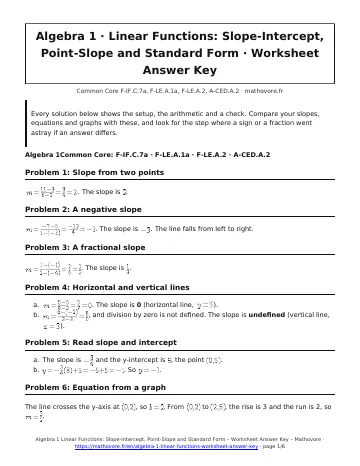
See every chapter on the Algebra 1 math page.