Key takeaway: This algebra 1 factoring test contains nine questions and 20 points. It covers the greatest common factor, trinomials, special patterns, grouping, zeros of quadratics and an area problem about a poster.
Show every step, because partial credit follows correct work. Check each factorization by multiplying. Plan on about 45 minutes, and keep scratch paper for factor pairs. The answer key is a separate page for teachers. Use a pencil, and mark the problems you want to revisit.
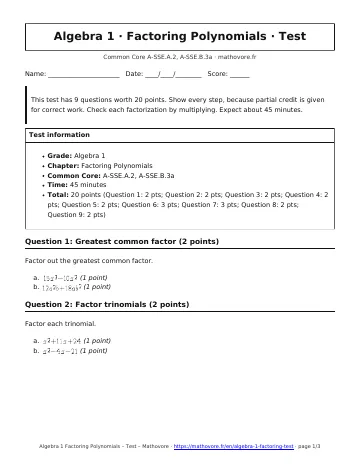
This test has 9 questions worth 20 points. Show every step, because partial credit is given for correct work. Check each factorization by multiplying. Expect about 45 minutes.
- Grade: Algebra 1
- Chapter: Factoring Polynomials
- Common Core: A-SSE.A.2, A-SSE.B.3a
- Time: 45 minutes
- Total: 20 points (Question 1: 2 pts; Question 2: 2 pts; Question 3: 2 pts; Question 4: 2 pts; Question 5: 2 pts; Question 6: 3 pts; Question 7: 3 pts; Question 8: 2 pts; Question 9: 2 pts)
Algebra 1 Factoring Test: questions 1–5
1. Greatest common factor (2 points)
Factor out the greatest common factor.
- \(15 x^{3} – 10 x^{2}\) (1 point)
- \(12 a^{2} b + 18 a b^{2}\) (1 point)
2. Factor trinomials (2 points)
Factor each trinomial.
- \(x^{2} + 11 x + 24\) (1 point)
- \(x^{2} – 4 x – 21\) (1 point)
3. Factor with a leading coefficient (2 points)
Factor each trinomial.
- \(3 x^{2} + 10 x + 8\) (1 point)
- \(4 x^{2} – 8 x – 5\) (1 point)
4. Special patterns (2 points)
Factor.
- \(49 x^{2} – 36\) (1 point)
- \(9 x^{2} + 30 x + 25\) (1 point)
5. Factor by grouping (2 points)
Factor each polynomial by grouping.
- \(x^{3} + 5 x^{2} + 2 x + 10\) (1 point)
- \(3 x^{3} – 6 x^{2} – 4 x + 8\) (1 point)
Algebra 1 Factoring Test: questions 6–9
6. Factor completely (3 points)
Factor completely.
- \(3 x^{2} – 48\) (1 point)
- \(2 x^{3} + 12 x^{2} + 18 x\) (1 point)
- \(6 x^{2} – 5 x – 4\) (1 point)
7. Zeros and the graph (3 points)
The graph of \(y=x^{2}-x-6\) is shown.
- Factor \(x^{2}-x-6\). (1 point)
- Solve \(x^{2}-x-6=0\). (1 point)
- Label the x-intercepts on the graph by writing their coordinates. (1 point)
8. Poster dimensions (2 points)
A rectangular poster has area \(2x^{2}+11x+12\) square inches and width \(x+4\) inches.
- Write an expression for the length. (1 point)
- Find the length and width when \(x=5\). (1 point)
9. Is it complete? (2 points)
Aisha factors \(4x^{2}-100\) as \((2x-10)(2x+10)\).
- Explain why the factorization is not complete. (1 point)
- Write the complete factorization. (1 point)

What does the algebra 1 factoring test ask?
Question 1 factors \(15x^{3}-10x^{2}\) and \(12a^{2}b+18ab^{2}\). Next, question 2 factors \(x^{2}+11x+24\) and \(x^{2}-4x-21\). Then question 3 adds a leading coefficient with \(3x^{2}+10x+8\) and \(4x^{2}-8x-5\).
Question 4 uses special patterns, for example \(49x^{2}-36\) and \(9x^{2}+30x+25\). After that, question 5 groups four-term polynomials.
Which questions carry extra points?
Question 6 is worth 3 points and asks for complete factoring of \(3x^{2}-48\), \(2x^{3}+12x^{2}+18x\) and \(6x^{2}-5x-4\). Then question 7 is also worth 3 points and links \(x^{2}-x-6\) to its graph. Because the zeros appear on the graph, you can verify your factors visually.
Questions 8 and 9 are worth 2 points each. The poster has area \(2x^{2}+11x+12\) and width \(x+4\), so divide to find the length. Aisha’s \(4x^{2}-100\) needs a second look.
What mistakes should you avoid?
First, never skip the GCF. Next, do not mix up the signs in the two binomials. Also, avoid stopping at \((2x-10)(2x+10)\), because each factor still hides a 2. Therefore, scan the final answer for one more common factor.
How can you study for the factoring test?
Make three flash cards, one each for GCF, trinomials and special patterns. Then factor five mixed expressions in a row without notes. After that, multiply every answer back out. Finally, time one full practice set so the 45 minutes feel familiar.

See every chapter on the Algebra 1 math page.