



This algebra 1 key test answer key gives the full solution and the scoring guide for each of the 8 test questions on key features of graphs and rate of change.
Use this answer key to grade out of 20 points. Each question shows the full solution and a scoring guide with partial credit. Accept equivalent forms of intervals and any valid method, and require units in the questions that have a context.
Algebra 1 Key Test Answer Key: questions 1–5
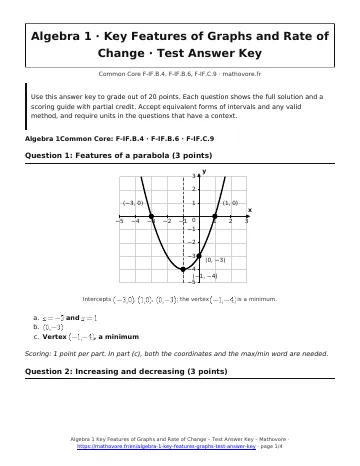
Question 1: Features of a parabola (3 points)
- \(x=-3\) and \(x=1\)
- \((0,-3)\)
- Vertex \((-1,-4)\), a minimum
Scoring: 1 point per part. In part (c), both the coordinates and the max/min word are needed.
Question 2: Increasing and decreasing (3 points)
- \(-6 < x < -4\) and \(0 < x < 3\)
- \(-4 < x < 0\) and \(3 < x < 6\)
- Minimum value \(-3\) at \(x=0\)
Scoring: 1 point per part. In parts (a) and (b), both intervals are needed; give 0.5 for one interval.
Question 3: End behavior (2 points)
- The term \(-x^{2}\) becomes very negative. \(f(x)\) decreases without bound.
- Powers like \(2^{-10}=\frac{1}{1024}\) are tiny and positive. \(g(x)\) approaches 0.
Scoring: 1 point per part for the correct description.
Question 4: Symmetry of a parabola (2 points)
The axis is \(x=-\frac{-8}{2(1)}=4\). Then \(f(4)=16-32+10=-6\).
Axis \(x=4\); vertex \((4,-6)\)
Scoring: 1 point for the axis. 1 point for the vertex: 0.5 for the correct \(x\)-value and 0.5 for the \(y\)-value.
Question 5: Average rate of change (2 points)
\(f(1)=2\) and \(f(4)=16+4=20\). The rate is \(\frac{20-2}{4-1}=\frac{18}{3}=6\).
6
Scoring: 1 point for both function values; 1 point for the correct quotient.
Algebra 1 Key Test Answer Key: questions 6–8
Question 6: Biking distance (3 points)
- \(\frac{20-0}{2-0}=10\). 10 miles per hour
- \(\frac{32-20}{4-2}=\frac{12}{2}=6\). 6 miles per hour
- The first interval: his average speed was 10 mph, which is greater than 6 mph.
Scoring: 1 point per part. Parts (a) and (b) need units; part (c) needs the comparison of the two rates.
Question 7: Compare two functions (2 points)
- \(f\) has rate 4. \(g\) rises 2 per step, so its rate is 2. \(f\)
- \(f(10)=4(10)-5=35\). \(g(10)=3+2(10)=23\). \(f\)
Scoring: 1 point per part for the correct function with supporting numbers.
Question 8: Ball height (3 points)
- The axis is \(t=-\frac{32}{2(-16)}=1\), and \(h(1)=-16+32+6=22\). 22 feet at 1 second
- \(h(0)=6\). The ball starts 6 feet above the ground.
- \(\frac{22-6}{1-0}=16\). 16 feet per second
Scoring: 1 point per part. In part (b), an interpretation without units earns 0.5.
Scoring summary
20 points: add the points of every question of this algebra 1 key test answer key.
How to use this algebra 1 key test answer key
Use this algebra 1 key test answer key to score the test fairly and to see which skills need more practice.

See every chapter on the Algebra 1 math page.