Key takeaway: Graders can mark the 20-point paper with this algebra 1 key test answer key. Every question has a full solution and a scoring guide with partial credit, and any valid method is accepted.
Equivalent forms of intervals earn full marks, and questions with a context require units. For example, write 22 feet for a height, not just 22. Read the reasoning on each paper before checking the final number, since a sound setup deserves recognition.
Use this answer key to grade out of 20 points. Each question shows the full solution and a scoring guide with partial credit. Accept equivalent forms of intervals and any valid method, and require units in the questions that have a context.
Algebra 1 Key Test Answer Key: questions 1–5
1. Features of a parabola (3 points)
- \(x=-3\) and \(x=1\)
- \((0,-3)\)
- Vertex \((-1,-4)\), a minimum
Scoring: 1 point per part. In part (c), both the coordinates and the max/min word are needed.
2. Increasing and decreasing (3 points)
- \(-6 < x < -4\) and \(0 < x < 3\)
- \(-4 < x < 0\) and \(3 < x < 6\)
- Minimum value \(-3\) at \(x=0\)
Scoring: 1 point per part. In parts (a) and (b), both intervals are needed; give 0.5 for one interval.
3. End behavior (2 points)
- The term \(-x^{2}\) becomes very negative. \(f(x)\) decreases without bound.
- Powers like \(2^{-10}=\frac{1}{1024}\) are tiny and positive. \(g(x)\) approaches 0.
Scoring: 1 point per part for the correct description.
4. Symmetry of a parabola (2 points)
The axis is \(x=-\frac{-8}{2(1)}=4\). Then \(f(4)=16-32+10=-6\).
Axis \(x=4\); vertex \((4,-6)\)
Scoring: 1 point for the axis. 1 point for the vertex: 0.5 for the correct \(x\)-value and 0.5 for the \(y\)-value.
5. Average rate of change (2 points)
\(f(1)=2\) and \(f(4)=16+4=20\). The rate is \(\frac{20-2}{4-1}=\frac{18}{3}=6\).
6
Scoring: 1 point for both function values; 1 point for the correct quotient.
Algebra 1 Key Test Answer Key: questions 6–8
6. Biking distance (3 points)
- \(\frac{20-0}{2-0}=10\). 10 miles per hour
- \(\frac{32-20}{4-2}=\frac{12}{2}=6\). 6 miles per hour
- The first interval: his average speed was 10 mph, which is greater than 6 mph.
Scoring: 1 point per part. Parts (a) and (b) need units; part (c) needs the comparison of the two rates.
7. Compare two functions (2 points)
- \(f\) has rate 4. \(g\) rises 2 per step, so its rate is 2. \(f\)
- \(f(10)=4(10)-5=35\). \(g(10)=3+2(10)=23\). \(f\)
Scoring: 1 point per part for the correct function with supporting numbers.
8. Ball height (3 points)
- The axis is \(t=-\frac{32}{2(-16)}=1\), and \(h(1)=-16+32+6=22\). 22 feet at 1 second
- \(h(0)=6\). The ball starts 6 feet above the ground.
- \(\frac{22-6}{1-0}=16\). 16 feet per second
Scoring: 1 point per part. In part (b), an interpretation without units earns 0.5.
Scoring summary
20 points: add the points of every question of this algebra 1 key test answer key.
Which values does the algebra 1 key test answer key list?
Question 4 gives the axis \(x=4\) and the vertex \((4,-6)\). Question 5 gives \(\frac{20-2}{3}=6\). Next, question 7 shows that f has rate 4 while g has rate 2, so f changes faster. Question 8 gives a maximum height of 22 feet at 1 second.
Where should graders split credit?
In question 8, award one point for the time, another for plugging in, and a third for the height with units. However, a student who gives the time only earns one point. Meanwhile, question 3 earns a point per function, so accept words such as decreases without bound.
Question 1 is worth 3 points, one each for the intercepts, the y-intercept and the vertex. Question 6 earns a point for the interval, one for the speed and one for the sentence.
What do low scores suggest?
Misses on questions 1 and 2 suggest weak vocabulary. By contrast, misses on 5 and 7 suggest trouble with rate of change. Hence, plan short practice on whichever pair shows more errors.
How can you act on these results?
Group students by missed question and give each group a small graph to annotate. Next, ask them to explain one answer aloud. Finally, retest the weakest feature with a short quiz after a week to confirm progress.

Printable PDF · Test Answer Key
Algebra 1 Key Features of Graphs and Rate of Change test answer key
Download the PDF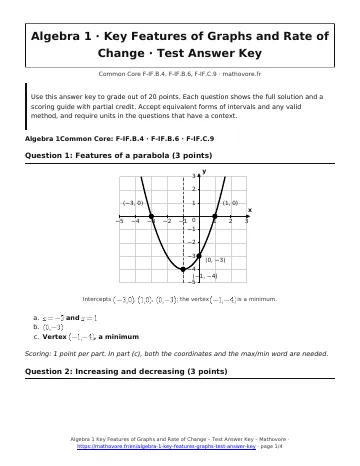
See every chapter on the Algebra 1 math page.