


This algebra 1 functions notation test checks functions, domain, range and function notation in 45 minutes, with 8 questions for a total of 20 points.
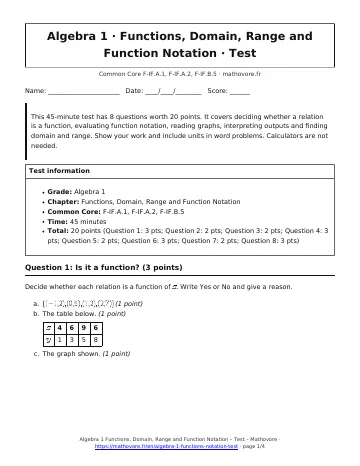
This 45-minute test has 8 questions worth 20 points. It covers deciding whether a relation is a function, evaluating function notation, reading graphs, interpreting outputs and finding domain and range. Show your work and include units in word problems. Calculators are not needed.
- Grade: Algebra 1
- Chapter: Functions, Domain, Range and Function Notation
- Common Core: F-IF.A.1, F-IF.A.2, F-IF.B.5
- Time: 45 minutes
- Total: 20 points (Question 1: 3 pts; Question 2: 2 pts; Question 3: 2 pts; Question 4: 3 pts; Question 5: 2 pts; Question 6: 3 pts; Question 7: 2 pts; Question 8: 3 pts)
Algebra 1 Functions Notation Test: questions 1–5
Question 1: Is it a function? (3 points)
Decide whether each relation is a function of \(x\). Write Yes or No and give a reason.
- \(\{(-1,2),(0,5),(1,2),(2,7)\}\) (1 point)
- The table below. (1 point)
\(x\) 4 6 9 6 \(y\) 1 3 5 8 - The graph shown. (1 point)
Question 2: Evaluate a quadratic (2 points)
Let \(f(x)=x^{2}-4x+1\). Find each value.
- \(f(-2)\) (1 point)
- \(f(5)\) (1 point)
Question 3: Evaluate and solve (2 points)
Let \(g(x)=-3x+8\).
- Find \(g(-4)\). (1 point)
- Find \(x\) so that \(g(x)=-7\). (1 point)
Question 4: Read values from a graph (3 points)
The graph of a function \(f\) is shown.
- Find \(f(0)\). (1 point)
- Find \(f(1)\). (1 point)
- Find all values of \(x\) for which \(f(x)=0\). (1 point)
Question 5: Ticket profit (2 points)
A school play earns a profit of \(P(n)=6n-150\) dollars when \(n\) tickets are sold.
- Find \(P(40)\) and explain what it means. (1 point)
- Find \(n\) when \(P(n)=0\) and explain what it means. (1 point)
Algebra 1 Functions Notation Test: questions 6–8
Question 6: Domain and range of a graph (3 points)
The graph of a function is a line segment. Its left endpoint is a closed point and its right endpoint is an open point.
- State the domain with an inequality. (1 point)
- State the range with an inequality. (1 point)
- Is the situation modeled by this graph discrete or continuous? Explain. (1 point)
Question 7: Notebook sale (2 points)
Notebooks cost \(\$2.50\) each. A student may buy 1 to 8 notebooks, so the cost is \(N(k)=2.5k\).
- State the domain. (1 point)
- State the range. (1 point)
Question 8: Rocket launch (3 points)
A toy rocket is launched upward. Its height in feet after \(t\) seconds is \(h(t)=-16t^{2}+64t\).
- Find \(h(3)\). (1 point)
- Find \(h(4)\) and explain what it means. (1 point)
- State a reasonable domain and range for this situation. (1 point)

How to use this algebra 1 functions notation test
Take this algebra 1 functions notation test without notes, then grade it with the test answer key out of 20 points.

See every chapter on the Algebra 1 math page.