


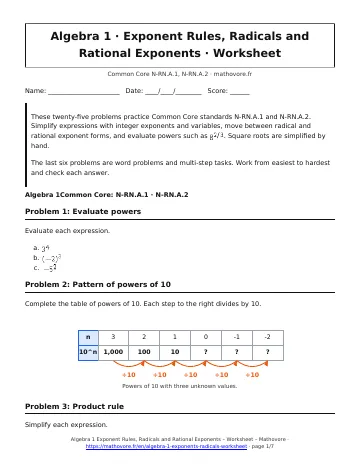
These twenty-five problems practice Common Core standards N-RN.A.1 and N-RN.A.2. Simplify expressions with integer exponents and variables, move between radical and rational exponent forms, and evaluate powers such as \(8^{2/3}\). Square roots are simplified by hand.
The last six problems are word problems and multi-step tasks. Work from easiest to hardest and check each answer.
Problem 1: Evaluate powers
Evaluate each expression.
- \(3^{4}\)
- \((-2)^{3}\)
- \(-5^{2}\)
Problem 2: Pattern of powers of 10
Complete the table of powers of 10. Each step to the right divides by 10.
Problem 3: Product rule
Simplify each expression.
- \(x^{6}\cdot x^{3}\)
- \(a\cdot a^{4}\)
- \(y^{2}\cdot y^{5}\cdot y\)
Problem 4: Quotient rule
Simplify each expression. Assume no variable equals 0.
- \(\dfrac{x^{12}}{x^{5}}\)
- \(\dfrac{m^{7}}{m}\)
- \(\dfrac{b^{6}}{b^{6}}\)
Problem 5: Power of a power
Simplify each expression.
- \((y^{4})^{3}\)
- \((n^{5})^{2}\)
- \((z^{2})^{6}\)
Problem 6: Power of a product
Simplify each expression.
- \((2a^{3})^{4}\)
- \((-3x^{2})^{3}\)
- \((5pq^{2})^{2}\)
Problem 7: Coefficients and variables
Simplify each product.
- \(3x^{2}\cdot4x^{5}\)
- \((-2a^{3}b)(5ab^{4})\)
- \((7y^{2})(-y^{6})\)
Problem 8: Dividing monomials
Simplify each quotient. Assume no variable equals 0.
- \(\dfrac{20m^{8}}{5m^{3}}\)
- \(\dfrac{36x^{5}y^{4}}{12xy^{2}}\)
- \(\dfrac{-18a^{9}}{6a^{9}}\)
Problem 9: Negative exponents
Rewrite each expression with positive exponents and simplify.
- \(4x^{-3}\)
- \(\dfrac{5}{m^{-2}}\)
- \(2^{-5}\)
Problem 10: Mixed exponent rules
Simplify. Write each answer with positive exponents.
- \(x^{5}\cdot x^{-8}\)
- \((2x^{3})^{2}\cdot x^{-4}\)
- \(\dfrac{a^{-2}b^{5}}{a^{3}b^{2}}\)
Problem 11: Unit-fraction exponents
Evaluate each expression.
- \(25^{1/2}\)
- \(64^{1/3}\)
- \(81^{1/4}\)
Problem 12: Radicals to exponents
Write each expression using a rational exponent.
- \(\sqrt{7}\)
- \(\sqrt[3]{x^{5}}\)
- \((\sqrt[4]{a})^{3}\)
Problem 13: Exponents to radicals
Write each expression as a radical.
- \(x^{1/2}\)
- \(y^{2/3}\)
- \(5^{3/4}\)
Problem 14: Rational powers
Evaluate each expression. Use the figure for part (b).
- \(8^{2/3}\)
- \(4^{3/2}\)
- \(81^{3/4}\)
Problem 15: Negative rational powers
Evaluate each expression.
- \(27^{-2/3}\)
- \(16^{-1/2}\)
- \(32^{-3/5}\)
Problem 16: Reading a graph
The graph shows \(y=x^{1/2}\).
- Find \(9^{1/2}\) from the graph.
- Use the graph to estimate \(10^{1/2}\).
- Find the value of \(x\) when \(y=4\).
Problem 17: Simplify numeric square roots
Write each radical in simplest form.
- \(\sqrt{50}\)
- \(\sqrt{48}\)
- \(\sqrt{200}\)
Problem 18: Rational exponent rules
Simplify. Assume \(x>0\).
- \(x^{1/2}\cdot x^{3/2}\)
- \(\dfrac{x^{5/3}}{x^{2/3}}\)
- \((x^{3/4})^{2}\)
- \((x^{2/3})^{6}\)
Problem 19: Square roots with variables
Simplify. Assume every variable is positive.
- \(\sqrt{x^{6}}\)
- \(\sqrt{18x^{4}}\)
- \(\sqrt{75a^{5}}\)
Problem 20: Square garden
Maya’s square garden has an area of 98 square feet. Find the side length in simplest radical form and to the nearest tenth of a foot. Then find the length of fencing needed to go around the garden, to the nearest tenth.
Problem 21: Orbit model
In a model of a distant star system, a planet that orbits at distance \(d\) astronomical units (AU) from its star has a period of \(T=d^{3/2}\) years.
- Find \(T\) when \(d=4\) and when \(d=9\). Compare with the graph.
- A second planet has a period of 64 years. Find its distance \(d\).
Problem 22: Cube crate
A cube-shaped crate holds 512 cubic inches. Find the edge length using a rational exponent. Then find the total outside surface area of the crate.
Problem 23: Patio diagonal
Ethan lays a square patio with 6-foot sides. He wants a rope along the diagonal. Use the Pythagorean theorem to find the diagonal length in simplest radical form and to the nearest tenth.
Problem 24: Find the errors
Two students made mistakes. Explain each mistake and give the correct answer.
- Jamal wrote \((2x^{3})^{3}=6x^{9}\).
- Aisha wrote \(16^{3/2}=24\) because \(16\cdot\frac{3}{2}=24\).
Problem 25: Cube with a variable edge
A cube has volume \(27x^{6}\) cubic units, where \(x>0\). Find the edge length as a simplified expression. Then write the surface area of the cube.

See every chapter on the Algebra 1 math page.