


Each solution lists the full sample space first, counts the favorable outcomes, and then writes the probability as a simplified fraction. Compare the sample-space counts with yours before checking the final answers, because a missing outcome is the most common source of error.
Problem 1: Sandwich choices
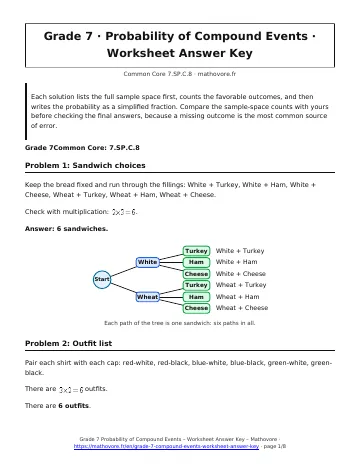
Keep the bread fixed and run through the fillings: White + Turkey, White + Ham, White + Cheese, Wheat + Turkey, Wheat + Ham, Wheat + Cheese.
Check with multiplication: \(2\times 3=6\).
Answer: 6 sandwiches.
Problem 2: Outfit list
Pair each shirt with each cap: red-white, red-black, blue-white, blue-black, green-white, green-black.
There are \(3 \times 2 = 6\) outfits.
There are 6 outfits.
Problem 3: Two coin flips
The sample space is HH, HT, TH, TT: 4 equally likely outcomes.
- Only HH: \(\frac{1}{4}\).
- HT and TH: \(\frac{2}{4}=\frac{1}{2}\).
- HH, HT and TH: \(\frac{3}{4}\).
Answers: \(\frac{1}{4}\), \(\frac{1}{2}\), \(\frac{3}{4}\).
Problem 4: Number cube and coin
The sample space has \(6 \times 2 = 12\) equally likely outcomes.
- Primes are 2, 3, and 5, each with tails: 3 outcomes. \(\frac{3}{12} = \frac{1}{4}\).
- 5 or 6 with heads: 2 outcomes. \(\frac{2}{12} = \frac{1}{6}\).
- Odd numbers (1, 3, 5) with either coin side: 6 outcomes. Even numbers with tails (2, 4, 6): 3 more outcomes. \(\frac{9}{12} = \frac{3}{4}\).
Answers: \(\frac{1}{4}\), \(\frac{1}{6}\), \(\frac{3}{4}\).
Problem 5: Spinner and coin
The outcomes are 1H, 1T, 2H, 2T, 3H, 3T, 4H, 4T.
- \(4\times 2=8\) outcomes.
- 2H and 4H: \(\frac{2}{8}=\frac{1}{4}\).
- 1T, 2T and 3T: \(\frac{3}{8}\).
Answers: 8; \(\frac{1}{4}\); \(\frac{3}{8}\).
Problem 6: Three-part meal
- \(4 \times 3 \times 2 = 24\) meals.
- Veggie with apple can have either drink, so 2 meals. \(\frac{2}{24} = \frac{1}{12}\).
- Sandwich: 4 choices. Side: chips or apple, 2 choices. Drink: lemonade, 1 choice. \(4 \times 2 \times 1 = 8\) meals, so \(\frac{8}{24} = \frac{1}{3}\).
Answers: 24; \(\frac{1}{12}\); \(\frac{1}{3}\).
Problem 7: Two number cubes
There are \(6\times 6=36\) equally likely outcomes.
- Sum 7: (1,6), (2,5), (3,4), (4,3), (5,2), (6,1) are 6 outcomes, so \(\frac{6}{36}=\frac{1}{6}\).
- Sum 10: 3 outcomes; sum 11: 2; sum 12: 1. That is 6 outcomes, so \(\frac{6}{36}=\frac{1}{6}\).
- Only (1,1): \(\frac{1}{36}\).
Answers: \(\frac{1}{6}\), \(\frac{1}{6}\), \(\frac{1}{36}\).
Problem 8: Table of two spinner sums
Sums by row: 2, 3, 4; then 3, 4, 5; then 4, 5, 6. There are \(3 \times 3 = 9\) outcomes.
- Even sums: 2, 4, 4, 4, 6, which is 5 outcomes. \(\frac{5}{9}\).
- Sums of 5 or 6: 5, 5, 6, which is 3 outcomes. \(\frac{3}{9} = \frac{1}{3}\).
- Sums of 4: 3 outcomes. \(\frac{3}{9} = \frac{1}{3}\).
Answers: \(\frac{5}{9}\), \(\frac{1}{3}\), \(\frac{1}{3}\).
Problem 9: Marbles with replacement
- \(3\times 3=9\) outcomes.
- RR, BB and GG: \(\frac{3}{9}=\frac{1}{3}\).
- Both marbles come from {R, G}: RR, RG, GR, GG, so \(\frac{4}{9}\).
Answers: 9; \(\frac{1}{3}\); \(\frac{4}{9}\).
Problem 10: Two cards without replacement
- The diagonal cells are impossible, so \(4 \times 3 = 12\) outcomes.
- Pairs with sum 5: (1, 4), (2, 3), (3, 2), (4, 1). \(\frac{4}{12} = \frac{1}{3}\).
- Both even: (2, 4) and (4, 2). \(\frac{2}{12} = \frac{1}{6}\).
- Pairs with a larger first card are the 6 cells below the diagonal. \(\frac{6}{12} = \frac{1}{2}\).
Answers: 12; \(\frac{1}{3}\); \(\frac{1}{6}\); \(\frac{1}{2}\).
Problem 11: Marbles without replacement
- \(3\times 2=6\) outcomes: RB, RG, BR, BG, GR, GB.
- Only RB: \(\frac{1}{6}\).
- Without G: RB and BR, so \(\frac{2}{6}=\frac{1}{3}\).
Answers: 6; \(\frac{1}{6}\); \(\frac{1}{3}\).
Problem 12: Two number cubes: products
There are \(6 \times 6 = 36\) equally likely outcomes.
- Product 12: (2, 6), (6, 2), (3, 4), (4, 3). \(\frac{4}{36} = \frac{1}{9}\).
- Doubles: (1, 1) through (6, 6), 6 outcomes. \(\frac{6}{36} = \frac{1}{6}\).
- Sum 2: (1, 1). Sum 3: (1, 2), (2, 1). Sum 4: (1, 3), (3, 1), (2, 2). That is 6 outcomes. \(\frac{6}{36} = \frac{1}{6}\).
Answers: \(\frac{1}{9}\), \(\frac{1}{6}\), \(\frac{1}{6}\).
Problem 13: Three coin flips
There are 8 outcomes.
- HHT, HTH, THH: \(\frac{3}{8}\).
- Every outcome except HHH has a tail: \(\frac{7}{8}\).
- HHH and TTT: \(\frac{2}{8}=\frac{1}{4}\).
Answers: \(\frac{3}{8}\), \(\frac{7}{8}\), \(\frac{1}{4}\).
Problem 14: Simulate guessing
- The four digits are equally likely, so one digit out of four is \(\frac{1}{4} = 25\%\).
- Only the trial 11 has two 1s. \(\frac{1}{15} \approx 0.07\).
- Trials with at least one 1: 41, 11, 14, 21, 12, 31, 13. That is 7 of 15, so \(\frac{7}{15} \approx 0.47\).
- There are \(4 \times 4 = 16\) outcomes. Outcomes with no correct guess use only 2, 3, or 4: \(3 \times 3 = 9\). So \(16 – 9 = 7\) outcomes have at least one correct guess: \(\frac{7}{16} = 0.4375\). The simulation estimate is close.
Answers: \(\frac{1}{15}\); \(\frac{7}{15}\); \(\frac{7}{16}\).
Problem 15: School lunch tray
Sample space: \(3\times 3=9\) trays.
- Only pizza + juice: \(\frac{1}{9}\).
- Salad + milk and salad + water: \(\frac{2}{9}\).
- Milk or juice with any of 3 mains: \(3\times 2=6\) trays, so \(\frac{6}{9}=\frac{2}{3}\).
Answers: \(\frac{1}{9}\), \(\frac{2}{9}\), \(\frac{2}{3}\).
Problem 16: Class raffle
- \(5 \times 4 = 20\) outcomes.
- Only (Maya, Ethan). \(\frac{1}{20}\).
- Sofia first: 4 outcomes. Sofia second: 4 outcomes. \(\frac{8}{20} = \frac{2}{5}\).
- (Jamal, Ethan) and (Ethan, Jamal). \(\frac{2}{20} = \frac{1}{10}\).
- The two winners come from the other 4 names: \(4 \times 3 = 12\) outcomes. \(\frac{12}{20} = \frac{3}{5}\).
Answers: 20; \(\frac{1}{20}\); \(\frac{2}{5}\); \(\frac{1}{10}\); \(\frac{3}{5}\).
Problem 17: Two spinners
There are \(3\times 4=12\) outcomes.
- Sum 5: (1,4), (2,3), (3,2), so \(\frac{3}{12}=\frac{1}{4}\).
- The product is odd only when both numbers are odd: A in {1, 3} and B in {1, 3} gives 4 outcomes. Even products: \(12-4=8\), so \(\frac{8}{12}=\frac{2}{3}\).
- \(\frac{1}{4}\times 240=60\) sums of 5.
Answers: \(\frac{1}{4}\); \(\frac{2}{3}\); 60.
Problem 18: Board game bonus
There are 36 equally likely outcomes.
- Sum 8: (2, 6), (3, 5), (4, 4), (5, 3), (6, 2), which is 5 outcomes. \(\frac{5}{36}\).
- Doubles: 6 outcomes. \(\frac{6}{36} = \frac{1}{6}\).
- The outcome (4, 4) is in both lists, so count it once: \(5 + 6 – 1 = 10\) outcomes. \(\frac{10}{36} = \frac{5}{18}\).
- \(\frac{5}{18} \times 180 = 50\) bonuses.
Answers: \(\frac{5}{36}\); \(\frac{1}{6}\); \(\frac{5}{18}\); 50 bonuses.
Problem 19: Simulate free throws
- The digits 0, 1, 2, 3, 4, 5 are 6 of the 10 digits, and \(\frac{6}{10}=60\%\).
- Both digits are at most 5 in 51, 04, 45 and 12, so 4 trials. Estimate: \(\frac{4}{10}=\frac{2}{5}=40\%\).
- The first digit has 6 choices and the second has 6 choices, so \(6\times 6=36\) pairs. Probability: \(\frac{36}{100}=\frac{9}{25}=36\%\).
Answers: 6 of 10 digits; \(\frac{2}{5}\); \(\frac{9}{25}\).
Problem 20: Carnival game
- \(5 \times 2 = 10\) outcomes.
- Winning outcomes: (2, H) and (4, H). \(\frac{2}{10} = \frac{1}{5}\).
- \(\frac{1}{5} \times 150 = 30\) wins.
- The booth collects \(150 \times \$1 = \$150\) and pays \(30 \times \$4 = \$120\). Profit: \(\$150 – \$120 = \$30\).
Answers: 10; \(\frac{1}{5}\); 30 wins; \$30 profit.
See every chapter on the Grade 7 math page.