Key takeaway: This grade 8 scientific worksheet answer key works through all 25 powers-of-ten tasks. It supports 8th grade standards 8.EE.A.3-4, so each line reveals where the decimal moved and why the exponent has its sign.
Attempt the conversions first, and then compare.
This answer key gives every step for the 25 problems on the scientific notation worksheet (8.EE.A.3 and 8.EE.A.4). Use it to check the exponent, the coefficient and the units in each answer, and to see how a coefficient of 10 or more is fixed.
Grade 8 Scientific Worksheet Answer Key: problems 1–5
1. Thousands
Move the decimal point 3 places left to get 5. So 5,000 is 5 times \(10^{3}\).
\(5\times 10^{3}\)
2. Ten thousands
Move the point 4 places left to get 7.2. Check: 7.2 times 10,000 is 72,000.
\(7.2\times 10^{4}\)
3. A very large number
Place the point after the 3: 3.8. Count the places from the end of the number: 8.
\(3.8\times 10^{8}\)
4. A small number
Move the point 4 places right to get 4. The number is less than 1, so the exponent is negative.
\(4\times 10^{-4}\)
5. Small number with two digits
The point moves 4 places right to sit after the 6, giving 6.2. The number is less than 1, so the exponent is \(-4\).
\(6.2\times 10^{-4}\)
Grade 8 Scientific Worksheet Answer Key: problems 6–10
6. Standard form
The exponent 5 moves the point 5 places right: 3.5 becomes 350000 after filling with zeros.
350,000
7. Negative exponent to decimal
The exponent \(-3\) moves the point 3 places left: 0.0081.
0.0081
8. Millions
Move the point 6 places right: 2.04 becomes 2,040,000.
2,040,000
9. Tiny decimal
The first nonzero digit, 7, is in the seventh decimal place. Move the point 7 places right to get 7.05.
\(7.05\times 10^{-7}\)
10. Compare two numbers
The exponents are 5 and 6. The larger exponent gives the larger number. Check: 420,000 is less than 3,900,000.
\(4.2\times 10^{5}<3.9\times 10^{6}\)
Grade 8 Scientific Worksheet Answer Key: problems 11–15
11. Order small numbers
Compare exponents: \(-4<-3<-2\). The values are 0.00099, 0.0061 and 0.025.
\(9.9\times 10^{-4},\ 6.1\times 10^{-3},\ 2.5\times 10^{-2}\)
12. How many times as much?
Divide: \(\frac{6\times 10^{8}}{3\times 10^{5}}=\frac{6}{3}\times 10^{8-5}=2\times 10^{3}\).
2,000 times as large (\(2\times 10^{3}\))
13. Small numbers: how many times
\(\frac{9\times 10^{-2}}{3\times 10^{-5}}=3\times 10^{-2-(-5)}=3\times 10^{3}\). Check: 0.09 divided by 0.00003 is 3,000.
3,000 times as large
14. Multiply
Multiply the coefficients: \(3\cdot2=6\). Add the exponents: \(4+3=7\).
\(6\times 10^{7}\)
15. Multiply and fix
\(4\cdot5=20\) and \(5+(-2)=3\), so the product is \(20\times 10^{3}\). The coefficient must be less than 10: \(20\times 10^{3}=2\times 10^{4}\). Check: 400,000 times 0.05 is 20,000.
\(2\times 10^{4}\)
Grade 8 Scientific Worksheet Answer Key: problems 16–20
16. Divide
\(8.4: 2.1=4\) and \(7-3=4\).
\(4\times 10^{4}\)
17. Add
Rewrite \(4.8\times 10^{5}\) as \(0.48\times 10^{6}\). Then \(0.48+3.7=4.18\).
\(4.18\times 10^{6}\)
18. Calculator notation
3.2E5 means \(3.2\times 10^{5}\): move the point 5 places right to get 320,000. 7.5E-3 means \(7.5\times 10^{-3}\): move the point 3 places left to get 0.0075.
320,000 = \(3.2\times 10^{5}\); 0.0075 = \(7.5\times 10^{-3}\)
19. Miles to feet
Multiply: \(2450\cdot5280=12936000\) ft, or 12,936,000 ft. Move the point 7 places left: 1.2936.
\(1.2936\times 10^{7}\) feet
20. Population comparison
Divide: \(\frac{3\times 10^{8}}{2.5\times 10^{5}}=1.2\times 10^{3}\) because \(3: 2.5=1.2\) and \(8-5=3\).
1,200 times as large
Grade 8 Scientific Worksheet Answer Key: problems 21–25
21. Sunlight to Earth
Time = distance \(: \) speed: \(\frac{9.3\times 10^{7}}{1.86\times 10^{5}}=5\times 10^{2}\) seconds, since \(9.3: 1.86=5\).
500 seconds is 8 minutes and 20 seconds.
\(5\times 10^{2}\) seconds, or 8 min 20 s
22. Stack of paper
Multiply: \((4\times 10^{-3})(5\times 10^{3})=20\times 10^{0}=2\times 10^{1}\). Check: 5,000 sheets at 0.004 inch each is 20 inches.
\(2\times 10^{1}\) inches
23. Photos on a tablet
Divide: \(\frac{6.4\times 10^{10}}{4\times 10^{6}}=1.6\times 10^{4}\), because \(6.4: 4=1.6\) and \(10-6=4\).
\(1.6\times 10^{4}\) photos (16,000)
24. Snail on a trail
Distance = rate \(\times \) time: \((2\times 10^{-3})(4\times 10^{2})=8\times 10^{-1}\).
\(8\times 10^{-1}\) mile, which is 0.8 mile
25. Earth and Moon
\(\frac{1.3\times 10^{25}}{1.6\times 10^{23}}=0.8125\times 10^{2}=81.25\). Rounded, that is 81.
About 81 times as heavy
How do you check conversion answers?
First, move the decimal back and see whether you return to the start. For example, 72,000 becomes \(7.2\times 10^{4}\), and 0.0004 becomes \(4\times 10^{-4}\). Likewise, \(8.1\times 10^{-3}\) becomes 0.0081, and \(2.04\times 10^{6}\) becomes 2,040,000.
What are the operation answers?
Problem 14 gives \(6\times 10^{7}\), and problem 15 gives \(2\times 10^{4}\) after fixing the coefficient. Next, problem 16 gives \(4\times 10^{4}\), because \(8.4: 2.1=4\) and \(7-3=4\). Problem 17 gives \(4.18\times 10^{6}\), since \(0.48\times 10^{6}+3.7\times 10^{6}=4.18\times 10^{6}\).
- Problem 10: \(3.9\times 10^{6}\) is greater.
- In problem 12, the first number is \(2\times 10^{3}\) times as large.
- For problem 13, the ratio is \(3\times 10^{3}\).
What do the story answers tell you about size?
Chicago to Los Angeles is about \(1.2936\times 10^{7}\) feet. Light needs 500 seconds to cross the Sun-Earth gap, so sunlight is about eight minutes old. The paper stack is 20 inches tall, and the tablet holds \(1.6\times 10^{4}\) photos. Finally, the snail covers 0.8 mile.
How can you learn from missed powers-of-ten problems?
Label each miss as a decimal count, an exponent sign or a coefficient fix. Then rework a pair of items from the most common type. Finally, estimate each answer in plain numbers, because estimation catches sign errors quickly.

Printable PDF · Worksheet Answer Key
Grade 8 Scientific Notation worksheet answer key
Download the PDF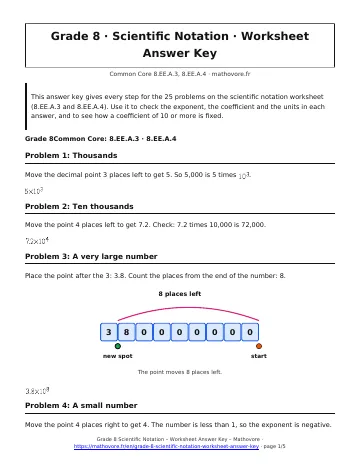
See every chapter on the Grade 8 math page.