



Problem 1: Hypotenuse of a 6-8 triangle
\(6^{2}+8^{2}=c^{2}\), so \(36+64=100\) and \(c=\sqrt{100}=10\). The hypotenuse is 10 in.
Problem 2: Hypotenuse of a 5-12 triangle
\(5^{2}+12^{2}=25+144=169\), so \(c=\sqrt{169}=13\). The hypotenuse is 13 ft.
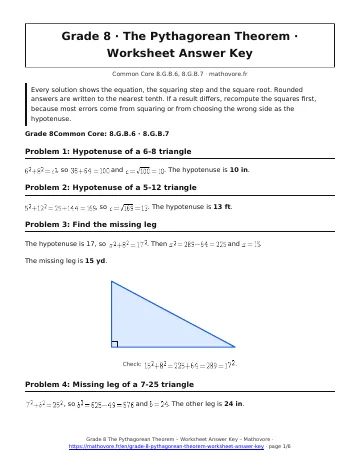
Problem 3: Find the missing leg
The hypotenuse is 17, so \(x^{2}+8^{2}=17^{2}\). Then \(x^{2}=289-64=225\) and \(x=15\).
The missing leg is 15 yd.
Problem 4: Missing leg of a 7-25 triangle
\(7^{2}+b^{2}=25^{2}\), so \(b^{2}=625-49=576\) and \(b=24\). The other leg is 24 in.
Problem 5: Legs 9 and 12
\(9^{2}+12^{2}=81+144=225\), so \(c=15\). The hypotenuse is 15 in.
Problem 6: Hypotenuse that is not whole
\(4^{2}+7^{2}=16+49=65\), so \(c=\sqrt{65}\). Since \(8^{2}=64\) and \(9^{2}=81\), the value is a little more than 8.
\(c=\sqrt{65}\approx 8.06\), so the hypotenuse is about 8.1 ft.
Problem 7: Leg that is not whole
\(9^{2}+b^{2}=13^{2}\), so \(b^{2}=169-81=88\). Then \(b=\sqrt{88}\approx 9.38\).
The other leg is about 9.4 in.
Problem 8: Squares on the sides
Each square has area equal to its side squared, so \(a^{2}=36\) and \(b^{2}=64\). By the theorem, \(c^{2}=36+64=100\).
The square on the hypotenuse has area 100 square units, and the hypotenuse is \(\sqrt{100}=\)10 units.
Problem 9: Area proof with numbers
- \(17^{2}=289\) square inches.
- Each triangle has area \(\frac{1}{2}\cdot 5\cdot 12=30\), so four triangles have area \(4\cdot 30=120\).
- \(289-120=169\) square inches.
- \(\sqrt{169}=13\) in.
The tilted square has side 13 in, which is the hypotenuse of the 5-12 triangle.
Problem 10: Explain the proof
The large square has area \((a+b)^{2}=a^{2}+2ab+b^{2}\).
It is also made of four triangles with area \(\frac{1}{2}ab\) each, which total \(2ab\), plus the tilted square with area \(c^{2}\). So the area is \(2ab+c^{2}\).
Both expressions describe the same area: \(a^{2}+2ab+b^{2}=2ab+c^{2}\). Subtracting \(2ab\) from both sides gives \(a^{2}+b^{2}=c^{2}\).
Problem 11: Converse: 9, 12, 15
The longest side is 15. Check: \(9^{2}+12^{2}=81+144=225\) and \(15^{2}=225\).
The sums are equal, so by the converse the triangle is a right triangle.
Problem 12: Converse: 7, 10, 12
The longest side is 12. Check: \(7^{2}+10^{2}=49+100=149\), but \(12^{2}=144\).
Since \(149\neq 144\), the triangle is not a right triangle.
Problem 13: Which sets are right triangles?
- \(64+225=289=17^{2}\). Right triangle.
- \(36+49=85\), but \(10^{2}=100\). Not right.
- \(400+441=841=29^{2}\). Right triangle.
- \(121+144=265\), but \(18^{2}=324\). Not right.
Parts (a) and (c) form right triangles.
Problem 14: Perimeter and area
Hypotenuse: \(10^{2}+24^{2}=100+576=676\), so \(c=26\).
Perimeter: \(10+24+26=\)60 in. Area: \(\frac{1}{2}\cdot 10\cdot 24=\)120 square inches.
Problem 15: Diagonal of a square
The diagonal is the hypotenuse of a right triangle with both legs 9: \(d^{2}=9^{2}+9^{2}=81+81=162\).
\(d=\sqrt{162}\approx 12.73\), so the diagonal is about 12.7 in.
Problem 16: Height of an isosceles triangle
The height meets the base at its midpoint, so each half of the base is 6 in. Then \(6^{2}+h^{2}=10^{2}\), so \(h^{2}=100-36=64\) and \(h=8\).
Height: 8 in. Area: \(\frac{1}{2}\cdot 12\cdot 8=\)48 square inches.
Problem 17: Diagonal of a prism
First find the diagonal of the base: \(x^{2}=8^{2}+6^{2}=64+36=100\), so \(x=10\).
Then \(d^{2}=10^{2}+24^{2}=100+576=676\), so \(d=26\). The space diagonal is 26 in.
Problem 18: Ladder against a house
\(7^{2}+h^{2}=25^{2}\), so \(h^{2}=625-49=576\) and \(h=24\).
The ladder reaches 24 ft up the wall.
Problem 19: TV screen diagonal
\(d^{2}=24^{2}+18^{2}=576+324=900\), so \(d=30\).
This is a 30-inch TV.
Problem 20: Little League throw
The throw is the diagonal of the square: \(d^{2}=60^{2}+60^{2}=3600+3600=7200\).
\(d=\sqrt{7200}\approx 84.85\), so the throw is about 84.9 ft.
Problem 21: Is the corner square?
Check the converse: \(60^{2}+80^{2}=3600+6400=10000\) and \(100^{2}=10000\).
The sums are equal, so the corner is a right angle.
Problem 22: Walk east and north
\(d^{2}=0.9^{2}+1.2^{2}=0.81+1.44=2.25\), so \(d=1.5\).
Jamal is 1.5 mi from his start.
Problem 23: Longest rod in a box
The longest rod fits along the space diagonal. Base diagonal: \(x^{2}=12^{2}+9^{2}=144+81=225\), so \(x=15\).
Space diagonal: \(d^{2}=15^{2}+8^{2}=225+64=289\), so \(d=17\).
The diagonal is exactly 17 in., so the 17-in. rod just fits (diagonally, corner to corner).
See every chapter on the Grade 8 math page.