



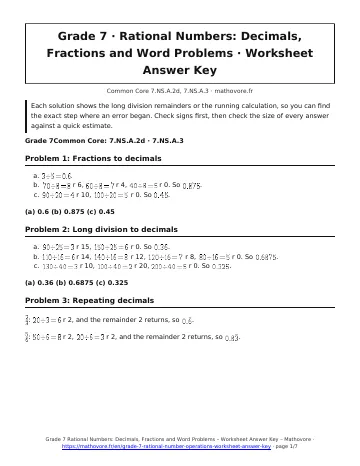
Problem 1: Fractions to decimals
- \(3: 5=0.6\).
- \(70: 8=8\) r 6, \(60: 8=7\) r 4, \(40: 8=5\) r 0. So \(0.875\).
- \(90: 20=4\) r 10, \(100: 20=5\) r 0. So \(0.45\).
(a) 0.6 (b) 0.875 (c) 0.45
Problem 2: Long division to decimals
- \(90: 25=3\) r 15, \(150: 25=6\) r 0. So \(0.36\).
- \(110: 16=6\) r 14, \(140: 16=8\) r 12, \(120: 16=7\) r 8, \(80: 16=5\) r 0. So \(0.6875\).
- \(130: 40=3\) r 10, \(100: 40=2\) r 20, \(200: 40=5\) r 0. So \(0.325\).
(a) 0.36 (b) 0.6875 (c) 0.325
Problem 3: Repeating decimals
\(\frac{2}{3}\): \(20: 3=6\) r 2, and the remainder 2 returns, so \(0.\overline{6}\).
\(\frac{5}{6}\): \(50: 6=8\) r 2, \(20: 6=3\) r 2, and the remainder 2 returns, so \(0.8\overline{3}\).
\(\frac{2}{3}=0.\overline{6}\) and \(\frac{5}{6}=0.8\overline{3}\)
Problem 4: Repeating digits
- \(50: 9=5\) r 5, and the remainder 5 returns. So \(0.\overline{5}\).
- \(70: 12=5\) r 10, \(100: 12=8\) r 4, \(40: 12=3\) r 4, and the remainder 4 returns. So \(0.58\overline{3}\).
- \(40: 11=3\) r 7, \(70: 11=6\) r 4, and the remainder 4 returns, so the digits 36 repeat: \(0.\overline{36}\).
(a) \(0.\overline{5}\) (b) \(0.58\overline{3}\) (c) \(0.\overline{36}\)
Problem 5: Terminate or repeat
- \(70: 20=3\) r 10, \(100: 20=5\) r 0: \(0.35\), terminates.
- \(40: 9=4\) r 4, the remainder 4 returns: \(0.\overline{4}\), repeats.
- \(110: 12=9\) r 2, \(20: 12=1\) r 8, \(80: 12=6\) r 8: \(0.91\overline{6}\), repeats.
- \(90: 16=5\) r 10, \(100: 16=6\) r 4, \(40: 16=2\) r 8, \(80: 16=5\) r 0: \(0.5625\), terminates.
(a) 0.35, terminates (b) \(0.\overline{4}\), repeats (c) \(0.91\overline{6}\), repeats (d) 0.5625, terminates
Problem 6: Mixed numbers
- Convert the fraction part: \(30: 8=3\) r 6, \(60: 8=7\) r 4, \(40: 8=5\) r 0, so \(\frac{3}{8}=0.375\). Then \(2\frac{3}{8}=2.375\).
- \(50: 6=8\) r 2, \(20: 6=3\) r 2, so \(\frac{5}{6}=0.8\overline{3}\). Then \(3\frac{5}{6}=3.8\overline{3}\), and the sign gives \(-3.8\overline{3}\).
- \(70: 20=3\) r 10, \(100: 20=5\) r 0, so \(\frac{7}{20}=0.35\). Then \(1\frac{7}{20}=1.35\).
(a) 2.375 (b) \(-3.8\overline{3}\) (c) 1.35
Problem 7: Negative fractions
- \(70: 11=6\) r 4, \(40: 11=3\) r 7, \(70: 11=6\) r 4, so the digits 63 repeat: \(\frac{7}{11}=0.\overline{63}\). Keep the sign: \(-0.\overline{63}\).
- \(\frac{13}{8}=1\) r 5, then \(50: 8=6\) r 2, \(20: 8=2\) r 4, \(40: 8=5\) r 0: \(1.625\). So \(-1.625\).
(a) \(-0.\overline{63}\) (b) \(-1.625\)
Problem 8: Add and subtract decimals
- Different signs: \(9.75-6.4=3.35\), and 9.75 has the larger absolute value, so \(3.35\).
- Subtracting a negative is adding: \(2.8+4.15=6.95\).
- Both are moves to the left: \(-(7.25+3.6)=-10.85\).
- \(-0.75+1.5=0.75\).
(a) 3.35 (b) 6.95 (c) \(-10.85\) (d) 0.75
Problem 9: Order on a number line
Write each as a decimal: \(0.6\); \(-\frac{3}{4}=-0.75\); \(\frac{5}{8}=0.625\); \(-0.7\).
Negatives first: \(-0.75\) is less than \(-0.7\). Then positives: \(0.6\) is less than \(0.625\).
\(-\frac{3}{4},\ -0.7,\ 0.6,\ \frac{5}{8}\)
Problem 10: Ordering mixed forms
Write each as a decimal: \(\frac{1}{4}=0.25\); \(-0.3\); \(0.2\); \(-\frac{1}{3}=-0.\overline{3}\approx-0.333\); \(-0.35\).
Negatives: \(-0.35\) is less than \(-0.333\), which is less than \(-0.3\). Positives: \(0.2\) is less than \(0.25\).
A = \(-0.35\), B = \(-\frac{1}{3}\), C = \(-0.3\), D = \(0.2\), E = \(\frac{1}{4}\).
\(-0.35,\ -\frac{1}{3},\ -0.3,\ 0.2,\ \frac{1}{4}\)
Problem 11: Four operations
- Different signs: \(3.5-2.25=1.25\), sign of the larger absolute value (negative): \(-1.25\).
- \(\frac{3}{4}+\frac{1}{2}=\frac{3}{4}+\frac{2}{4}=\frac{5}{4}\).
- \(-\frac{2\times 9}{3\times 10}=-\frac{18}{30}=-\frac{3}{5}\).
- \(\frac{5}{6}\times \frac{12}{5}=\frac{60}{30}=2\); same signs give a positive result.
(a) \(-1.25\) (b) \(\frac{5}{4}\) (c) \(-\frac{3}{5}\) (d) \(2\)
Problem 12: Add and subtract fractions
- \(-\frac{8}{20}+\frac{15}{20}=\frac{7}{20}\).
- \(\frac{5}{6}+\frac{2}{6}=\frac{7}{6}=1\frac{1}{6}\).
- \(-\frac{3}{8}-\frac{4}{8}=-\frac{7}{8}\).
- \(-\frac{3}{2}+\frac{9}{4}=-\frac{6}{4}+\frac{9}{4}=\frac{3}{4}\).
(a) \(\frac{7}{20}\) (b) \(1\frac{1}{6}\) (c) \(-\frac{7}{8}\) (d) \(\frac{3}{4}\)
Problem 13: Multiply and divide
- Same signs give a positive: \(1.5\times 4.2=6.3\).
- Different signs give a negative: \(-\frac{3\times 10}{5\times 9}=-\frac{30}{45}=-\frac{2}{3}\).
- \(12.6: 3=4.2\), and the signs are different, so \(-4.2\).
- \(\frac{7}{8}\times (-\frac{4}{7})=-\frac{28}{56}=-\frac{1}{2}\).
(a) 6.3 (b) \(-\frac{2}{3}\) (c) \(-4.2\) (d) \(-\frac{1}{2}\)
Problem 14: Temperature rise
Total rise: \(4\times 3.25=13\). New temperature: \(-8.5+13=4.5\).
\(4.5^{\circ}\text{F}\)
Problem 15: Account balance
\(42.50-18.75=23.75\); \(23.75+25.20=48.95\); \(48.95-31.95=17.00\).
$17.00
Problem 16: Death Valley hike
- \(3\times (-42.25)=-126.75\) feet.
- \(-150.5+(-126.75)=-277.25\) feet.
- \(-277.25+60.5=-216.75\) feet.
Answers: (a) \(-126.75\) ft (b) \(-277.25\) ft (c) \(-216.75\) ft.
Problem 17: Diver depth
Descending: \(-36.5-14.75=-51.25\). Rising: \(-51.25+8.25=-43\).
\(-43\text{ ft}\)
Problem 18: Draining tank
- \(6\times (-2\frac{1}{4})=6\times (-2.25)=-13.5\) gallons.
- \(24+(-13.5)=10.5\) gallons.
- \(24: 2.25=\frac{24}{2.25}=\frac{96}{9}=\frac{32}{3}\) hours. Long division: \(32: 3=10\) r 2, \(20: 3=6\) r 2, and the remainder 2 returns, so \(10.\overline{6}\) hours.
Check part (c): \(2.25\times 10\frac{2}{3}=24\), because \(2.25\times 10=22.5\) and \(2.25\times \frac{2}{3}=1.5\).
Answers: (a) \(-13.5\) gal (b) 10.5 gal (c) \(10.\overline{6}\) hours, or \(10\frac{2}{3}\) hours.
Problem 19: Rate of change
- \(-6.5-14.5=-21\).
- \(-21: 6=-3.5\) degrees per hour.
- \(14.5+4\times (-3.5)=14.5-14=0.5\).
(a) \(-21^{\circ}\text{F}\) (b) \(-3.5^{\circ}\text{F}\) per hour (c) \(0.5^{\circ}\text{F}\)
Problem 20: Share price
- Change: \(6\times (-0.35)=-2.10\). Price: \(27.80-2.10=25.70\).
- Change: \(4\times 1.25=5.00\). Price: \(25.70+5.00=30.70\).
- Net change: \(30.70-27.80=2.90\), or \(-2.10+5.00=2.90\).
Answers: (a) $25.70 (b) $30.70 (c) a net increase of $2.90.
See every chapter on the Grade 7 math page.