


Full worked solutions for the 20 problems on equations of proportional relationships. Each solution shows how the constant \(k\) is found, how the equation \(y=kx\) is written, and how it is used. Compare each step with the work on the worksheet and fix any difference.
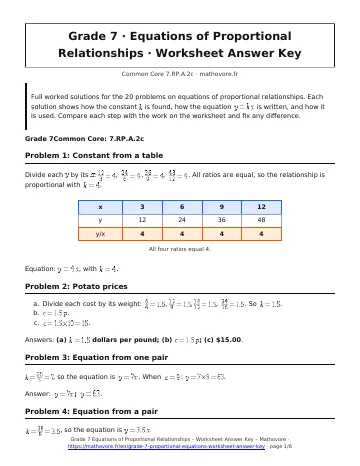
Problem 1: Constant from a table
Divide each \(y\) by its \(x\): \(\frac{12}{3}=4\), \(\frac{24}{6}=4\), \(\frac{36}{9}=4\), \(\frac{48}{12}=4\). All ratios are equal, so the relationship is proportional with \(k=4\).
Equation: \(y=4x\), with \(k=4\).
Problem 2: Potato prices
- Divide each cost by its weight: \(\frac{6}{4}=1.5\), \(\frac{12}{8}=1.5\), \(\frac{18}{12}=1.5\), \(\frac{24}{16}=1.5\). So \(k=1.5\).
- \(c=1.5p\).
- \(c=1.5\times 10=15\).
Answers: (a) \(k=1.5\) dollars per pound; (b) \(c=1.5p\); (c) $15.00.
Problem 3: Equation from one pair
\(k=\frac{35}{5}=7\), so the equation is \(y=7x\). When \(x=9\): \(y=7\times 9=63\).
Answer: \(y=7x\); \(y=63\).
Problem 4: Equation from a pair
\(k=\frac{28}{8}=3.5\), so the equation is \(y=3.5x\).
(a) \(y=3.5\times 12=42\).
(b) \(49=3.5x\), so \(x=49: 3.5=14\). Check: \(3.5\times 14=49\).
Answers: \(y=3.5x\); (a) 42; (b) 14.
Problem 5: Equation from a price
Each muffin costs $2.75, so \(k=2.75\) and \(c=2.75m\). For 8 muffins: \(2.75\times 8=22\).
Answer: \(c=2.75m\); the cost is $22.00.
Problem 6: Trail mix price
The price per pound is the constant, so \(c=6.4p\).
(a) \(c=6.4\times 2.5=16\). The cost is $16.00.
(b) \(32=6.4p\), so \(p=32: 6.4=5\). Check: \(6.4\times 5=32\).
Answer: \(c=6.4p\); (a) $16.00; (b) 5 pounds.
Problem 7: Equation from a graph
Use the point \((4,10)\): \(k=\frac{10}{4}=2.5\). Check with \((2,5)\): \(\frac{5}{2}=2.5\), and with \((8,20)\): \(\frac{20}{8}=2.5\). The equation is \(y=2.5x\). When \(x=10\): \(y=2.5\times 10=25\).
Answer: \(y=2.5x\); \(y=25\).
Problem 8: Reading a line
Use the point \((10,8)\): \(k=\frac{8}{10}=0.8\). Check with the other points: \(\frac{4}{5}=0.8\) and \(\frac{12}{15}=0.8\). The equation is \(y=0.8x\).
When \(x=25\): \(y=0.8\times 25=20\).
Answer: \(y=0.8x\); \(y=20\).
Problem 9: Proportional or not?
Compute the ratios: \(\frac{5}{2}=2.5\), \(\frac{9}{4}=2.25\), \(\frac{13}{6}\approx 2.17\). The ratios are not all equal.
Answer: not proportional, because there is no single constant \(k\). (The table follows \(y=2x+1\).)
Problem 10: Which equations are proportional?
A proportional relationship has the form \(y=kx\), with no added or subtracted number.
- \(y=6x\): proportional, \(k=6\).
- \(y=x+6\): not proportional, because 6 is added. When \(x=0\), \(y=6\), not 0.
- \(y=\frac{x}{5}=\frac{1}{5}x\): proportional, \(k=\frac{1}{5}=0.2\).
- \(y=2x+3\): not proportional, because 3 is added.
- \(y=0.5x\): proportional, \(k=0.5\).
Answer: (a), (c) and (e) are proportional, with k equal to 6, \(\frac{1}{5}\) and 0.5.
Problem 11: Using the equation
- \(c=4.8\times 3.5=16.8\). The cost is $16.80.
- \(33.6=4.8p\), so \(p=33.6: 4.8=7\). Check: \(4.8\times 7=33.6\).
Answer: (a) $16.80; (b) 7 pounds.
Problem 12: Hybrid car mileage
- \(d=48\times 6.5=312\) miles.
- \(624=48g\), so \(g=624: 48=13\) gallons. Check: \(48\times 13=624\).
Answers: (a) 312 miles; (b) 13 gallons.
Problem 13: Double number line
- \(k=\frac{0.5}{10}=0.05\) mile per minute. Check: \(\frac{1}{20}=0.05\) and \(\frac{1.5}{30}=0.05\). The equation is \(d=0.05m\).
- \(d=0.05\times 45=2.25\).
Answer: (a) \(d=0.05m\); (b) 2.25 miles.
Problem 14: Water flow number line
- \(k=\frac{6}{5}=1.2\) gallons per minute. Check: \(\frac{12}{10}=1.2\) and \(\frac{18}{15}=1.2\). The equation is \(g=1.2m\).
- \(g=1.2\times 22=26.4\) gallons.
- \(45=1.2m\), so \(m=45: 1.2=37.5\) minutes.
Answers: (a) \(g=1.2m\); (b) 26.4 gallons; (c) 37.5 minutes.
Problem 15: Road trip
- \(k=\frac{195}{3}=65\) miles per hour, so \(d=65h\).
- \(d=65\times 5.5=357.5\) miles.
- \(520=65h\), so \(h=520: 65=8\) hours.
Answer: (a) \(d=65h\); (b) 357.5 miles; (c) 8 hours.
Problem 16: Smoothie recipe
- \(k=\frac{3}{2}=1.5\) cups of fruit per cup of yogurt, so \(f=1.5y\).
- \(f=1.5\times 7=10.5\) cups.
- \(12=1.5y\), so \(y=12: 1.5=8\) cups. Check: \(1.5\times 8=12\).
Answers: (a) \(f=1.5y\); (b) 10.5 cups of fruit; (c) 8 cups of yogurt.
Problem 17: Comparing two jobs
- \(\frac{33}{3}=11\), \(\frac{66}{6}=11\), \(\frac{88}{8}=11\), so \(y=11x\).
- Maya earns $11.50 per hour and Jamal earns $11 per hour. Maya earns \(11.5-11=0.5\) dollars more per hour.
- In 40 hours: Maya \(11.5\times 40=460\), Jamal \(11\times 40=440\), a difference of $20.
Answer: (a) \(y=11x\); (b) Maya, by $0.50 per hour; (c) $20 more.
Problem 18: Two bike riders
- \(\frac{27}{2}=13.5\), \(\frac{67.5}{5}=13.5\), \(\frac{81}{6}=13.5\), so \(d=13.5t\).
- Rider A rides 12 miles per hour and Rider B rides 13.5 miles per hour. Rider B is faster by \(13.5-12=1.5\) miles per hour.
- In 4 hours: Rider A \(12\times 4=48\) miles, Rider B \(13.5\times 4=54\) miles. Difference: \(54-48=6\) miles.
Answers: (a) \(d=13.5t\); (b) Rider B, by 1.5 miles per hour; (c) 6 miles farther.
Problem 19: Peaches at two stands
- \(k=\frac{7.5}{3}=2.5\), so \(c=2.5p\).
- Stand A: \(2.5\times 12=30\). Stand B: \(2.4\times 12=28.8\). Costs: $30.00 and $28.80.
- Stand B is cheaper. Savings: \(30-28.8=1.2\).
Answer: (a) \(c=2.5p\); (b) $30.00 at A and $28.80 at B; (c) $1.20.
Problem 20: Copy shop prices
- \(k=\frac{12}{150}=0.08\), so \(c=0.08n\).
- Shop X charges $0.08 per copy and Shop Y charges $0.075 per copy, so Shop Y is cheaper.
- Shop X: \(0.08\times 1{,}200=96\). Shop Y: \(0.075\times 1{,}200=90\). Savings: \(96-90=6\).
Answers: (a) \(c=0.08n\); (b) Shop Y; (c) $6.00.
See every chapter on the Grade 7 math page.