


Problem 1: Combine like terms
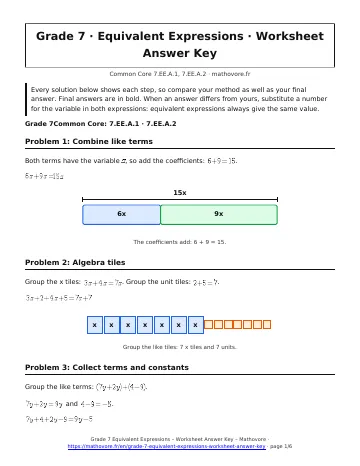
Both terms have the variable \(x\), so add the coefficients: \(6+9=15\).
\(6x+9x=\)\(15x\)
Problem 2: Algebra tiles
Group the x tiles: \(3x + 4x = 7x\). Group the unit tiles: \(2 + 5 = 7\).
\(3x + 2 + 4x + 5 = 7x + 7\)
Problem 3: Collect terms and constants
Group the like terms: \((7y+2y)+(4-9)\).
\(7y+2y=9y\) and \(4-9=-5\).
\(7y+4+2y-9=\)\(9y-5\)
Check with \(y=1\): \(7+4+2-9=4\) and \(9-5=4\).
Problem 4: Expand with the distributive property
Multiply 5 by each term inside the parentheses: \(5\cdot x=5x\) and \(5\cdot 6=30\).
\(5(x+6)=\)\(5x+30\)
Problem 5: Area model for expanding
Left area: \(7 \times 3x = 21x\). Right area: \(7 \times 2 = 14\).
Add the areas: \(7(3x + 2) = 21x + 14\)
Problem 6: Test equivalence with a table
Substitute each value. For \(x = 1\): \(2(1 + 3) = 8\), \(2(1) + 6 = 8\), and \(2(1) + 3 = 5\). The other columns follow the same way.
\(2(x + 3)\) and \(2x + 6\) give the same value in every column. By the distributive property, \(2(x + 3) = 2x + 6\), so they are equivalent.
\(2x + 3\) is always 3 less, so it is not equivalent to the other two.
Problem 7: Expand with a negative factor
\(-3\cdot 2x=-6x\) and \(-3\cdot(-4)=+12\).
\(-3(2x-4)=\)\(-6x+12\)
Check with \(x=1\): \(-3(-2)=6\) and \(-6+12=6\).
Problem 8: Expand and combine
- \(6 \times 2y = 12y\) and \(6 \times (-3) = -18\). \(12y – 18\)
- \(-2 \times 5 = -10\) and \(-2 \times (-3a) = 6a\). \(-10 + 6a\)
- \(4(x + 2) = 4x + 8\) and \(3(x – 1) = 3x – 3\). Add: \(4x + 3x = 7x\) and \(8 – 3 = 5\). \(7x + 5\)
Problem 9: Factor out the greatest common factor
The common factors of 12 and 18 are 1, 2, 3 and 6; the greatest is \(6\).
\(12x: 6=2x\) and \(18: 6=3\).
\(12x+18=\)\(6(2x+3)\)
Problem 10: Factor out a common factor
- GCF of 15 and 25 is 5. \(5(3a + 5)\)
- GCF of 8 and 12 is 4. \(4(2x – 3)\)
- GCF of 18 and 54 is 18. \(18(m + 3)\)
- Factor out \(-3\): \(-6y = -3 \times 2y\) and \(-9 = -3 \times 3\). \(-3(2y + 3)\)
Problem 11: Subtract an expression
Subtracting changes the sign of each term in the second expression: \(3x+8-x+5\).
\(3x-x=2x\) and \(8+5=13\).
\((3x+8)-(x-5)=\)\(2x+13\)
Check with \(x=1\): \(11-(-4)=15\) and \(2+13=15\).
Problem 12: Subtract and simplify
- Distribute the minus sign: \(7x + 3 – 2x – 9 = 5x – 6\). \(5x – 6\)
- \(2m – 5 – m + 8 = m + 3\). \(m + 3\)
- \(10 – 3a – 4 + a = 6 – 2a\). \(6 – 2a\)
Problem 13: Rational coefficients
Distribute: \(\frac{2}{3}\cdot 9x=6x\) and \(\frac{2}{3}\cdot(-6)=-4\), so the expression is \(6x-4+x\).
Combine \(6x+x=7x\).
\(\frac{2}{3}(9x-6)+x=\)\(7x-4\)
Check with \(x=3\): \(\frac{2}{3}(21)+3=17\) and \(21-4=17\).
Problem 14: Decimal and fraction coefficients
- \(0.5 \times 6x = 3x\) and \(0.5 \times 10 = 5\), so \(3x + 5 + 1.5x = 4.5x + 5\). \(4.5x + 5\)
- \(\frac{1}{3} \times 12x = 4x\) and \(\frac{1}{3} \times 9 = 3\), so \(4x + 3 – x = 3x + 3\). \(3x + 3\)
- \(\frac{3}{4} \times 8 = 6\) and \(\frac{3}{4} \times (-4x) = -3x\), so \(6 – 3x + x = 6 – 2x\). \(6 – 2x\)
Problem 15: Sales tax at the school store
(a) \(p+0.08p=1p+0.08p=\)\(1.08p\).
(b) \(1.08(25)=27\), so the total is \(\$27.00\).
(c) \(1.08p=54\), so \(p=54: 1.08=50\). The price is \(\$50\). Check: \(1.08(50)=54\).
Problem 16: Discount, then tax
(a) \(p – 0.15p = 0.85p\).
(b) Adding 8% tax means multiplying by 1.08: \(1.08 \times 0.85p = 0.918p\).
(c) \(0.918 \times 60 = 55.08\).
(d) \(0.918 \times 100 = 91.8\), so the regular price is $100.
\(0.85p\); \(0.918p\); $55.08; $100.
Problem 17: Perimeter of a garden bed
(a) The perimeter is twice the length plus twice the width: \(2(3x+2)+2(x+5)=6x+4+2x+10=\)\(8x+14\) feet.
(b) \(8(3)+14=38\). 38 feet.
Check: the sides are \(3(3)+2=11\) ft and \(3+5=8\) ft, and \(2(11)+2(8)=38\).
Problem 18: Perimeter of a triangular bed
(a) \((2x + 3) + (x + 7) + (3x – 1) = (2x + x + 3x) + (3 + 7 – 1) = 6x + 9\) feet.
(b) \(6(4) + 9 = 33\) ft. The sides are \(2(4) + 3 = 11\), \(4 + 7 = 11\), and \(3(4) – 1 = 11\), so the bed is an equilateral triangle.
(c) Set \(6x + 9 = 45\). Then \(6x = 36\) and \(x = 6\). The sides are 15 ft, 13 ft, and 17 ft, and \(15 + 13 + 17 = 45\).
\(6x + 9\); 33 ft (equilateral); \(x = 6\) with sides 15, 13, 17 ft.
Problem 19: Three ways to write a gym bill
(a) Maya: \(4(c + 3) = 4c + 12\). Noah: \(3(c + 4) + c = 3c + 12 + c = 4c + 12\).
(b) Ethan’s \(12 + 4c\) is \(4c + 12\) in a different order. All three equal \(4c + 12\), so they are equivalent.
(c) \(4(9) + 12 = 48\) and \(4(5) + 12 = 32\).
Equivalent; $48 for 9 classes; $32 for 5 classes.
Problem 20: Two ways to price a jersey
(a) Maya: \(p-0.20p-5=0.80p-5\). Ethan: \(0.80(p-5)=0.80p-4\).
(b) The expressions are not equivalent: \(0.8p-5\) and \(0.8p-4\) differ by \(1\) for every price.
(c) Maya: \(0.8(40)-5=32-5=\)\(\$27\). Ethan: \(0.8(40)-4=32-4=28\), which is \(\$28\). Check Ethan directly: \(0.8(35)=28\). Maya pays \(\$1\) less.
See every chapter on the Grade 7 math page.