Key takeaway: This grade 7 area worksheet answer key reveals the split for every figure, the formula chosen, and the arithmetic that follows, all across 20 problems. Every answer ends in bold with the correct unit. Students can see whether a mistake came from the split, the formula, or the multiplication.
Read the split first, because a wrong split ruins everything after it. Then follow the formula line, and finally compare the units. Parents can follow the same order when they review homework.
This answer key gives a worked solution to each of the 20 area, volume, and surface area problems. Each solution shows how the figure is split, every formula, and the arithmetic, and ends with the answer in bold with correct units. Use it to check your work and fix mistakes.
Grade 7 Area Worksheet Answer Key: problems 1–5
1. Parallelogram and triangle
- \(A = bh = 9 \times 6 = 54\).
- \(A = \frac{1}{2}bh = \frac{1}{2} \times 14 \times 5 = \frac{1}{2} \times 70 = 35\).
(a) \(54\text{ in}^2\). (b) \(35\text{ in}^2\).
2. Volume of a rectangular prism
\(V=\ell wh=8\times 5\times 3\).
\(8\times 5=40\) and \(40\times 3=120\).
\(120\text{ in}^3\)
3. Cube surface and volume
A cube has 6 identical square faces. One face: \(7 \times 7 = 49\). Surface area: \(6 \times 49 = 294\).
Volume: \(7 \times 7 \times 7 = 49 \times 7 = 343\).
Surface area \(294\text{ ft}^2\); volume \(343\text{ ft}^3\).
4. Area of a trapezoid
Use \(A=\frac{1}{2}(b_1+b_2)h\) with \(b_1=8\), \(b_2=14\), \(h=5\).
\(A=\frac{1}{2}(8+14)(5)=\frac{1}{2}(22)(5)=55\).
Check by splitting: two triangles with base \(3\) and height \(5\) have area \(7.5\) each, and the middle rectangle is \(8\times 5=40\). \(7.5+7.5+40=55\).
\(55\text{ in}^2\)
5. Trapezoid ramp
\(A=\frac{1}{2}(b_1+b_2)h=\frac{1}{2}(9+15)(6)\)
\(=\frac{1}{2}(24)(6)=12 \times 6=72\).
Check: the average of the bases is \(12\), and \(12 \times 6 = 72\).
\(72\text{ ft}^2\)
Grade 7 Area Worksheet Answer Key: problems 6–10
6. Area of an L-shape
Split the patio into a bottom rectangle \(12\text{ ft}\) by \(5\text{ ft}\) and a top rectangle \(7\text{ ft}\) by \(3\text{ ft}\).
\(12\times 5=60\) and \(7\times 3=21\), so \(60+21=81\).
Check: the full \(12\times 8=96\) minus the notch \(5\times 3=15\) is \(81\).
\(81\text{ ft}^2\)
7. Lawn with a pool
Whole yard: \(20 \times 12 = 240\).
Pool: \(5 \times 4 = 20\).
Grass: \(240 – 20 = 220\).
\(220\text{ ft}^2\)
8. Rectangle and triangle
Rectangle: \(10\times 6=60\).
Triangle: \(\frac{1}{2}\times 10\times 4=20\).
Total: \(60+20=80\).
\(80\text{ cm}^2\)
9. Volume of a triangular prism
Base area: \(B=\frac{1}{2}\times 6\times 5=15\).
\(V=Bh=15\times 12=180\).
\(180\text{ cm}^3\)
10. Right triangle prism
Base area: \(B=\frac{1}{2}\times 7\times 6=21\).
\(V=Bh=21\times 8=168\).
\(168\text{ in}^3\)
Grade 7 Area Worksheet Answer Key: problems 11–15
11. Surface area of a box
The faces come in three pairs.
Top and bottom: \(2\times (12\times 7)=2\times 84=168\).
Front and back: \(2\times (12\times 5)=2\times 60=120\).
Two sides: \(2\times (7\times 5)=2\times 35=70\).
\(168+120+70=358\).
\(358\text{ in}^2\)
12. Surface area from a net
Find the area of each face. Top and bottom: \(6 \times 4 = 24\) each. Front and back: \(6 \times 3 = 18\) each. Two sides: \(4 \times 3 = 12\) each.
Add the six faces: \(24+24+18+18+12+12=108\).
Check with pairs: \(2(24+18+12)=2(54)=108\).
\(108\text{ in}^2\)
13. Surface area of a triangular prism
Each base: \(B=\frac{1}{2}\times 12\times 5=30\), so the two bases total \(60\).
Rectangles: \(12\times 8=96\), \(5\times 8=40\), \(13\times 8=104\). Their sum is \(240\).
Surface area: \(60+240=300\).
\(300\text{ cm}^2\)
14. Missing prism length
Base area: \(B=\frac{1}{2}\times 10\times 6=30\).
\(V=Bh\), so \(270=30h\) and \(h=270: 30=9\).
Check: \(30\times 9=270\).
\(9\text{ cm}\)
15. Missing dimension
\(V=Bh\) and the base area is \(B=24\times 10=240\).
\(240h=3{,}600\), so \(h=3{,}600: 240=15\).
Check: \(24\times 10\times 15=3{,}600\).
\(15\text{ in}\)
Grade 7 Area Worksheet Answer Key: problems 16–20
16. Painting a toy chest
Lid: \(4 \times 2 = 8\). Front and back: \(2 \times (4 \times 2) = 16\). Two ends: \(2 \times (2 \times 2) = 8\).
Area to paint: \(8+16+8=32\text{ ft}^2\) (the bottom is left out).
Cans: \(32 : 16 = 2\). Cost: \(2 \times 9 = 18\).
\(32\text{ ft}^2\) to paint; the paint costs \(\$18\).
17. Volume of a composite solid
First find the area of the L-shaped face: \(8\times 6-3\times 2=48-6=42\).
Then \(V=Bh=42\times 5=210\).
\(210\text{ cm}^3\)
18. House-shaped solid
Rectangular part: \(V=6\times 4\times 10=240\text{ ft}^3\).
Roof: the triangle has area \(\frac{1}{2}\times 6\times 3=9\), so \(V=9\times 10=90\text{ ft}^3\).
Total: \(240+90=330\).
\(330\text{ ft}^3\)
19. Tiling a pool
(a) \(V=20\times 10\times 5=1{,}000\text{ ft}^3\).
(b) Floor: \(20\times 10=200\). Two long walls: \(2\times (20\times 5)=200\). Two short walls: \(2\times (10\times 5)=100\). The pool has no top, so the area is \(200+200+100=500\text{ ft}^2\).
(c) \(500\times 3=1{,}500\).
(a) \(1{,}000\text{ ft}^3\). (b) \(500\text{ ft}^2\). (c) \(\$1{,}500\).
20. Tent problem
- Base area: \(\frac{1}{2}\times 6\times 4=12\). Volume: \(12\times 8=96\). \(96\text{ ft}^3\)
- Two ends: \(2\times 12=24\). Two slanted sides: \(2\times (5\times 8)=80\). Total: \(24+80=104\). \(104\text{ ft}^2\)
The floor, \(6\times 8=48\text{ ft}^2\), is not counted.
Which totals belong to the cube, the shoe box, and the net?
Edges of 7 feet give the storage cube a surface of 294 square feet and a volume of 343 cubic feet. Meanwhile, the shoe box measures 358 square inches. The net box totals 108 square inches. Each total is the sum of three doubled face areas.
How do you verify the composite figure answers?
Subtract the pool from the lawn, 240 minus 20, and the grass is 220 square feet. Check by splitting the lawn instead into strips and adding them. Both routes should agree, and if they do not, one split has an error.
Which answers involve triangular prisms and missing sides?
The right-triangle prism with legs of 7 and 6 inches and a length of 8 inches has a volume of 168 cubic inches. In the fish tank problem, 3,600 divided by 240 gives 15 inches. Multiply back to confirm, since 240 times 15 returns 3,600.
Which units trip students up in this key?
Some papers list square feet for a volume or cubic feet for a surface. The key marks these as lost points. A quick test helps: if you multiplied three lengths, the unit is cubic, but two lengths make it square.
Finally, remember that two bases and the side faces together make up the surface area of a triangular prism, so none of the five faces may be skipped.
Use this key to fix weak spots
Tag every miss as a bad split, a wrong formula, or a unit slip. Tomorrow, rework a single problem for each tag. By the weekend, a quiz with fresh figures will show whether the habit stuck.

Printable PDF · Worksheet Answer Key
Grade 7 Area, Surface Area and Volume of Prisms worksheet answer key
Download the PDF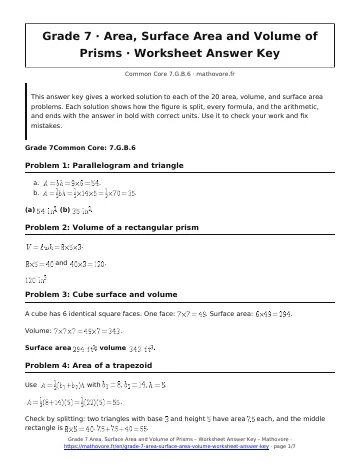
See every chapter on the Grade 7 math page.