


This grade 5 conversions line plots lesson explains converting units and line plots in one printable page, with definitions, a method and a worked example.
Converting units changes the unit but not the amount. To convert a larger unit to a smaller one, multiply by how many small units fit in one large unit; to convert smaller to larger, divide. A line plot with fractions shows measurements as X marks above a number line marked in halves, fourths, or eighths.
Grade 5 Conversions Line Plots Lesson: key facts
- Larger unit to smaller unit: multiply. Smaller unit to larger unit: divide.
- 1 foot = 12 inches, 1 yard = 3 feet, 1 pound = 16 ounces, 1 gallon = 4 quarts.
- Metric units use powers of 10: 1 meter = 100 centimeters and 1 kilometer = 1,000 meters.
- On a line plot, each X stands for one measurement.
- Equal share = total of the data divided by the number of data values.
What does it mean to convert units?
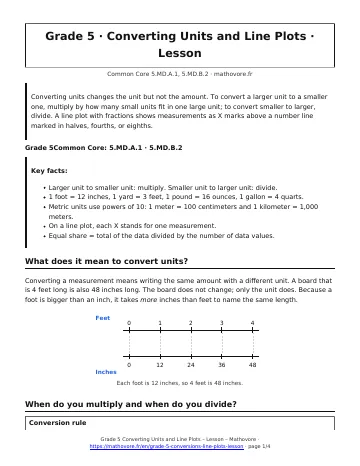
Converting a measurement means writing the same amount with a different unit. A board that is 4 feet long is also 48 inches long. The board does not change; only the unit does. Because a foot is bigger than an inch, it takes more inches than feet to name the same length.
When do you multiply and when do you divide?
Going from a larger unit to a smaller unit, multiply by the number of small units in one large unit. Going from a smaller unit to a larger unit, divide by that same number.
Here are the equivalents to know for Grade 5.
| Measure | Equivalents |
|---|---|
| Length | \(1\text{ ft} = 12\text{ in}\), \(1\text{ yd} = 3\text{ ft}\), \(1\text{ mi} = 5{,}280\text{ ft}\) |
| Weight | \(1\text{ lb} = 16\text{ oz}\) |
| Capacity | \(1\text{ gal} = 4\text{ qt}\), \(1\text{ qt} = 2\text{ pt}\), \(1\text{ pt} = 2\text{ c}\) |
| Metric | \(1\text{ km} = 1{,}000\text{ m}\), \(1\text{ m} = 100\text{ cm}\), \(1\text{ kg} = 1{,}000\text{ g}\), \(1\text{ L} = 1{,}000\text{ mL}\) |
| Time | \(1\text{ h} = 60\text{ min}\), \(1\text{ min} = 60\text{ s}\) |
How do you convert a measurement step by step?
- Find how many small units are in one large unit.
- Decide the direction: large to small means multiply, small to large means divide.
- Calculate and write the new unit.
Example. Convert \(3.5\text{ kg}\) to grams. One kilogram is \(1{,}000\text{ g}\), and kilograms are larger than grams, so multiply: \(3.5 \times 1{,}000 = 3{,}500\). The answer is \(3{,}500\text{ g}\).
How do you read a line plot with fractions?
A line plot shows each measurement as an X above a number line. The number line is marked in the same fractions as the data, such as halves, fourths, or eighths. Count the X marks above a number to see how many measurements have that value.
To find the total, add every measurement. To find an equal share, divide the total by the number of measurements. For the four ribbons above, the total is \(\frac{1}{4} + \frac{1}{2} + \frac{1}{2} + \frac{3}{4} = 2\) yards. Shared equally, each ribbon would be \(2 : 4 = \frac{1}{2}\) yard.
Converting Units and Line Plots: frequently asked questions
How do you know whether to multiply or divide when converting units?
Compare the sizes of the two units. If you are changing to a smaller unit, you need more of them, so multiply. If you are changing to a larger unit, you need fewer of them, so divide.
How many cups are in a gallon?
A gallon is 4 quarts, a quart is 2 pints, and a pint is 2 cups. So one gallon is \(4 \times 2 \times 2 = 16\) cups.
Why are metric conversions easier than customary conversions?
Metric units are based on 10, 100, and 1,000, so converting only moves the decimal point. Customary units use factors such as 12, 3, 16, and 5,280, which must be memorized.
What does each X on a line plot mean?
Each X is one measurement from the data set. If three X marks are above \(\frac{1}{2}\), three items measured \(\frac{1}{2}\) unit.
How do you find an equal share from a line plot?
Add all the measurements to get the total, then divide by the number of X marks. This shows how much each item would hold if the amounts were leveled out evenly.
How to use this grade 5 conversions line plots lesson
Use this grade 5 conversions line plots lesson before the worksheet, then check what you learned with the quiz.

See every chapter on the Grade 5 math page.