Key takeaway: This grade 5 multiply whole worksheet provides 22 printable problems on multi-digit multiplication. Students begin with an area model and a three-digit by one-digit product, then move to four-digit by two-digit and three-digit by three-digit products with zeros. The last six problems turn the skill into bake sale, auditorium, league, market and ferry stories. A separate answer key follows every solution.
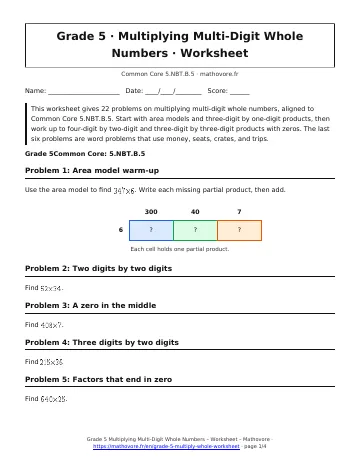
This worksheet gives 22 problems on multiplying multi-digit whole numbers, aligned to Common Core 5.NBT.B.5. Start with area models and three-digit by one-digit products, then work up to four-digit by two-digit and three-digit by three-digit products with zeros. The last six problems are word problems that use money, seats, crates, and trips.
Grade 5 Multiply Whole Worksheet: problems 1–5
1. Area model warm-up
Use the area model to find \(347 \times 6\). Write each missing partial product, then add.
2. Two digits by two digits
Find \(52 \times 34\).
3. A zero in the middle
Find \(408 \times 7\).
4. Three digits by two digits
Find \(215 \times 36\).
5. Factors that end in zero
Find \(640 \times 25\).
Grade 5 Multiply Whole Worksheet: problems 6–10
6. Estimate then multiply
Round each factor to the nearest ten to estimate \(38 \times 52\). Then find the exact product and tell whether it is reasonable.
7. Find the missing digit
The digit in the tens place is missing: \(3? 4 \times 6 = 2{,}064\). Find the missing digit.
8. Four digits by one digit
Find \(1{,}246 \times 8\).
9. Standard algorithm
Use the standard algorithm to find \(756 \times 43\).
10. Zero in the thousands
Find \(2{,}305 \times 27\).
Grade 5 Multiply Whole Worksheet: problems 11–15
11. Four digits by two digits
Find \(4{,}872 \times 36\).
12. Find the mistake
Noah multiplied 63 by 48 and got 756. Describe his mistake and find the correct product.
13. Three digits by three digits
Find \(214 \times 125\).
14. Zeros in both factors
Find \(807 \times 309\).
15. Fill the area model
The area model is set up for \(46 \times 73\). Find the four partial products and their sum.
Grade 5 Multiply Whole Worksheet: problems 16–20
16. Which product is greater?
Compare \(48 \times 62\) and \(51 \times 58\). Which product is greater, and by how much?
17. Bake sale cookies
Aisha packs 36 cookies in each box for the bake sale. She fills 24 boxes. How many cookies does she pack?
18. Auditorium seats
The school auditorium has 38 rows. Each row has 45 seats. How many seats are in the auditorium?
19. Little League fees
A Little League has 125 players. Each player pays an $85 fee. How much money does the league collect?
20. Apples at the market
Priya brings 36 crates to the farmers market. Each crate holds 144 apples. On the drive, 275 apples are bruised and thrown away. How many apples are left to sell?
Grade 5 Multiply Whole Worksheet: problems 21–22
21. Supply order
Ethan’s school orders 15 cartons of pencils with 144 pencils in each carton, and 28 cartons of erasers with 36 erasers in each carton. How many pencils and erasers is that in all?
22. Ferry passengers
A ferry makes 14 trips a day and carries 235 passengers on every trip. If the ferry runs for 25 days, how many passengers does it carry in all?

What are 5th grade multi-digit multiplication problems like?
Problem 1 fills an area model for 347 times 6. Then problems 2 to 5 try 52 times 34, 408 times 7, 215 times 36 and 640 times 25, so students meet a zero in the middle and zeros at the end. Problem 7 hides a digit in 3?4 times 6 equals 2,064, which makes students work backward.
How do the harder problems build accuracy?
Problem 9 asks for 756 times 43 with the standard algorithm, and problem 11 pushes to 4,872 times 36. Problem 14 multiplies 807 by 309, where zeros appear in both factors. In problem 12, Noah gets 756 for 63 times 48, and students explain that he skipped the second row. Problem 16 compares 48 times 62 with 51 times 58, so the difference of 18 must be found with exact products.
How does the grade 5 multiply whole worksheet use real stories?
Aisha packs 36 cookies into each of 24 boxes. The auditorium has 38 rows of 45 seats, and a Little League with 125 players collects an $85 fee from each. Priya’s 36 crates hold 144 apples each, minus the bruised ones, and the ferry carries 235 passengers on 14 trips a day for 25 days. Because each story needs a different structure, students plan before they multiply.
How should you review your finished page?
Circle every product whose size seemed off when you estimated. Then redo it using an area model and compare partial products. Afterward, mark your work against the key and take the quiz.

See every chapter on the Grade 5 math page.