

Key takeaway: This grade 5 powers of ten lesson explains why every place in our number system is worth ten times the place on its right. A power of 10, such as \(10^{3}\), uses 10 as a factor three times , so it equals 1,000. Multiplying by \(10^{n}\) slides every digit n places left, while dividing slides it n places right. Zeros then fill the empty places.
In our base-ten system, each place is worth 10 times the place to its right and \(\frac{1}{10}\) of the place to its left. A power of 10 such as \(10^{3}\) means 10 used as a factor 3 times , or 1,000. Multiplying by \(10^{n}\) moves digits n places left; dividing moves them n places right.
Grade 5 Powers of Ten Lesson: key facts
- Each place is 10 times the place to its right and 1/10 of the place to its left.
- 10^n means n factors of 10, and it has n zeros: 10^3 = 1,000.
- Multiplying by 10^n moves every digit n places to the left.
- Dividing by 10^n moves every digit n places to the right.
- Use zeros to hold empty places after moving digits.
How are the places in a number related?
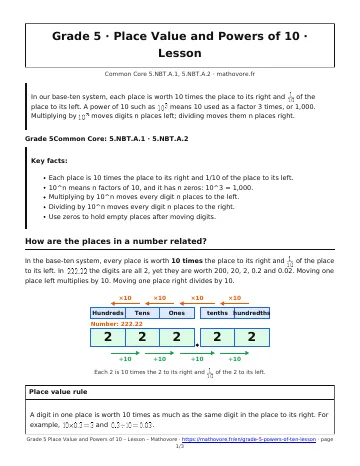
In the base-ten system, every place is worth 10 times the place to its right and \(\frac{1}{10}\) of the place to its left. In \(222.22\) the digits are all 2, yet they are worth 200, 20, 2, 0.2 and 0.02. Moving one place left multiplies by 10. Moving one place right divides by 10.
A digit in one place is worth 10 times as much as the same digit in the place to its right. For example, \(10 \times 0.3 = 3\) and \(0.3 : 10 = 0.03\).
What is a power of 10?
A power of 10 uses an exponent to show how many times 10 is used as a factor. The exponent counts the factors of 10, so \(10^{3} = 10 \times 10 \times 10 = 1,000\). The exponent also equals the number of zeros in the answer.
How do you multiply by a power of 10?
When you multiply by \(10^{n}\), every digit moves n places to the left, which makes the number larger. Equivalently, the decimal point moves n places to the right. Use zeros to fill empty places.
How do you divide by a power of 10?
When you divide by \(10^{n}\), every digit moves n places to the right, which makes the number smaller.
Method with an example: Find \(0.074 \times 10^{3}\).
- Read the exponent: it is 3, so the digits move 3 places left.
- Move each digit 3 places: 0.074 becomes 74 because the 7 goes from hundredths to tens.
- Check the size: a number times 1,000 should be much larger, and \(74\) is larger than \(0.074\).
So \(0.074 \times 10^{3} = 74\). Use the same steps for division, but move the digits right.
Place Value and Powers of 10: frequently asked questions
Why does a digit become 10 times larger when it moves one place left?
Each place is defined to be worth 10 times the place to its right. A 4 in the tens place is 40, and a 4 in the ones place is 4, so the tens 4 is worth 10 times as much.
What does the exponent in 10^4 tell you?
It tells how many times 10 is used as a factor. So 10^4 = 10 x 10 x 10 x 10 = 10,000. The exponent is also the number of zeros after the 1.
Do I move the decimal point or the digits?
Both ideas give the same answer. The digits move left when you multiply by a power of 10, and the decimal point appears to move right. Picture the digits moving in a place-value chart to understand why.
What do I do when there are no digits left to fill a place?
Write a zero in each empty place. For example, 6.3 x 10^3 = 6,300, because the 6 and 3 move three places left and two zeros fill the gap.
How can I check that my answer makes sense?
Multiplying by a power of 10 must make the number greater, and dividing must make it smaller. Estimate the size too: 0.5 x 10^2 should be about 50, not 5 or 500.
How are the places in a number related?
Look at 6,600. The left 6 sits in the thousands place, and the right 6 sits in the hundreds place, so the left one counts ten times more. The same link holds for decimals: 0.5 is 10 times as much as 0.05. Moving one place left multiplies by 10, and moving one place right divides by 10.
What does the exponent in 10 to the fourth power tell you?
It counts the factors of 10, not the number of zeros you add to the front. Because \(10^{4} = 10 \times 10 \times 10 \times 10\), the value is 10,000, which has four zeros. Therefore \(10^{9}\) is 1 followed by nine zeros. Students sometimes write \(10^{4} = 40\), mixing up an exponent with multiplication.
How do you shift digits in a grade 5 powers of ten lesson?
The digits move, and the decimal point simply shows the ones place. For \(3.45 \times 10^{2}\), each digit moves two places left, so the answer is 345. For \(520 : 10^{2}\), each digit moves two places right, so the answer is 5.2. When no digit remains to fill a place, write a zero, as in \(5 : 10^{3} = 0.005\).
Always check size. Multiplying by a power of 10 must make a number bigger, and dividing must make it smaller.
What can you try at home with powers of ten?
Take a price such as 0.68 dollars and find the cost of 10, 100 and 1,000 items. Then divide a 4,500-meter run by 10, 100 and 1,000 to see kilometers appear. Afterward, test yourself on the printable problems.

See every chapter on the Grade 5 math page.