

Key takeaway: This grade 5 add fractions lesson explains how to add and subtract fractions with unlike denominators for CCSS 5.NF.A.1 and the word problems of 5.NF.A.2. First, rename each fraction with a common denominator. Then combine the numerators, keep the denominator, and so \(\frac{2}{3} + \frac{1}{4}\) becomes \(\frac{8}{12} + \frac{3}{12} = \frac{11}{12}\). Fifth graders also regroup mixed numbers and check each result with the benchmarks 0, 1/2 and 1. Short worked examples keep every step easy to follow at home or in class.
To add or subtract fractions with unlike denominators, rename each fraction with a common denominator, then add or subtract the numerators and keep the denominator. For example, 2/3 + 1/4 = 8/12 + 3/12 = 11/12. Simplify the result, and estimate with benchmarks 0, 1/2 and 1 to check it.
Grade 5 Add Fractions Lesson: key facts
- Only fractions with the same denominator can be added or subtracted directly.
- A common denominator is a multiple of both denominators, and the smallest one is the least common denominator.
- Renaming a fraction multiplies its numerator and denominator by the same number.
- When subtracting mixed numbers, regroup one whole if the first fraction is smaller.
- Benchmarks 0, 1/2 and 1 give a quick estimate to check an answer.
How do you add fractions with unlike denominators?
Fractions can be added only when the pieces are the same size. Halves and thirds are different sizes, so first rename both fractions using a common unit. Sixths work for \(\frac{1}{2}\) and \(\frac{1}{3}\): three sixths plus two sixths make five sixths.
A common denominator is a number that both denominators divide into evenly. The smallest one is the least common denominator. Multiply the top and bottom of each fraction by the same number to rename it without changing its value.
Here is the method with \(\frac{2}{3} + \frac{1}{4}\).
- Find a common denominator. For 3 and 4, use 12.
- Rename each fraction: \(\frac{2}{3} = \frac{8}{12}\) and \(\frac{1}{4} = \frac{3}{12}\).
- Add the numerators and keep the denominator: \(\frac{8}{12} + \frac{3}{12} = \frac{11}{12}\).
- Simplify or rewrite as a mixed number if needed. Here \(\frac{11}{12}\) is already in simplest form.
How do you subtract fractions with unlike denominators?
Use the same steps, but subtract the numerators. For \(\frac{3}{4} – \frac{1}{6}\), rename with 12: \(\frac{9}{12} – \frac{2}{12} = \frac{7}{12}\).
How do you add and subtract mixed numbers?
Rename the fraction parts with a common denominator, then combine. When you subtract and the first fraction is too small, regroup one whole. For \(3\frac{1}{4} – 1\frac{3}{4}\), rewrite \(3\frac{1}{4}\) as \(2\frac{5}{4}\). Then \(2\frac{5}{4} – 1\frac{3}{4} = 1\frac{2}{4} = 1\frac{1}{2}\).
How can you estimate a sum or difference?
Round each fraction to the nearest benchmark: 0, one half, or 1. In the picture, \(\frac{3}{8}\) and \(\frac{7}{12}\) are both near one half, so the sum is about 1. The exact sum is \(\frac{23}{24}\), which agrees.
| Fraction is close to | Benchmark |
|---|---|
| \(\frac{1}{8}\) or \(\frac{1}{10}\) | 0 |
| \(\frac{5}{12}\) or \(\frac{4}{7}\) | \(\frac{1}{2}\) |
| \(\frac{7}{8}\) or \(\frac{11}{12}\) | 1 |
Adding and Subtracting Fractions with Unlike Denominators: frequently asked questions
Why can you not just add the denominators?
The denominator tells the size of the pieces, and adding fractions combines pieces of the same size. Adding tops and bottoms gives 1/2 + 1/3 = 2/5, which is smaller than 1/2 even though a third was added. The correct sum is 5/6.
Do you always need the least common denominator?
No. Any common denominator works, such as multiplying the two denominators. The least common denominator keeps numbers smaller, so there is less simplifying at the end.
How do you subtract mixed numbers when the fraction is too small?
Regroup one whole from the whole number part and add it to the fraction as equal parts. For 3 1/4, rewrite it as 2 5/4, then subtract the fractions and the wholes.
How do you write an improper fraction as a mixed number?
Divide the numerator by the denominator. The quotient is the whole number and the remainder is the new numerator. For example, 17/12 is 1 and 5/12.
How can benchmark fractions check an answer?
Round each fraction to 0, 1/2 or 1 and add or subtract the rounded numbers. If 5/12 + 6/11 is about 1/2 + 1/2 = 1, an answer like 11/23 or 2 cannot be right.
What is a common denominator in 5th grade?
Both denominators must divide evenly into a common denominator, which can be any shared multiple. For \(\frac{1}{6}\) and \(\frac{3}{4}\), the multiples of 6 are 6, 12 and 18, and 12 is also a multiple of 4. So twelfths work for both fractions. The smallest choice is the least common denominator, but any shared multiple gives a correct answer.
What mistake do students make when they add unlike fractions?
Many students write \(\frac{1}{2} + \frac{1}{3} = \frac{2}{5}\) because they add the tops and the bottoms. However, \(\frac{2}{5}\) is smaller than \(\frac{1}{2}\), and a sum can never shrink. Instead, rename both pieces in sixths and write \(\frac{3}{6} + \frac{2}{6} = \frac{5}{6}\). In other words, the pieces must be the same size before you count them.
How do you know a fraction answer is reasonable?
Round each fraction to the nearest benchmark before you start. For \(\frac{7}{8} + \frac{5}{12}\), seven eighths is close to 1 and five twelfths is close to \(\frac{1}{2}\), so expect about \(1\frac{1}{2}\). If your exact answer lands far away, check the renamed numerators first. Also simplify at the end, because \(\frac{6}{8}\) should become \(\frac{3}{4}\).
For mixed numbers, subtract the fractions first. When the top fraction is smaller, regroup one whole into extra pieces. For example, \(4\frac{1}{6} – 1\frac{1}{2}\) turns into \(3\frac{7}{6} – 1\frac{3}{6}\).
Where should you go after this fractions lesson?
Next, try the printable practice set, where bars and number lines come before word problems about recipes and running distances. After that, take the quiz to see which step still slows you down. Keep the answer key beside you, and compare estimates before you read each full solution.

Printable PDF · Lesson
Grade 5 Adding and Subtracting Fractions with Unlike Denominators lesson
Download the PDF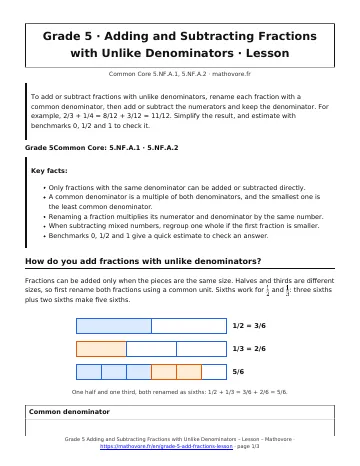
- Adding and Subtracting Fractions with Unlike Denominators worksheet (23 problems)
- Adding and Subtracting Fractions with Unlike Denominators quiz (10 questions)
- Adding and Subtracting Fractions with Unlike Denominators test (45 minutes)
- Previous lesson: Operations with Decimals
- Next lesson: Multiplying Fractions
See every chapter on the Grade 5 math page.