Key takeaway: This grade 5 multiply fractions lesson shows that multiplying fractions means finding a part of a part. Combine the tops, combine the bottoms, then reduce, so \(\frac{2}{3} \times \frac{3}{4} = \frac{6}{12} = \frac{1}{2}\). A fraction also equals a division, and a factor below 1 shrinks the other number. Fifth graders use area models and mixed numbers to see why the rule works.
Multiplying fractions means finding a part of a part. Multiply the numerators, multiply the denominators, and simplify: \(\frac{2}{3} \times \frac{3}{4} = \frac{6}{12} = \frac{1}{2}\). A fraction \(\frac{a}{b}\) also equals \(a : b\). A factor less than 1 shrinks a number, and a factor greater than 1 enlarges it.
Grade 5 Multiply Fractions Lesson: key facts
- A fraction is a division: \(a : b = \frac{a}{b}\).
- To multiply fractions, multiply numerators and multiply denominators, then simplify.
- Write mixed numbers as improper fractions before multiplying.
- The area of a rectangle with fractional sides is length times width.
- Multiplying by a factor less than 1 gives a smaller product; greater than 1 gives a larger product.
What does a fraction mean as division?
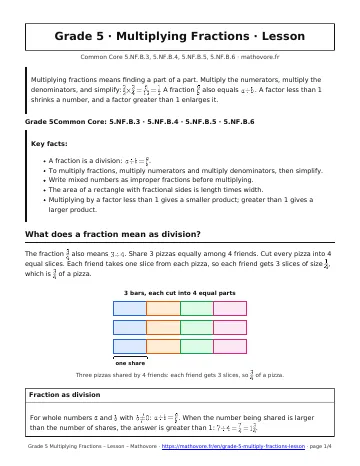
The fraction \(\frac{3}{4}\) also means \(3 : 4\). Share 3 pizzas equally among 4 friends. Cut every pizza into 4 equal slices. Each friend takes one slice from each pizza, so each friend gets 3 slices of size \(\frac{1}{4}\), which is \(\frac{3}{4}\) of a pizza.
For whole numbers \(a\) and \(b\) with \(b \neq 0\): \(a : b = \frac{a}{b}\). When the number being shared is larger than the number of shares, the answer is greater than 1: \(7 : 4 = \frac{7}{4} = 1\frac{3}{4}\).
How do you multiply a fraction by a whole number?
The product \(4 \times \frac{2}{3}\) means 4 groups of \(\frac{2}{3}\). That is 8 pieces of size \(\frac{1}{3}\), so the product is \(\frac{8}{3} = 2\frac{2}{3}\). To find a fraction of a number, multiply: \(\frac{3}{4} \times 8 = \frac{24}{4} = 6\).
How do you multiply two fractions?
Taking a fraction of a fraction cuts a piece into smaller pieces. In the model, \(\frac{3}{4}\) of the columns and \(\frac{2}{3}\) of the rows are shaded. The green overlap is \(\frac{3}{4}\) of \(\frac{2}{3}\).
Multiply the numerators, multiply the denominators, then simplify: \(\frac{a}{b} \times \frac{c}{d} = \frac{a \times c}{b \times d}\).
How does multiplying change the size of a number?
Multiplying by a factor greater than 1 scales a number up. Multiplying by a factor less than 1 scales it down. Multiplying by 1 changes nothing.
| Factor | Product compared with 6 | Example |
|---|---|---|
| Less than 1 | Smaller than 6 | \(6 \times \frac{1}{2} = 3\) |
| Equal to 1 | Equal to 6 | \(6 \times \frac{4}{4} = 6\) |
| Greater than 1 | Larger than 6 | \(6 \times \frac{3}{2} = 9\) |
How do you multiply mixed numbers?
- Write each mixed number as an improper fraction.
- Cancel common factors, then multiply numerators and denominators.
- Write the result as a mixed number.
Example. A rectangle is \(2\frac{1}{3}\) ft wide and \(1\frac{1}{2}\) ft tall. Then \(2\frac{1}{3} = \frac{7}{3}\) and \(1\frac{1}{2} = \frac{3}{2}\). So \(\frac{7}{3} \times \frac{3}{2} = \frac{21}{6} = \frac{7}{2} = 3\frac{1}{2}\) square feet.
Common mistake: multiplying only the whole parts and the fraction parts separately. \(1\frac{1}{2} \times 2\frac{1}{3}\) is not \(1 \times 2 = 2\) plus \(\frac{1}{2} \times \frac{1}{3}\).
Multiplying Fractions: frequently asked questions
How do you multiply fractions?
Multiply the top numbers to get the new numerator and multiply the bottom numbers to get the new denominator. Then simplify. For example, \(\frac{3}{5} \times \frac{2}{9} = \frac{6}{45} = \frac{2}{15}\).
Why is a fraction the same as division?
The fraction \(\frac{3}{4}\) is what one person gets when 3 wholes are shared equally among 4 people. Each person gets \(3 : 4\), so \(3 : 4 = \frac{3}{4}\).
Why does multiplying by a fraction sometimes make a number smaller?
Multiplying by a fraction less than 1 takes only part of the number. For example, \(\frac{1}{2} \times 10 = 5\) is half of 10, so the product is smaller than 10.
How do you multiply a mixed number by a fraction?
Change the mixed number to an improper fraction, multiply the fractions, and simplify. For example, \(1\frac{1}{2} \times \frac{2}{3} = \frac{3}{2} \times \frac{2}{3} = 1\).
How do you find the area of a rectangle with fractional sides?
Multiply the length by the width. A rectangle \(\frac{3}{4}\) ft by \(\frac{2}{3}\) ft has area \(\frac{6}{12} = \frac{1}{2}\) square foot.
What is six groups of one fourth, and how does it extend?
Think of repeated groups. Six groups of \(\frac{1}{4}\) make \(\frac{6}{4}\), which is \(1\frac{1}{2}\). For a fraction of a whole number, such as \(\frac{3}{5} \times 10\), divide 10 into 5 equal parts of 2 and take 3 of them to get 6. In both cases, the whole number acts as a numerator over 1.
Why does an area model prove the rule?
Cut a unit square into thirds one way and fourths the other way. The overlap of one third and one fourth is 1 of 12 small rectangles, so \(\frac{1}{3} \times \frac{1}{4} = \frac{1}{12}\). Because the denominators multiply to count all pieces, the numerators count the shaded ones. Rectangles with fractional sides then have area equal to length times width.
How do you multiply mixed numbers in a grade 5 multiply fractions lesson?
Convert each mixed number to an improper fraction first. For \(2\frac{1}{2} \times 1\frac{3}{5}\), write \(\frac{5}{2} \times \frac{8}{5}\). Cancel the 5s and divide 8 by 2, which leaves 4. Skipping the conversion and multiplying the whole parts gives 2, a classic error, and the estimate 2.5 times about 1.6 shows the answer should be near 4.
Finally, use size to check. A factor greater than 1 enlarges a number, while a factor less than 1 shrinks it, so \(\frac{7}{8} \times 5\) is below 5.
What can you do next with these rules?
Measure a tabletop in feet and half feet, then compute its area. Next, scale a recipe by \(\frac{2}{3}\) and write each new amount. Finally, work through the printable problems and compare your estimates with the exact products.

See every chapter on the Grade 5 math page.