Key takeaway: Use this grade 4 division test answer key to score the paper out of 20. Each worked solution lists the steps, and the note explains how to split the points. Award credit for sound reasoning as well as the right quotient. In addition, check every remainder against the divisor, because a remainder equal to or larger than the divisor signals an unfinished problem. Teachers can finish scoring a class set quickly with this layout.
This answer key gives the worked solution and the scoring guide for each question, out of 20 points. Award points for correct reasoning as well as correct answers, and check every remainder against the divisor. A total of 16 points or more shows strong understanding.
Grade 4 Division Test Answer Key: questions 1–5
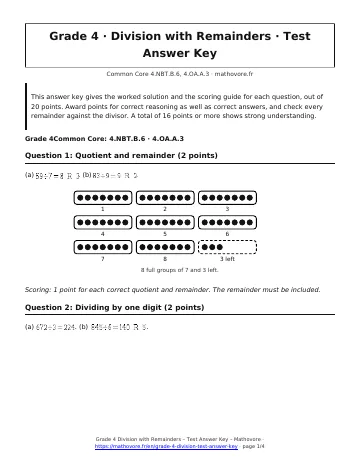
1. Quotient and remainder (2 points)
(a) \(59 : 7 = 8\text{ R }3\). (b) \(83 : 9 = 9\text{ R }2\).
Scoring: 1 point for each correct quotient and remainder. The remainder must be included.
2. Dividing by one digit (2 points)
(a) \(672 : 3 = 224\). (b) \(845 : 6 = 140\text{ R }5\).
Scoring: 1 point for each correct answer. In part (b), the remainder 5 must be included.
3. Area model (2 points)
(a) \(1,200 : 4 = 300\), \(80 : 4 = 20\), \(4 : 4 = 1\). (b) \(300 + 20 + 1 = 321\). So \(1,284 : 4 = 321\).
Scoring: 1 point for all three missing numbers (300, 20, 1); 1 point for the quotient 321.
4. Large dividends (2 points)
(a) \(3,642 : 5 = 728\text{ R }2\). (b) \(7,008 : 8 = 876\).
Scoring: 1 point for each correct answer. In part (b), the 0 in the quotient is needed for the point.
5. Remainder rules (2 points)
(a) \(6 \times 52 = 312\) and \(312 + 5 = 317\). The number is 317. (b) A remainder must be less than the divisor. With a remainder of 7, another group of 6 would still fit, so the quotient would be one larger.
Scoring: 1 point for 317. 1 point for an explanation that the remainder must be less than the divisor 6.
Grade 4 Division Test Answer Key: questions 6–9
6. Shelves for books (2 points)
(a) \(83 : 9 = 9\text{ R }2\). (b) Two books are left over and still need a shelf, so \(9 + 1 = 10\) shelves are needed.
Scoring: 1 point for 9 R 2. 1 point for the answer 10 shelves, with the reason that the leftover books need a shelf.
7. Baseball card pages (3 points)
\(1,003 : 4 = 250\text{ R }3\). Check: \(4 \times 250 = 1,000\text{, then }1,000 + 3 = 1,003\).
(a) 250 full pages. (b) 3 cards. (c) The 3 extra cards need one more page: \(250 + 1 = 251\) pages.
Scoring: 1 point for each part. Part (c) needs the quotient rounded up to 251.
8. Pencil boxes (3 points)
\(1,250 : 6 = 208\text{ R }2\). Check: \(6 \times 208 = 1,248\text{, then }1,248 + 2 = 1,250\).
(a) 208 boxes. (b) 2 pencils. (c) \(208 \times 2 = 416\), so the store makes $416.
Scoring: 1 point for each part. Award part (c) if the multiplication follows from the student’s answer to part (a).
9. Number puzzles (2 points)
(a) \(7 \times 128 = 896\) and \(896 + 5 = 901\). (b) \(9 \times 43 = 387\) and \(390 – 387 = 3\). The remainder is 3.
Scoring: 1 point for 901 and 1 point for the remainder 3.
Scoring summary
20 points: add the points of every question of this grade 4 division test answer key.
What are the answers to the early questions?
Question 1 expects 8 R 3 and 9 R 2. Next, question 2 expects 224 and 140 R 5. Then question 3 expects 321, because 1,200, 80, and 4 divide into 300, 20, and 1. Finally, question 4 expects 728 R 2 and 876. Each part earns one point.
How does the grade 4 division test answer key treat remainder rules?
Question 5 expects \(6 \times 52 + 5 = 317\). Also, accept any explanation that says a remainder for 6 must be 5 or smaller. Meanwhile, question 9 expects \(7 \times 128 + 5 = 901\). However, a student who writes 133 has added the quotient and remainder, so give no point for the first part.
How do you score the story questions?
For question 6, accept 10 shelves, since 9 shelves hold only 81 books. Then question 7 gives 250 full pages, with 3 cards left over. Finally, question 8 gives 208 full boxes, so the sale totals $416. Because these questions earn 3 points, give one for the division, one for the interpretation, and one for the final number.
What do the scores tell you?
First, add the points and look at which question types lost them. Then compare long division misses with story misses. If stories lose more, practice reading the final sentence. If calculations lose more, rebuild each quotient with an area model. Afterward, retest with the quiz.

See every chapter on the Grade 4 math page.