Key takeaway: This geometry foundations test answer key gives a complete solution and a scoring guide for the eight questions. Award points for the correct equation and reasoning, not only for the final number. Accept equivalent definitions and notation that names the endpoint first for a ray.
Each answer shows a complete solution and a scoring guide. Award points for the correct equation and reasoning, not only for the final number. Accept equivalent definitions and notation that names the endpoint first.
Geometry Foundations Test Answer Key: questions 1–5
1. Undefined terms and definitions (2 points)
- Point, line and plane.
- A ray is a part of a line that consists of one endpoint and all the points of the line extending in one direction from it.
Scoring: 1 point for all three terms; 1 point for a definition that includes one endpoint and extension in one direction only.
2. Naming rays and points (2 points)
- Ray BC (endpoint first).
- Ray BA and ray BC share endpoint B and form line AC: ray BA and ray BC.
Scoring: 1 point for each part. Award the first point only if the endpoint is named first.
3. Segment addition (3 points)
- \((2x+3)+(3x-1)=37\), so \(5x+2=37\) and \(5x=35\). x = 7.
- \(KL=3(7)-1=20\). KL = 20.
Scoring: 1 point for the correct equation, 1 point for x = 7, 1 point for KL = 20.
4. Midpoint (2 points)
- \(5x-4=3x+8\), so \(2x=12\) and x = 6.
- \(RN=5(6)-4=26\) and \(NS=3(6)+8=26\), so \(RS=26+26=52\). RS = 52.
Scoring: 1 point for each part.
5. Angle addition (3 points)
- \((3x+7)+(5x-1)=118\), so \(8x+6=118\) and \(8x=112\). x = 14.
- \(m\angle BOC\)\(=5(14)-1=69^{\circ}\). 69°.
Scoring: 1 point for applying the Angle Addition Postulate, 1 point for x = 14, 1 point for 69°.
Geometry Foundations Test Answer Key: questions 6–8
6. Complement problem (2 points)
Let the complement be \(y^{\circ}\). The angle is \(4y^{\circ}\) and they add to \(90^{\circ}\): \(y+4y=90\), so \(5y=90\) and \(y=18\).
Complement 18°; angle 72°. Check: \(4\times 18=72\) and \(72+18=90\).
Scoring: 1 point for a correct equation, 1 point for both measures.
7. Vertical angles and linear pairs (3 points)
- Vertical angles are congruent: \(6x-8=4x+14\), so \(2x=22\) and x = 11.
- \(m\angle 1\)\(=6(11)-8=58^{\circ}\). 58°.
- Angles 1 and 2 are a linear pair, so they are supplementary: \(m\angle 2\)\(=180-58=122^{\circ}\). 122°.
Scoring: 1 point for each part; part (c) needs the measure and the linear pair reason.
8. Angle bisector (3 points)
- A bisector makes equal angles: \(4x-6=2x+14\), so \(2x=20\) and x = 10.
- Each part is \(4(10)-6=34^{\circ}\), so \(m\angle ABC\)\(=34+34=68^{\circ}\). 68°.
- \(68^{\circ}< 90^{\circ}\) (less than a right angle), so the angle is acute.
Scoring: 1 point for each part.
Scoring summary
20 points: add the points of every question of this geometry foundations test answer key.
How do you score the foundations test?
Question 3 earns two points for \(x=7\), since \(5x+2=37\), and one for \(KL=20\). Next, question 4 gives \(x=6\) and \(RS=52\), one point each. Then 6 gives \(72^{\circ}\) and a complement of \(18^{\circ}\), because the equation \(x=4(90-x)\) leads to \(5x=360\).
When should you give partial credit?
In question 7, \(6x-8=4x+14\) gives \(x=11\), so the angle is \(58^{\circ}\). Give one point for the vertical angle equation and one for the value. In question 8, \(x=10\) and each half is \(34^{\circ}\), so the whole is \(68^{\circ}\). A correct equation with a wrong final angle earns two of three.
What should you reteach?
If question 1 is missed, students probably defined a ray with the word ray. Therefore, model a definition built from point and line only.
How can you use the scores?
Sort lost points into definitions, equation setup and arithmetic. Then assign two practice items per group. The short quiz later reveals which students need more help.

Printable PDF · Test Answer Key
Geometry Points, Lines, Planes, Segments and Angles test answer key
Download the PDF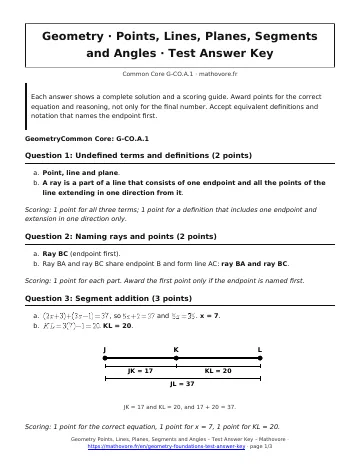
See every chapter on the Geometry math page.