



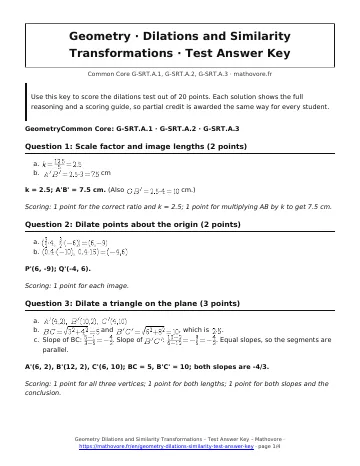
Use this key to score the dilations test out of 20 points. Each solution shows the full reasoning and a scoring guide, so partial credit is awarded the same way for every student.
Question 1: Scale factor and image lengths (2 points)
- \(k=\frac{12.5}{5}=2.5\)
- \(A^{\prime}B^{\prime}=2.5\cdot 3=7.5\) cm
k = 2.5; A’B’ = 7.5 cm. (Also \(OB^{\prime}=2.5\cdot 4=10\) cm.)
Scoring: 1 point for the correct ratio and k = 2.5; 1 point for multiplying AB by k to get 7.5 cm.
Question 2: Dilate points about the origin (2 points)
- \((\frac{3}{2}\cdot 4,\ \frac{3}{2}\cdot(-6))=(6,-9)\)
- \((0.4\cdot(-10),\ 0.4\cdot 15)=(-4,6)\)
P'(6, -9); Q'(-4, 6).
Scoring: 1 point for each image.
Question 3: Dilate a triangle on the plane (3 points)
- \(A^{\prime}(4,2),\ B^{\prime}(10,2),\ C^{\prime}(4,10)\)
- \(BC=\sqrt{3^{2}+4^{2}}=5\) and \(B^{\prime}C^{\prime}=\sqrt{6^{2}+8^{2}}=10\), which is \(2\cdot 5\).
- Slope of BC: \(\frac{5-1}{3-6}=-\frac{4}{3}\). Slope of \(B^{\prime}C^{\prime}\): \(\frac{10-2}{6-12}=-\frac{8}{6}=-\frac{4}{3}\). Equal slopes, so the segments are parallel.
A'(6, 2), B'(12, 2), C'(6, 10); BC = 5, B’C’ = 10; both slopes are -4/3.
Scoring: 1 point for all three vertices; 1 point for both lengths; 1 point for both slopes and the conclusion.
Question 4: Dilating a line (2 points)
- The line misses the origin, so the image is parallel with its intercept multiplied by 4: \(y=-2x+12\). (Check: \((0,3)\to(0,12)\) has slope \(-2\) to \((2,8)\), the image of \((1,1)\).)
- The line passes through the center, so it maps to itself: \(y=3x\).
(a) y = -2x + 12; (b) y = 3x (unchanged).
Scoring: 1 point for each equation; in (b) full credit requires saying the line is unchanged.
Question 5: Center other than the origin (2 points)
- C to A is 2 right, 2 up. Tripled: 6 right, 6 up from C: \(A^{\prime}=(8,7)\).
- C to B is 3 left, 1 down. Tripled: 9 left, 3 down from C: \(B^{\prime}=(2-9,\ 1-3)=(-7,-2)\).
A'(8, 7); B'(-7, -2).
Scoring: 1 point each; 0 points if the origin was used as the center.
Question 6: Describe a similarity transformation (3 points)
- \(AB=4-1=3\) and \(DE=8-2=6\), so \(k=\frac{6}{3}=2\).
- Dilate about the origin with \(k=2\), then reflect across the x-axis.
- \(C(1,3)\to(2,6)\to(2,-6)=F\).
k = 2; dilation then reflection across the x-axis; C maps to F(2, -6). Reflection first and dilation second also works.
Scoring: 1 point for k = 2; 1 point for a dilation of 2 plus a reflection across the x-axis; 1 point for tracking C through both steps to F.
Question 7: AA similarity and a missing side (3 points)
- \(m\angle C=180^{\circ}-48^{\circ}-67^{\circ}=65^{\circ}\) and \(m\angle D=180^{\circ}-67^{\circ}-65^{\circ}=48^{\circ}\).
- All three angle pairs match (\(48^{\circ},\ 67^{\circ},\ 65^{\circ}\)), so the triangles are similar by AA: \(triangle ABC\) ~ \(triangle DEF\).
- \(\frac{DE}{AB}=\frac{9}{6}=1.5\), so \(EF=1.5\cdot BC=1.5\cdot 4.9=7.35\) cm.
C = 65 degrees, D = 48 degrees; similar by AA, ABC ~ DEF; EF = 7.35 cm.
Scoring: 1 point for both angles; 1 point for AA and a correctly ordered statement; 1 point for the ratio 1.5 and EF = 7.35 cm.
Question 8: Poster dilation (2 points)
- \(k=\frac{30}{5}=6\), so the height is \(6\cdot 7=42\) in.
- No. A dilation multiplies both dimensions by the same factor. Width gives \(6\), but \(\frac{40}{7}\) ≈ \(5.7\neq 6\), so the poster is distorted.
k = 6 and height 42 in.; the 30 by 40 poster is not a dilation.
Scoring: 1 point for k = 6 and 42 in.; 1 point for the correct conclusion with a comparison of the two ratios.
Question 9: Perimeter after a dilation (1 point)
Original perimeter: \(5+12+13=30\) cm. Image perimeter: \(\frac{2}{5}\cdot 30=12\) cm (sides 2, 4.8 and 5.2).
12 cm
Scoring: 1 point for 12 cm; a correct method with an arithmetic slip earns no point.
20 points
See every chapter on the Geometry math page.