



This answer key shows a complete worked solution for every problem on the coordinate geometry worksheet. Compare each step with your own work, check the slope and distance calculations, and note where a figure helps verify a result.
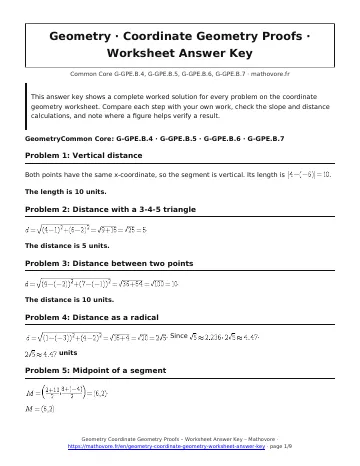
Problem 1: Vertical distance
Both points have the same x-coordinate, so the segment is vertical. Its length is \(|4-(-6)|=10\).
The length is 10 units.
Problem 2: Distance with a 3-4-5 triangle
\(d=\sqrt{(4-1)^{2}+(6-2)^{2}}=\sqrt{9+16}=\sqrt{25}=5\).
The distance is 5 units.
Problem 3: Distance between two points
\(d=\sqrt{(4-(-2))^{2}+(7-(-1))^{2}}=\sqrt{36+64}=\sqrt{100}=10\).
The distance is 10 units.
Problem 4: Distance as a radical
\(d=\sqrt{(1-(-3))^{2}+(4-2)^{2}}=\sqrt{16+4}=\sqrt{20}=2\sqrt{5}\). Since \(\sqrt{5}\approx 2.236\), \(2\sqrt{5}\approx 4.47\).
\(2\sqrt{5}\approx 4.47\) units
Problem 5: Midpoint of a segment
\(M=(\frac{2+10}{2},\frac{8+(-4)}{2})=(6,2)\).
\(M=(6,2)\)
Problem 6: Midpoint with fractions
\(M=(\frac{-5+2}{2},\frac{3+6}{2})=(-\frac{3}{2},\frac{9}{2})\).
\(M=(-\frac{3}{2},\frac{9}{2})=(-1.5,\,4.5)\)
Problem 7: Missing endpoint
Let \(B=(x,y)\). Then \(\frac{-2+x}{2}=3\) gives \(x=8\), and \(\frac{4+y}{2}=-1\) gives \(y=-6\).
\(B=(8,-6)\)
Problem 8: Slopes of two lines
Slope of \(a\): \(\frac{8-2}{4-1}=2\). Slope of \(b\): \(\frac{2-5}{6-0}=-\frac{1}{2}\). The slopes are not equal, but \(2\cdot(-\frac{1}{2})=-1\).
The lines are perpendicular.
Problem 9: Parallel line through a point
A parallel line has the same slope, 3. Point-slope form: \(y-(-1)=3(x-4)\), so \(y+1=3x-12\).
\(y=3x-13\)
Check: when \(x=4\), \(y=3(4)-13=-1\).
Problem 10: Perpendicular line through a point
The perpendicular slope is the opposite reciprocal of \(-\frac{2}{3}\), which is \(\frac{3}{2}\). Then \(y-2=\frac{3}{2}(x-6)\), so \(y=\frac{3}{2}x-9+2\).
\(y=\frac{3}{2}x-7\)
Check: when \(x=6\), \(y=9-7=2\).
Problem 11: Point one third of the way
The fraction is \(\frac{1}{1+2}=\frac{1}{3}\). The run is \(12-0=12\) and the rise is \(14-2=12\). Move \(\frac{1}{3}(12)=4\) right and 4 up from \(A\).
\(P=(4,6)\)
Problem 12: Ratio 3 to 2
The fraction is \(\frac{3}{3+2}=\frac{3}{5}\). Run: \(4-(-6)=10\), so move \(\frac{3}{5}(10)=6\). Rise: \(-8-2=-10\), so move \(\frac{3}{5}(-10)=-6\). Then \((-6+6,\,2-6)=(0,-4)\).
\((0,-4)\)
Problem 13: Perimeter of a triangle
\(AB=6\) (horizontal) and \(BC=8\) (vertical). \(AC=\sqrt{6^{2}+8^{2}}=\sqrt{100}=10\). Perimeter: \(6+8+10=24\).
The perimeter is 24 units.
Problem 14: Area of a tilted rectangle
\(PQ=\sqrt{4^{2}+2^{2}}=\sqrt{20}=2\sqrt{5}\) and \(QR=\sqrt{(-1)^{2}+2^{2}}=\sqrt{5}\). Area \(=2\sqrt{5}\cdot\sqrt{5}=2\cdot 5=10\).
The area is 10 square units.
Check: slope of \(\overline{PQ}\) is \(\frac{1}{2}\) and slope of \(\overline{QR}\) is \(-2\); their product is \(-1\), so the angle at \(Q\) is right.
Problem 15: Area of a triangle
\(\overline{AB}\) is horizontal, so the base is \(6-(-2)=8\). The height is the vertical distance from \(C\) to the line \(y=1\): \(7-1=6\). Area \(=\frac{1}{2}(8)(6)=24\).
The area is 24 square units.
Problem 16: Classify a triangle by sides
\(AB=6\). \(AC=\sqrt{3^{2}+5^{2}}=\sqrt{34}\). \(BC=\sqrt{(-3)^{2}+5^{2}}=\sqrt{34}\). Two sides are equal, and \(\sqrt{34}\approx 5.83\neq 6\).
The triangle is isosceles but not equilateral.
Problem 17: Right angle with slopes
Slope of \(\overline{PQ}\): \(\frac{3-1}{5-1}=\frac{1}{2}\). Slope of \(\overline{QR}\): \(\frac{7-3}{3-5}=-2\). Product: \(\frac{1}{2}\cdot(-2)=-1\), so \(\overline{PQ}\perp\overline{QR}\).
\(PQ=\sqrt{20}\) and \(QR=\sqrt{(-2)^{2}+4^{2}}=\sqrt{20}\). Area \(=\frac{1}{2}\sqrt{20}\cdot\sqrt{20}=10\).
The right angle is at \(Q\) and the area is 10 square units.
Problem 18: Prove a parallelogram
Midpoint of \(\overline{AC}\): \((\frac{1+8}{2},\frac{1+6}{2})=(4.5,\,3.5)\). Midpoint of \(\overline{BD}\): \((\frac{6+3}{2},\frac{2+5}{2})=(4.5,\,3.5)\).
The diagonals share a midpoint, so they bisect each other and ABCD is a parallelogram.
Check: from \(A\) to \(B\) and from \(D\) to \(C\) the move is 5 right and 1 up.
Problem 19: Prove a rhombus
Each side has a 3 by 4 change: \(AB=\sqrt{3^{2}+4^{2}}=5\), \(BC=5\), \(CD=5\), \(DA=5\). Four equal sides make a rhombus.
The diagonals lie on the x-axis and the y-axis, so they are perpendicular and cut the figure into four right triangles with legs 3 and 4. Each has area \(\frac{1}{2}(3)(4)=6\), so the area is \(4\cdot 6=24\).
It is a rhombus with area 24 square units.
Problem 20: Walk to the library
(a) \(SL=\sqrt{12^{2}+5^{2}}=\sqrt{169}=13\) blocks, and \(13\times 0.1=1.3\) miles.
(b) \((\frac{2+14}{2},\frac{3+8}{2})=(8,\,5.5)\).
(a) 1.3 miles. (b) The bench is at \((8,5.5)\).
Problem 21: Ranger station on a trail
Move \(\frac{2}{5}(15)=6\) right and \(\frac{2}{5}(20)=8\) up: \(R=(6,8)\).
Whole trail: \(\sqrt{15^{2}+20^{2}}=\sqrt{625}=25\) units. The remaining \(\frac{3}{5}\) is \(15\) units, or \(15\times 0.1=1.5\) miles. Check: \(RC=\sqrt{9^{2}+12^{2}}=15\).
\(R=(6,8)\); the station is 1.5 miles from the campsite.
Problem 22: Garden fence cost
\(AB=8\) ft and \(BC=6\) ft.
(a) \(2(8+6)=28\) ft.
(b) \(28\times 4.50=126\).
(c) \(8\times 6=48\) square feet.
(d) \(AC=\sqrt{8^{2}+6^{2}}=10\) ft.
(a) 28 ft. (b) $126.00. (c) 48 square feet. (d) 10 ft.
Problem 23: Isosceles trapezoid park
Slopes: \(AB\) is 0 and \(DC\) is 0, so \(AB\parallel DC\). \(\text{Slope }AD=\frac{4}{2}=2\) and \(\text{slope }BC=\frac{4}{-2}=-2\), so the other pair is not parallel. Exactly one pair of parallel sides makes a trapezoid.
Legs: \(AD=\sqrt{2^{2}+4^{2}}=\sqrt{20}\) and \(BC=\sqrt{(-2)^{2}+4^{2}}=\sqrt{20}\). Equal legs make it isosceles.
Area: a 4 by 4 rectangle (16) plus two right triangles with legs 2 and 4 (each 4) is 24 square units. Each square unit is \(10\times 10=100\) square yards, so the area is \(24\times 100\) = 2,400 square yards.
It is an isosceles trapezoid with area 2,400 square yards.
Problem 24: Split a triangle
(a) Fraction \(\frac{1}{3}\) of the run 12 is 4, so \(D=(4,0)\).
(b) \(\overline{AB}\) lies on the x-axis (horizontal) and \(\overline{CD}\) lies on the line \(x=4\) (vertical), so they are perpendicular.
(c) Base \(12\), height \(CD=9\): area \(\frac{1}{2}(12)(9)=54\).
(d) \(AD=4\), \(CD=9\), \(AC=\sqrt{4^{2}+9^{2}}=\sqrt{97}\approx 9.85\). Perimeter \(4+9+9.85=22.85\).
(a) \(D=(4,0)\). (c) 54 square units. (d) about 22.85 units.
Problem 25: Drone flight
(a) \(PL=\sqrt{(8-(-4))^{2}+(14-(-2))^{2}}=\sqrt{144+256}=\sqrt{400}=20\) units, and \(20\times 10=200\) yards.
(b) \((\frac{-4+8}{2},\frac{-2+14}{2})=(2,\,6)\).
(a) 200 yards. (b) The photo point is \((2,6)\).
See every chapter on the Geometry math page.