Key takeaway: This AP calculus analyzing test answer key gives fully reasoned answers and a grading plan for the 20-point exam. Graders award separate points for the setup, the computation and the stated reason, which mirrors AP scoring. Equivalent exact forms are accepted. The key follows AB Unit 5, and it marks the justification lines that students most often omit.
Worked solutions and scoring guides for the Unit 5 test. Each answer shows the reasoning an AP reader looks for: the derivative, the sign analysis or the named theorem, and a clear conclusion. Award points exactly as the scoring note describes, and total them out of 20.
AP Calculus Analyzing Test Answer Key: questions 1–5
1. Critical numbers and monotonicity (2 points)
(a) \(f^{\prime}(x)=3x^{2}-6x-24=3(x-4)(x+2)\), so the critical numbers are \(x=-2\) and \(x=4\).
(b) \(f^{\prime} > 0\) on \((-\infty,-2)\) and \((4,\infty)\); \(f^{\prime} < 0\) on \((-2,4)\). So \(f\) is increasing on \((-\infty,-2)\) and \((4,\infty)\) and decreasing on \((-2,4)\). \(f^{\prime}\) changes from \(+\) to \(-\) at \(x=-2\) (local maximum \(f(-2)=33\)) and from \(-\) to \(+\) at \(x=4\) (local minimum \(f(4)=-75\)).
Scoring: (a) 1 point for both critical numbers. (b) 1 point for the correct intervals and the classification with the sign-change reason.
2. Mean Value Theorem (2 points)
(a) \(f\) is a polynomial, so it is continuous on \([0,2]\) and differentiable on \((0,2)\).
(b) \(\frac{f(2)-f(0)}{2-0}=\frac{6-0}{2}=3\). Solving \(3c^{2}-1=3\) gives \(c^{2}=\frac{4}{3}\), so \(c=\frac{2\sqrt{3}}{3}\approx 1.155\) (the negative root is outside the interval).
Scoring: (a) 1 point for naming both continuity and differentiability. (b) 1 point for the correct value of \(c\) with the root in \((0,2)\) chosen.
3. Reading the graph of f prime (2 points)
(a) \(f^{\prime}(x)=x^{2}-2x-3=(x-3)(x+1)\). \(f^{\prime}\) changes from positive to negative at \(x=-1\), so \(f\) has a local maximum at \(x=-1\); it changes from negative to positive at \(x=3\), so \(f\) has a local minimum at \(x=3\).
(b) \(f^{\prime}\) is decreasing for \(x < 1\) and increasing for \(x > 1\), so \(f^{\prime\prime}\) changes from negative to positive at \(x=1\). The inflection point is at \(x=1\).
Scoring: (a) 1 point for \(x=-1\) (maximum) and \(x=3\) (minimum) with the sign-change reason. (b) 1 point for \(x=1\) with the reason that \(f^{\prime}\) changes from decreasing to increasing.
4. Candidates Test (3 points)
\(f^{\prime}(x)=4x^{3}-16x=4x(x-2)(x+2)\). The critical numbers in \([-1,3]\) are \(x=0\) and \(x=2\) (\(x=-2\) is outside).
\(f(-1)=-4\), \(f(0)=3\), \(f(2)=-13\), \(f(3)=12\).
The absolute maximum is \(12\) (at \(x=3\)) and the absolute minimum is \(-13\) (at \(x=2\)).
Scoring: 1 point for the critical numbers in the interval; 1 point for the four function values; 1 point for the correct maximum and minimum.
5. Inscribed rectangle (3 points)
With upper right vertex \((x,12-x^{2})\), the width is \(2x\) and the height is \(12-x^{2}\), so \(A(x)=2x(12-x^{2})=24x-2x^{3}\) for \(0 < x < 2\sqrt{3}\).
\(A^{\prime}(x)=24-6x^{2}=0\) gives \(x=2\) (positive root). \(A^{\prime\prime}(x)=-12x\), so \(A^{\prime\prime}(2)=-24 < 0\): a maximum. (Also, \(A\to 0\) at both ends of the domain.)
Width \(=4\), height \(=12-4=8\), area \(=32\).
Scoring: 1 point for \(A(x)\) and its derivative; 1 point for \(x=2\); 1 point for the justification of the maximum and the dimensions \(4\times 8\) with area \(32\).
AP Calculus Analyzing Test Answer Key: questions 6–8
6. Implicit curve (3 points)
(a) Differentiate: \(2x-y-x\frac{dy}{dx}+2y\frac{dy}{dx}=0\), so \(\frac{dy}{dx}=\frac{y-2x}{2y-x}\).
(b) At \((1,2)\): \(\frac{dy}{dx}=\frac{2-2}{4-1}=0\), so the tangent is horizontal.
(c) \(\frac{d^{2}y}{dx^{2}}=\frac{(\frac{dy}{dx}-2)(2y-x)-(y-2x)(2\frac{dy}{dx}-1)}{(2y-x)^{2}}\). At \((1,2)\) with \(\frac{dy}{dx}=0\): \(\frac{(-2)(3)-0}{9}=-\frac{2}{3}\). Since it is negative, the curve is concave down and has a local maximum at \((1,2)\).
Scoring: (a) 1 point for the correct derivative. (b) 1 point for substituting and getting 0. (c) 1 point for \(-\frac{2}{3}\) and the conclusion (local maximum).
7. Factored derivative (2 points)
(a) The factor \((x-4)^{2}\) is nonnegative, so the sign of \(g^{\prime}\) matches the sign of \(x-1\) (for \(x\neq 4\)). \(g^{\prime} > 0\) for \(x > 1\) with \(x\neq 4\), and since \(g\) is continuous, \(g\) is increasing on \((1,\infty)\).
(b) No. \(g^{\prime}(4)=0\), but \(g^{\prime}\) is positive on both sides of \(x=4\), so there is no sign change and no local extremum.
Scoring: (a) 1 point for \((1,\infty)\). (b) 1 point for “no” with the reason that \(g^{\prime}\) does not change sign.
8. Open-top storage bin (3 points)
\(x^{2}h=32\) gives \(h=\frac{32}{x^{2}}\). The surface area is \(S=x^{2}+4xh=x^{2}+\frac{128}{x}\) for \(x > 0\).
\(S^{\prime}(x)=2x-\frac{128}{x^{2}}=0\) gives \(x^{3}=64\), so \(x=4\). \(S^{\prime\prime}(x)=2+\frac{256}{x^{3}} > 0\), so \(x=4\) gives a minimum.
\(h=\frac{32}{16}=2\). \(S(4)=16+32=48\). The bin is 4 ft by 4 ft by 2 ft, with surface area 48 square feet.
Scoring: 1 point for \(S(x)=x^{2}+\frac{128}{x}\); 1 point for \(S^{\prime}\) and \(x=4\); 1 point for the minimum justification, \(h=2\) and \(S=48\).
Scoring summary
20 points: add the points of every question of this ap calculus analyzing test answer key.
Which results open the test key?
For question 1, \(f'(x)=3(x-4)(x+2)\), so the critical numbers are \(-2\) and \(4\). Question 2 gives \(c=\frac{2\sqrt{3}}{3}\) after the hypotheses are checked. Question 3 reads sign changes of \(f’\) from the graph, so look for crossings, not for peaks of \(f’\).
How do you score a justification?
Award the point only when the answer cites a derivative sign and the interval. For instance, the statement that \(f’\) changes from negative to positive at \(x=4\) justifies a local minimum. Reject a bare claim such as \(f'(4)=0\), because zero alone does not decide the type.
What does an AP calculus analyzing test key list for questions 5 to 7?
Question 5 yields width 4, height 8 and area 32. Next, the slope in question 6 is 0 at \((1,2)\). Finally, an increasing interval of \((1,\infty)\) answers question 7, and there is no local extremum at \(x=4\) since the factor \((x-4)^2\) does not change sign.
Which partial-credit decisions come up most?
A student who finds the right critical numbers but classifies them wrongly keeps the first point. Likewise, a correct setup in the optimization question earns credit even with an arithmetic slip.
How can a class use the rubric results?
Sort the lost points by category and compare the totals. If justification costs the most, run a short writing drill with sentence stems. Next, collect a revised paper from each student, and check that the reasons now cite a sign and an interval.

Printable PDF · Test Answer Key
AP Calculus AB Analyzing Functions with Derivatives test answer key
Download the PDF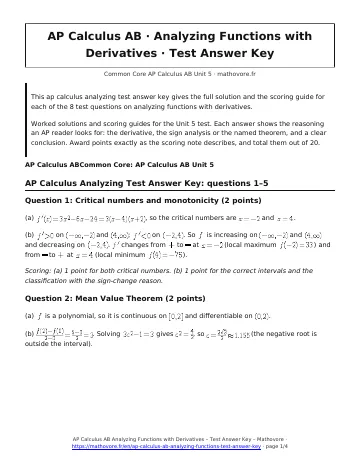
See every chapter on the AP Calculus AB math page.