



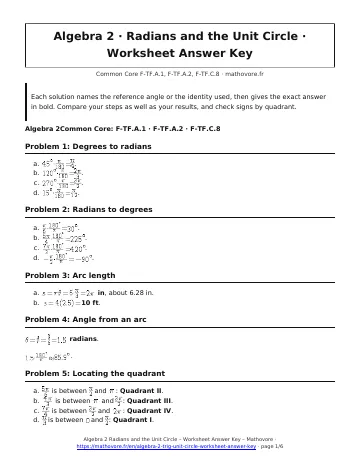
Each solution names the reference angle or the identity used, then gives the exact answer in bold. Compare your steps as well as your results, and check signs by quadrant.
Problem 1: Degrees to radians
- \(45^{\circ}\cdot\frac{\pi}{180}=\)\(\frac{\pi}{4}\).
- \(120^{\circ}\cdot\frac{\pi}{180}=\)\(\frac{2\pi}{3}\).
- \(270^{\circ}\cdot\frac{\pi}{180}=\)\(\frac{3\pi}{2}\).
- \(15^{\circ}\cdot\frac{\pi}{180}=\)\(\frac{\pi}{12}\).
Problem 2: Radians to degrees
- \(\frac{\pi}{6}\cdot\frac{180^{\circ}}{\pi}=\)\(30^{\circ}\).
- \(\frac{5\pi}{4}\cdot\frac{180^{\circ}}{\pi}=\)\(225^{\circ}\).
- \(\frac{7\pi}{3}\cdot\frac{180^{\circ}}{\pi}=\)\(420^{\circ}\).
- \(-\frac{\pi}{2}\cdot\frac{180^{\circ}}{\pi}=\)\(-90^{\circ}\).
Problem 3: Arc length
- \(s=r\theta=6\cdot\frac{\pi}{3}=\)\(2\pi\) in, about 6.28 in.
- \(s=4(2.5)=\)10 ft.
Problem 4: Angle from an arc
\(\theta=\frac{s}{r}=\frac{9}{6}=\)\(1.5\) radians.
\(1.5\cdot\frac{180^{\circ}}{\pi}\approx \)\(85.9^{\circ}\).
Problem 5: Locating the quadrant
- \(\frac{5\pi}{6}\) is between \(\frac{\pi}{2}\) and \(\pi\): Quadrant II.
- \(\frac{4\pi}{3}\) is between \(\pi\) and \(\frac{3\pi}{2}\): Quadrant III.
- \(\frac{7\pi}{4}\) is between \(\frac{3\pi}{2}\) and \(2\pi\): Quadrant IV.
- \(\frac{\pi}{3}\) is between \(0\) and \(\frac{\pi}{2}\): Quadrant I.
Problem 6: Special angle values
- \(\sin\frac{\pi}{6}=\)\(\frac{1}{2}\)
- \(\cos\frac{\pi}{4}=\)\(\frac{\sqrt{2}}{2}\)
- \(\tan\frac{\pi}{3}=\frac{\sqrt{3}/2}{1/2}=\)\(\sqrt{3}\)
- \(\cos\frac{\pi}{3}=\)\(\frac{1}{2}\)
Problem 7: Unit circle coordinates
- Reference angle \(\frac{\pi}{3}\) in Quadrant II (x negative, y positive): \((-\frac{1}{2},\ \frac{\sqrt{3}}{2})\).
- Reference angle \(\frac{\pi}{4}\) in Quadrant III (both negative): \((-\frac{\sqrt{2}}{2},\ -\frac{\sqrt{2}}{2})\).
- Reference angle \(\frac{\pi}{6}\) in Quadrant IV (x positive, y negative): \((\frac{\sqrt{3}}{2},\ -\frac{1}{2})\).
Problem 8: Reference angles
- \(\frac{5\pi}{6}\) is in Quadrant II: \(\pi-\frac{5\pi}{6}\) \(=\) \(\frac{\pi}{6}\).
- \(\frac{7\pi}{6}\) is in Quadrant III: \(\frac{7\pi}{6}-\pi\) \(=\) \(\frac{\pi}{6}\).
- \(\frac{5\pi}{3}\) is in Quadrant IV: \(2\pi-\frac{5\pi}{3}\) \(=\) \(\frac{\pi}{3}\).
- \(\frac{3\pi}{4}\) is in Quadrant II: \(\pi-\frac{3\pi}{4}\) \(=\) \(\frac{\pi}{4}\).
Problem 9: Quadrantal angles
| \(\theta\) | \(\sin\theta\) | \(\cos\theta\) | \(\tan\theta\) |
|---|---|---|---|
| \(0\) | \(0\) | \(1\) | \(0\) |
| \(\frac{\pi}{2}\) | \(1\) | \(0\) | undefined |
| \(\pi\) | \(0\) | \(-1\) | \(0\) |
| \(\frac{3\pi}{2}\) | \(-1\) | \(0\) | undefined |
The points are \((1,0)\), \((0,1)\), \((-1,0)\), \((0,-1)\). Tangent is \(\frac{y}{x}\), so it is undefined when \(x=0\).
Problem 10: Evaluating in other quadrants
- \(\sin\frac{7\pi}{6}\): Quadrant III, reference \(\frac{\pi}{6}\), sine negative: \(-\frac{1}{2}\).
- \(\cos\frac{5\pi}{3}\): Quadrant IV, reference \(\frac{\pi}{3}\), cosine positive: \(\frac{1}{2}\).
- \(\tan\frac{3\pi}{4}\): Quadrant II, reference \(\frac{\pi}{4}\), tangent negative: \(-1\).
Problem 11: Negative and large angles
- \(-\frac{\pi}{3}\) ends in Quadrant IV with reference \(\frac{\pi}{3}\): \(\frac{1}{2}\).
- \(-\frac{\pi}{4}\) ends in Quadrant IV: \(-\frac{\sqrt{2}}{2}\).
- \(\frac{13\pi}{6}=2\pi+\frac{\pi}{6}\), so it matches \(\frac{\pi}{6}\): \(\frac{1}{2}\).
- \(\frac{9\pi}{4}=2\pi+\frac{\pi}{4}\), so it matches \(\frac{\pi}{4}\): \(\frac{\sqrt{2}}{2}\).
Problem 12: Solving for the angle
- Reference angle \(\frac{\pi}{3}\). Sine is positive in Quadrants I and II: \(\theta=\frac{\pi}{3},\ \frac{2\pi}{3}\).
- Reference angle \(\frac{\pi}{4}\). Cosine is negative in Quadrants II and III: \(\theta=\frac{3\pi}{4},\ \frac{5\pi}{4}\).
Problem 13: Checking the identity
- \((\frac{1}{2})^{2}+(\frac{\sqrt{3}}{2})^{2}=\frac{1}{4}+\frac{3}{4}=\)\(1\).
- \((-\frac{\sqrt{2}}{2})^{2}+(-\frac{\sqrt{2}}{2})^{2}=\frac{2}{4}+\frac{2}{4}=\)\(1\).
Problem 14: Cosine from sine
\(\cos^{2}\theta=1-\frac{9}{25}=\frac{16}{25}\). Quadrant II has negative cosine: \(\cos\theta=-\frac{4}{5}\).
\(\tan\theta=\frac{3/5}{-4/5}=\)\(-\frac{3}{4}\).
Problem 15: Sine from cosine
\(\sin^{2}\theta=1-\frac{25}{169}=\frac{144}{169}\). Sine is negative in Quadrant IV: \(\sin\theta=-\frac{12}{13}\).
\(\tan\theta=\frac{-12/13}{5/13}=\)\(-\frac{12}{5}\).
Problem 16: Using the tangent
Write \(\sin\theta=\frac{4}{3}\cos\theta\) and substitute: \(\frac{16}{9}\cos^{2}\theta+\cos^{2}\theta=1\), so \(\frac{25}{9}\cos^{2}\theta=1\) and \(\cos^{2}\theta=\frac{9}{25}\).
Both are negative in Quadrant III: \(\cos\theta=-\frac{3}{5}\), then \(\sin\theta=\frac{4}{3}(-\frac{3}{5})=-\frac{4}{5}\).
Problem 17: Radical values
\(\sin^{2}\theta=1-\frac{5}{9}=\frac{4}{9}\). Sine is negative in Quadrant III: \(\sin\theta=-\frac{2}{3}\).
\(\tan\theta=\frac{-2/3}{-\sqrt{5}/3}=\frac{2}{\sqrt{5}}=\)\(\frac{2\sqrt{5}}{5}\).
Problem 18: Ferris wheel height
- \(30+25\cdot\frac{1}{2}=\)42.5 ft.
- \(30+25(1)=\)55 ft.
- \(30+25(-\frac{\sqrt{2}}{2})=30-12.5\sqrt{2}\approx \)12.3 ft.
- \(30+25(-1)=\)5 ft.
Problem 19: Clock hand
- \(\frac{1}{3}\cdot 2\pi=\)\(\frac{2\pi}{3}\) radians.
- \(s=r\theta=5\cdot\frac{2\pi}{3}=\)\(\frac{10\pi}{3}\) in, about 10.47 in.
Problem 20: Pizza slice
- \(\frac{\pi}{4}\) radians.
- \(s=8\cdot\frac{\pi}{4}=2\pi\approx \)6.28 in.
Problem 21: Bicycle wheel
- \(3\cdot 2\pi=\)\(6\pi\) radians.
- \(s=13\cdot 6\pi=78\pi\approx \)245.04 in\(,\ \frac{245.04}{12}\approx \)20.42 ft.
Problem 22: Point on the circle
\(x^{2}+y^{2}=1\) gives \(y^{2}=1-\frac{144}{169}=\frac{25}{169}\). In Quadrant III \(y=-\frac{5}{13}\).
\(\sin\theta=-\frac{5}{13}\), \(\cos\theta=-\frac{12}{13}\), \(\tan\theta=\frac{-5/13}{-12/13}=\)\(\frac{5}{12}\).
Problem 23: When is the rider low
\(30+25\sin\theta=17.5\) gives \(25\sin\theta=-12.5\), so \(\sin\theta=-\frac{1}{2}\).
Reference angle \(\frac{\pi}{6}\); sine is negative in Quadrants III and IV: \(\theta=\frac{7\pi}{6},\ \frac{11\pi}{6}\).
See every chapter on the Algebra 2 math page.