
Key takeaway: This algebra 2 radicals worksheet answer key lists the result and the check for each of the 26 problems. Every equation answer is substituted back into the original, so you can see which candidates are extraneous. Compare your simplest forms too, since \(\frac{\sqrt{10}}{2}\) and \(\frac{5}{\sqrt{10}}\) are equal but only one is rationalized.
Each solution shows the rewrite, the simplification and the check, with the final answer in bold. When you solve a radical equation, substitute every candidate into the original equation before you accept it.
Algebra 2 Radicals Worksheet Answer Key: problems 1–5
1. Evaluate nth roots
- \(13^{2}=169\), so \(13\).
- \((-4)^{3}=-64\), so \(-4\).
- \(2^{4}=16\), so \(2\).
- \((-2)^{5}=-32\), so \(-2\).
2. Real or not real
- An even root of a negative number: not a real number.
- \((-7)^{3}=-343\), so \(-7\).
- Even index, negative radicand: not a real number.
- \((-1)^{5}=-1\), so \(-1\).
3. Radical to exponent form
- \(x^{1/3}\)
- The index \(5\) is the denominator: \(y^{2/5}\).
- \(z^{3/4}\)
- \(7^{3/2}\)
4. Exponent to radical form
- \(\sqrt{5}\)
- \(\sqrt[3]{x^{2}}\)
- \(\sqrt[4]{(3a)^{3}}\)
- Only \(m\) carries the exponent, so the factor \(2\) stays outside: \(2\sqrt[3]{m}\).
5. Evaluate rational exponents
- \(\sqrt{25}=\) \(5\).
- \(\sqrt[3]{64}=\) \(4\).
- \((\sqrt[4]{16})^{3}=2^{3}=\) \(8\).
- \((\sqrt[3]{8})^{2}=2^{2}=\) \(4\).
- \((\sqrt[5]{32})^{3}=2^{3}=\) \(8\).
Algebra 2 Radicals Worksheet Answer Key: problems 6–10
6. Negative rational exponents
- \(\frac{1}{9^{1/2}}=\frac{1}{3}\). \(\frac{1}{3}\)
- \(27^{2/3}=3^{2}=9\), so \(\frac{1}{9}\).
- \(16^{3/4}=2^{3}=8\), so \(\frac{1}{8}\).
- Flip the base: \(4^{3/2}=(\sqrt{4})^{3}=2^{3}=\) \(8\).
7. Simplify square roots
- \(\sqrt{16\cdot 3}=4\sqrt{3}\). \(4\sqrt{3}\)
- \(\sqrt{9\cdot 10}=\) \(3\sqrt{10}\).
- \(\sqrt{100\cdot 2}=\) \(10\sqrt{2}\).
- \(\sqrt{25\cdot 3}=\) \(5\sqrt{3}\).
8. Simplify higher roots
- \(\sqrt[3]{8\cdot 3}=\) \(2\sqrt[3]{3}\).
- \(\sqrt[3]{125\cdot 2}=\) \(5\sqrt[3]{2}\).
- \(\sqrt[3]{-27\cdot 2}=\) \(-3\sqrt[3]{2}\).
- \(\sqrt[4]{16\cdot 3}=\) \(2\sqrt[4]{3}\).
9. Radicals with variables
- \(\sqrt{9x^{4}\cdot 2x}=\) \(3x^{2}\sqrt{2x}\).
- \(\sqrt[3]{8y^{6}\cdot 2y}=\) \(2y^{2}\sqrt[3]{2y}\).
- \(\sqrt{25a^{2}b^{4}\cdot 2a}=\) \(5ab^{2}\sqrt{2a}\).
- \(\sqrt[3]{27m^{3}n^{9}\cdot 2m^{2}}=\) \(3mn^{3}\sqrt[3]{2m^{2}}\).
10. Multiply radicals
- \(\sqrt{60}=\sqrt{4\cdot 15}=\) \(2\sqrt{15}\).
- \(\sqrt[3]{24}=\) \(2\sqrt[3]{3}\).
- \(15\sqrt{28}=15\cdot 2\sqrt{7}=\) \(30\sqrt{7}\).
- \(2\sqrt{18}=2\cdot 3\sqrt{2}=\) \(6\sqrt{2}\).
Algebra 2 Radicals Worksheet Answer Key: problems 11–15
11. Add and subtract radicals
- \(6\sqrt{3}+3\sqrt{3}=\) \(9\sqrt{3}\).
- \(10\sqrt{2}-6\sqrt{2}=\) \(4\sqrt{2}\).
- \(2\sqrt[3]{2}+3\sqrt[3]{2}=\) \(5\sqrt[3]{2}\).
- \(2\sqrt{5}-3\sqrt{5}+\sqrt{5}=\) \(0\).
12. Rationalize denominators
- \(\frac{6\sqrt{3}}{3}=\) \(2\sqrt{3}\).
- \(\frac{5\sqrt{10}}{10}=\) \(\frac{\sqrt{10}}{2}\).
- Multiply by \(\frac{\sqrt{7}+\sqrt{3}}{\sqrt{7}+\sqrt{3}}\): the denominator becomes \(7-3=4\), so the result is \(\sqrt{7}+\sqrt{3}\).
- Multiply by \(\frac{\sqrt[3]{4}}{\sqrt[3]{4}}\): \(\frac{3\sqrt[3]{4}}{\sqrt[3]{8}}=\) \(\frac{3\sqrt[3]{4}}{2}\).
13. Exponent properties
- \(\frac{1}{2}+\frac{1}{3}=\frac{5}{6}\): \(x^{5/6}\).
- \(\frac{2}{3}\cdot\frac{3}{4}=\frac{1}{2}\): \(y^{1/2}\).
- \(\frac{5}{4}-\frac{1}{4}=1\): \(x\).
- \(8^{2/3}a^{2}=\) \(4a^{2}\).
14. Change the index
- \(x^{4/6}=x^{2/3}=\) \(\sqrt[3]{x^{2}}\).
- \(9^{1/4}=(3^{2})^{1/4}=3^{1/2}=\) \(\sqrt{3}\).
- \(64^{1/6}=\) \(2\), since \(2^{6}=64\).
- \(x^{12/3}=x^{4}\), then \((x^{4})^{1/2}=\) \(x^{2}\).
15. One-step radical equations
- Square both sides: \(x=49\).
- Cube both sides: \(x=-27\).
- \(x-4=25\), so \(x=29\). Check: \(\sqrt{25}=5\).
- \(2x+1=81\), so \(x=40\). Check: \(\sqrt{81}=9\).
Algebra 2 Radicals Worksheet Answer Key: problems 16–20
16. Check for extraneous solutions
Square both sides: \(3x+4=x^{2}\), so \(x^{2}-3x-4=0\) and \((x-4)(x+1)=0\). The candidates are \(x=4\) and \(x=-1\).
Check \(x=4\): \(\sqrt{16}=4\), true. Check \(x=-1\): \(\sqrt{1}=1\), but \(x=-1\), false. The solution is \(x=4\); \(x=-1\) is extraneous.
17. Radical on the right
Square both sides: \(x^{2}-4x+4=x+4\), so \(x^{2}-5x=0\) and \(x(x-5)=0\). The candidates are \(x=0\) and \(x=5\).
Check \(x=0\): \(0-2=-2\), but \(\sqrt{4}=2\), false. Check \(x=5\): \(5-2=3\) and \(\sqrt{9}=3\), true. The solution is \(x=5\); \(x=0\) is extraneous.
18. Isolate the radical first
- \(\sqrt{x+5}=7\), so \(x+5=49\) and \(x=44\).
- \(2\sqrt{x-1}=8\), \(\sqrt{x-1}=4\), \(x-1=16\): \(x=17\).
- \(\sqrt[3]{2x-5}=3\), \(2x-5=27\), \(2x=32\): \(x=16\).
- \(\sqrt{x+7}=-2\). A principal square root is never negative: no solution.
19. Rational exponent equations
- Raise both sides to \(\frac{2}{3}\): \(x=27^{2/3}=9\). Check: \(9^{3/2}=27\). \(x=9\)
- The numerator is even, so there are two solutions: \(x=\pm 16^{3/2}=\pm 64\). Check: \(64^{2/3}=16\) and \((-64)^{2/3}=(-4)^{2}=16\). \(x=\pm 64\)
- Raise both sides to the fourth power: \(x=81\).
- \(x-1=\pm 4^{3/2}=\pm 8\), so \(x=9\) or \(x=-7\). Check: \(8^{2/3}=4\) and \((-8)^{2/3}=4\). \(x=9\) or \(x=-7\)
20. Equations with two radicals
- \(2x+3=x+7\), so \(x=4\). Check: both sides equal \(\sqrt{11}\).
Both curves reach \(\sqrt{11}\approx 3.32\) at \(x=4\). - \(x+4=3x-10\), so \(2x=14\) and \(x=7\). Check: both sides equal \(\sqrt[3]{11}\).
- \(5x-1=2x+8\), so \(3x=9\) and \(x=3\). Check: both sides equal \(\sqrt{14}\).
Algebra 2 Radicals Worksheet Answer Key: problems 21–25
21. Pendulum period
- \(T=2\pi\sqrt{\frac{8}{32}}=2\pi\cdot\frac{1}{2}=\pi\). \(\pi\approx 3.14\) seconds.
- \(\sqrt{\frac{L}{32}}=1\), so \(\frac{L}{32}=1\). \(L=32\) feet.
- \(\sqrt{\frac{L}{32}}=2\), so \(\frac{L}{32}=4\). \(L=128\) feet.
22. Free fall time
- \(t=\sqrt{\frac{144}{16}}=\sqrt{9}=\) \(3\) seconds.
- \(\frac{h}{16}=2.5^{2}=6.25\), so \(h=100\). \(100\) feet.
- \(t=\sqrt{25}=\) \(5\) seconds.
23. Skid marks
- \(s=\sqrt{30(0.75)(40)}=\sqrt{900}=\) \(30\) mph.
- \(45=\sqrt{30(0.6)d}\), so \(2025=18d\). \(d=112.5\) feet.
- \(s=\sqrt{720}=\sqrt{144\cdot 5}=12\sqrt{5}\). \(12\sqrt{5}\approx 26.83\) mph.
24. Distance to the horizon
- \(d=\sqrt{225}=\) \(15\) miles.
- \(441=1.5h\), so \(h=294\) feet.
- \(d=\sqrt{9}=\) \(3\) miles.
25. Cube-shaped box
- \(e=\sqrt[3]{250}=\sqrt[3]{125\cdot 2}=\) \(5\sqrt[3]{2}\) inches.
- \(5(1.2599)\approx\) \(6.30\) inches.
- \(e^{2}=(5\sqrt[3]{2})^{2}=25\sqrt[3]{4}\approx 25(1.5874)\). \(25\sqrt[3]{4}\approx 39.69\text{ in}^{2}\).
Algebra 2 Radicals Worksheet Answer Key: problems 26–26
26. Bike value
- \(V=900(0.64)^{1/2}=900(0.8)=\) \(\$720\).
- \(0.64^{3/2}=0.8^{3}=0.512\), so \(\$460.80\).
- \((0.64)^{t/2}=\frac{576}{900}=0.64\), so \(\frac{t}{2}=1\). \(t=2\) years.
- \(0.64^{5/2}=0.8^{5}=0.32768\), so \(V=\$294.912\). \(\$294.91\)
What are the answers for roots and exponents?
Problem 5 gives 5, 4, 8, 4 and 8. For problem 6, the values are \(\frac{1}{3}\), \(\frac{1}{9}\), \(\frac{1}{8}\) and 8. Problem 7 gives \(\sqrt{48}=4\sqrt{3}\). Problem 8 gives \(2\sqrt[3]{3}\), \(5\sqrt[3]{2}\), \(-3\sqrt[3]{2}\) and \(2\sqrt[4]{3}\). Likewise, problem 13 yields \(x^{5/6}\) and \(y^{1/2}\).
Which combining and rationalizing answers matter?
In problem 11, \(3\sqrt{12}+\sqrt{27}=9\sqrt{3}\) and \(5\sqrt{8}-2\sqrt{18}=4\sqrt{2}\). Rationalizing gives \(\frac{6}{\sqrt{3}}=2\sqrt{3}\). The change-of-index problem gives \(x^{2/3}\), \(\sqrt{3}\) and 2.
How do the equation answers check out?
For \(\sqrt{3x+4}=x\), the solution is 4, and \(-1\) is extraneous. For \(x-2=\sqrt{x+4}\), the solution is 5, and 0 is extraneous. In problem 18, \(\sqrt{x+5}-3=4\) gives 44, and \(2\sqrt{x-1}+3=11\) gives 17. Problem 19 gives \(x=9\), \(x=64\) and \(x=81\) for the first three parts. For two radicals, \(\sqrt{2x+3}=\sqrt{x+7}\) gives 4 and the cube-root version gives 7. Finally, the bike value after one year is \(900(0.64)^{1/2}=720\) dollars.
How can you learn from your errors?
Sort each miss into one of three bins: conversion, simplifying or solving. If most fall in solving, practice isolating the radical before you square. Then redo the five problems with the check step written out in full.

Printable PDF · Worksheet Answer Key
Algebra 2 Radicals and Rational Exponents worksheet answer key
Download the PDF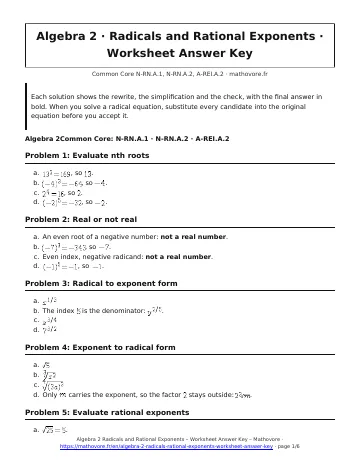
See every chapter on the Algebra 2 math page.