



Each solution is followed by a scoring guide. Table values are rounded to four decimals, so answers that differ in the last digit because of a calculator are acceptable. Award partial credit as described and add the points to a total out of 20.
Question 1: Mean and standard deviation (2 points)
- The sum is \(35\), so \(\overline{x}=\frac{35}{5}=7\) hours.
- Squared deviations: \(9,1,1,1,16\), sum \(28\). \(\sigma=\sqrt{\frac{28}{5}}=\sqrt{5.6}\approx 2.4\) hours.
Scoring: 1 point for the mean 7; 1 point for \(\sigma\approx 2.4\) (accept 0.5 point if the sum of squares 28 is correct but the division or root is wrong).
Question 2: Light bulb lifetimes (2 points)
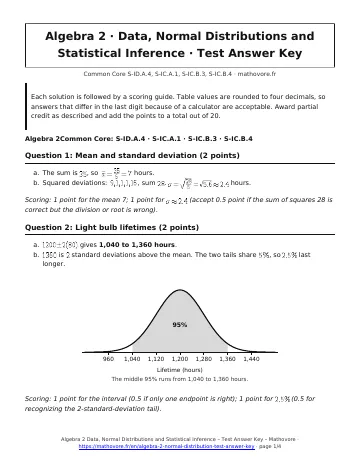
- \(1200\pm 2(80)\) gives 1,040 to 1,360 hours.
- \(1360\) is \(2\) standard deviations above the mean. The two tails share \(5\%\), so \(2.5\%\) last longer.
Scoring: 1 point for the interval (0.5 if only one endpoint is right); 1 point for \(2.5\%\) (0.5 for recognizing the 2-standard-deviation tail).
Question 3: Compare z-scores (2 points)
- \(z_{\text{alg}}=\frac{88-80}{4}=2\) and \(z_{\text{hist}}=\frac{90-82}{8}=1\).
- Algebra: \(2\) standard deviations above the mean is farther above average than \(1\).
Scoring: 1 point for both z-scores (0.5 each); 1 point for the correct subject with a reason based on the z-scores.
Question 4: Apple weights (2 points)
- \(z=\frac{7.6-7.0}{0.5}=1.2\).
- The area to the left of \(1.2\) is 0.8849, about \(88.5\%\) of apples.
Scoring: 1 point for \(z=1.2\); 1 point for 0.8849 (accept 0.885 or \(88.5\%\)).
Question 5: Puzzle times (2 points)
- \(z=\frac{16.4-20}{4}=-0.9\) and \(z=\frac{25.2-20}{4}=1.3\).
- Left areas: \(0.9032\) and \(0.1841\). Subtract: \(0.9032-0.1841=0.7191\). Answer: 0.7191.
Scoring: 1 point for both z-scores; 1 point for the area (accept 0.719; award 0.5 if the left areas are right but the subtraction is wrong).
Question 6: Identify the study (2 points)
- Experiment: the researchers assign the treatments.
- Random assignment makes the two groups similar in age, diet and other factors, so a difference in results can be attributed to the pill rather than to those factors.
Scoring: 1 point for experiment; 1 point for an explanation that mentions comparable groups or balancing other factors.
Question 7: Sampling plan (2 points)
- Students who arrive by car may live farther away or differ in other ways, so some students had no chance to be chosen and their opinions may be unlike the rest.
- List all students as \(1\) to \(1200\), use a random number generator to pick \(60\) different numbers, and survey those students.
Scoring: 1 point for a valid source of bias; 1 point for a method in which every student has an equal chance to be chosen.
Question 8: Margin of error (3 points)
- \(45\%\) to \(64\%\) (5 samples lie below \(45\%\) and 5 above \(64\%\)).
- \(\frac{64-45}{2}=9.5\), so the margin of error is about 9.5 percentage points.
- \(62\%\pm 9.5\%\) gives \(52.5\%\) to \(71.5\%\). Since \(50\%\) is below \(52.5\%\), it is not plausible.
Scoring: 1 point for the interval from the counts; 1 point for the half-width 9.5; 1 point for the interval 52.5% to 71.5% with the correct conclusion.
Question 9: Delivery times (3 points)
- \(z=\frac{38-28}{5}=2\).
- About \(95\%\) lie within \(2\) standard deviations, so \(5\%\) lie outside, half of it above: \(2.5\%\).
- \(0.025\times 600=15\). About 15 deliveries.
Scoring: 1 point for each part; part (c) may follow from a wrong part (b) answer if the multiplication is correct.
20 points
See every chapter on the Algebra 2 math page.