Key takeaway: Check your work against this algebra 1 polynomials worksheet answer key after you finish all 23 problems. Each result is written in standard form, and the middle steps show where like terms were combined or where each term was distributed.
Several entries add a number check, so you can see how a quick substitution exposes a lost sign. Compare steps first, then final lines.
Every solution below shows the steps: the combined like terms, the four FOIL products and the checks. Compare each step with your own work, not only the final answer in bold.
Algebra 1 Polynomials Worksheet Answer Key: problems 1–5
1. Degree and terms
The largest exponent is 3, so the degree is 3. The term \(4x^{3}\) has the largest exponent, so the leading coefficient is 4. There are 3 terms, so it is a trinomial.
2. Standard form
Order the terms from the highest power to the lowest, keeping each sign with its term: \(x^{3}\), \(-2x^{2}\), \(6x\), \(5\).
\(x^{3} – 2 x^{2} + 6 x + 5\)
3. Classify polynomials
- One term, degree 2: a monomial of degree 2.
- Two terms, degree 2: a binomial of degree 2.
- Three terms, degree 3: a trinomial of degree 3.
4. Add polynomials
Combine like terms column by column: \(3x^{2}+2x^{2}=5x^{2}\), \(5x-8x=-3x\), \(-4+9=5\).
\(5 x^{2} – 3 x + 5\)
5. Subtract polynomials
Distribute the negative sign: \(7x^{2}-3x+1-4x^{2}-2x+6\).
Combine like terms: \((7-4)x^{2}+(-3-2)x+(1+6)\).
\(3 x^{2} – 5 x + 7\)
Algebra 1 Polynomials Worksheet Answer Key: problems 6–10
6. Two variables
Match like terms: \(x^{2}+5x^{2}=6x^{2}\), \(4xy-2xy=2xy\), \(-3y^{2}+y^{2}=-2y^{2}\).
\(6 x^{2} + 2 x y – 2 y^{2}\)
7. Subtract with a missing term
Distribute the negative: \(6a^{3}-2a+5-a^{3}-4a^{2}+2a+3\).
The \(a\) terms cancel: \(-2a+2a=0\). The constants give \(5+3=8\).
\(5 a^{3} – 4 a^{2} + 8\)
8. Multiply monomials
Multiply the coefficients: \(3\cdot(-4)=-12\). Add the exponents: \(x^{2}\cdot x^{5}=x^{7}\).
\(- 12 x^{7}\)
9. Distribute a monomial
\(5x\cdot 2x^{2}=10x^{3}\), \(5x\cdot(-3x)=-15x^{2}\), \(5x\cdot 4=20x\).
\(10 x^{3} – 15 x^{2} + 20 x\)
10. Box method
The cells are \(x\cdot x=x^{2}\), \(4x\), \(3x\) and \(12\). Combine \(4x+3x=7x\).
\(x^{2} + 7 x + 12\)
Algebra 1 Polynomials Worksheet Answer Key: problems 11–15
11. FOIL with a negative
First: \(2 x^{2}\). Outer: \(12 x\). Inner: \(- 5 x\). Last: \(-30\).
Add: \(2 x^{2} + 12 x – 5 x – 30\), so \(12x-5x=7x\).
\(2 x^{2} + 7 x – 30\)
12. FOIL, both negative
First: \(12 x^{2}\). Outer: \(- 21 x\). Inner: \(- 8 x\). Last: \(14\).
Combine \(-21x-8x=-29x\).
\(12 x^{2} – 29 x + 14\)
13. Square of a binomial
Use \((a+b)^{2}=a^{2}+2ab+b^{2}\) with \(a=x\) and \(b=7\): \(x^{2}+2(x)(7)+7^{2}\).
\(x^{2} + 14 x + 49\)
14. Square of a difference
Use \((a-b)^{2}=a^{2}-2ab+b^{2}\) with \(a=3x\) and \(b=5\): \((3x)^{2}-2(3x)(5)+5^{2}\).
\(9 x^{2} – 30 x + 25\)
15. Difference of squares
The middle terms cancel, so \((a+b)(a-b)=a^{2}-b^{2}\) with \(a=2x\) and \(b=9\).
\(4 x^{2} – 81\)
Algebra 1 Polynomials Worksheet Answer Key: problems 16–20
16. Binomial times trinomial
Distribute \(x\): \(x^{3}+2x^{2}-5x\). Distribute \(-3\): \(-3x^{2}-6x+15\).
Combine like terms: \(2x^{2}-3x^{2}=-x^{2}\) and \(-5x-6x=-11x\).
\(x^{3} – x^{2} – 11 x + 15\)
17. Closure
The \(x^{2}\) terms cancel: \(4x^{2}-4x^{2}=0\). The sum is \(3x+5\), with degree 1.
\(3 x + 5\) is still a polynomial, which agrees with closure under addition. Note that the sum can have a lower degree than either addend.
18. Garden area
Area = length times width: \((x+8)(x+5)=x^{2}+5x+8x+40\), so the area is \(x^{2} + 13 x + 40\) square feet.
For \(x=4\): \(16+52+40=108\). Check with the dimensions: \(12\times 9=108\).
108 square feet
19. Profit polynomial
\(P=(-x^{2}+50x)-(10x+120)=-x^{2}+50x-10x-120\), so \(- x^{2} + 40 x – 120\).
For \(x=10\): \(-100+400-120=180\). Check: revenue \(\$400\) minus cost \(\$220\) is \(\$180\).
\$180
20. Picture frame
Border = outer square minus photo: \((x+8)^{2}-(x+2)^{2}\).
\((x^{2}+16x+64)-(x^{2}+4x+4)=12x+60\).
For \(x=4\): \(12(4)+60=108\). Check: \(12^{2}-6^{2}=144-36=108\).
\(12 x + 60\); 108 square inches
Algebra 1 Polynomials Worksheet Answer Key: problems 21–23
21. Mental math
Write \(52=50+2\) and \(48=50-2\). Then \((50+2)(50-2)=50^{2}-2^{2}\) by the difference of squares pattern.
\(2500-4=2496\).
2,496
22. Metal sheet with a cutout
Remaining area = sheet minus square: \((3x+4)(x+2)-x^{2}\).
\((3x^{2}+6x+4x+8)-x^{2}=2x^{2}+10x+8\).
For \(x=3\): \(18+30+8=56\). Check: \(13\times 5-3^{2}=65-9=56\).
\(2 x^{2} + 10 x + 8\); 56 square inches
23. Find the error
At \(x=1\): the left side is \((1+5)^{2}=36\) but Noah’s right side is \(1+25=26\). They differ, so he is wrong.
He squared each term separately. Squaring means multiplying the binomial by itself, so the middle term \(2\cdot x\cdot 5=10x\) is missing.
\(x^{2} + 10 x + 25\)
How do you read the algebra 1 polynomials worksheet answer key?
Begin with the final line of each solution, then trace backward. For example, the first item has degree 3, leading coefficient 4 and three terms, so it is a cubic trinomial. The second item in standard form is \(x^{3}-2x^{2}+6x+5\). Item 4 gives \(5x^{2}-3x+5\), and item 5 gives \(3x^{2}-5x+7\).
Which results are easy to miss?
Next, item 6 gives \(6x^{2}+2xy-2y^{2}\). Then item 7 gives \(5a^{3}-4a^{2}+8\), since the subtraction flips every sign. Also, item 8 gives \(-12x^{7}\), because exponents add and coefficients multiply. Item 11 gives \(2x^{2}+7x-30\), whereas item 12 gives \(12x^{2}-29x+14\).
Squares and the difference of squares follow. Item 13 gives \(x^{2}+14x+49\), item 14 gives \(9x^{2}-30x+25\), and item 15 gives \(4x^{2}-81\). Finally, item 16 gives \(x^{3}-x^{2}-11x+15\).
What do the application answers say?
Maya’s garden has area \(x^{2}+13x+40\) square feet. Meanwhile, the profit polynomial is \(-x^{2}+40x-120\) dollars. The picture-frame border has area \(12x+60\) square inches. Priya’s mental math works because \(52\cdot 48=(50+2)(50-2)=2500-4=2496\). The metal sheet leaves \(2x^{2}+10x+8\) square inches.
In the error problem, \((x+5)^{2}=x^{2}+10x+25\), and a test at x equal to 1 gives 36, not 26.
How should you respond to a wrong answer?
Locate the first term that differs. Then decide whether the slip was a sign, an exponent or a missing product. Next, redo that step with parentheses. Also, test the corrected answer at x equal to 2. As a result, you confirm the repair. Afterward, write one reminder in your notes, such as flip every sign when subtracting.
Why do the checks matter in this key?
A number check catches errors that a re-read misses. For instance, if you expand \((3x-5)^{2}\) as \(9x^{2}+25\), then x equal to 2 gives 61 for your answer but 1 for the true square. Because the values differ, you know the middle term is missing. Similarly, a lost negative shows up when the totals disagree by an even number. Therefore, a quick substitution works like an alarm. Meanwhile, the checks also build number sense, since you see how polynomials behave for small inputs. As a result, formulas feel less like tricks and more like patterns.
How do you subtract polynomials without losing a sign?
Begin by wrapping the second polynomial in parentheses. Next, put a minus sign in front of the parentheses. Then distribute that minus sign, which flips every term. For example, subtracting \(a^{3}+4a^{2}-2a-3\) turns into adding \(-a^{3}-4a^{2}+2a+3\). Afterward, combine like terms one power at a time. Because the cubic terms give \(5a^{3}\), the quadratic terms give \(-4a^{2}\), and the constants give 8, the answer is clean. Also, the middle terms cancel, since \(-2a\) and \(+2a\) add to zero. Therefore, a missing power in the answer is not an error.
Similarly, line up the powers in columns when the problem is long. First, write each polynomial in standard form. Next, leave a blank for any absent power. Then add or subtract down each column. As a result, no term hides. Finally, scan the answer from the highest power to the lowest, so the standard form is easy to read.
How do you expand a binomial product step by step?
First, write the four products in a row. For \((3x-2)(4x-7)\), they are \(12x^{2}\), \(-21x\), \(-8x\) and \(14\). Next, combine the two middle terms to get \(-29x\). Then write the answer in standard form. Also, remember that two negatives multiply to a positive, so the last term is +14. Meanwhile, the box method shows the same products in a grid. Thus you can choose whichever picture helps you. Besides, FOIL works only for two binomials, so switch to distribution when a trinomial appears. For that reason, learn the distribution idea first, and treat FOIL as a shortcut.
Likewise, a perfect square needs the middle term twice. Because \((x+7)^{2}\) means \((x+7)(x+7)\), the cross products are \(7x\) and \(7x\). Therefore, the middle term is \(14x\). Finally, compare with the difference of squares, where the cross products cancel.
What patterns appear across the answers?
Every product has as many terms before simplifying as the product of the term counts. A binomial times a trinomial starts with six pieces. However, like terms often merge, so the final answer has fewer. Likewise, multiplying adds the degrees, and the first term of the answer is the product of the first terms. Thus you can predict the first term of an answer before you expand. For example, \((x-3)(x^{2}+2x-5)\) must begin with \(x^{3}\). Finally, use that prediction as a quick check.
What comes after you review the key?
Group your misses into sign errors, distribution errors and special-product errors. Then take the first problem of the biggest group and solve it again on a blank page. When that goes cleanly, attempt the test and keep a number check beside every expansion.

Printable PDF · Worksheet Answer Key
Algebra 1 Adding, Subtracting and Multiplying Polynomials worksheet answer key
Download the PDF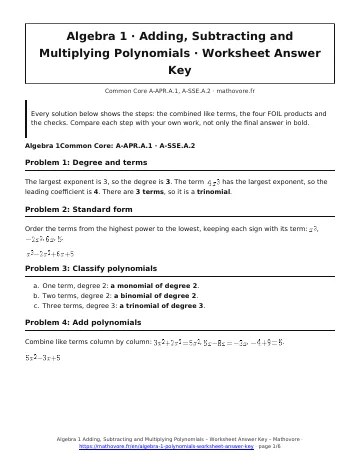
See every chapter on the Algebra 1 math page.