Key takeaway: Nine questions share 20 points on this algebra 1 polynomials test. It covers standard form, adding and subtracting, multiplying, special products, area models and two real situations about a garden and a bakery.
Show every distribution, because partial credit rewards correct steps. Write each final answer in standard form. A calculator is not needed, and the scoring guide sits on a separate page for teachers.
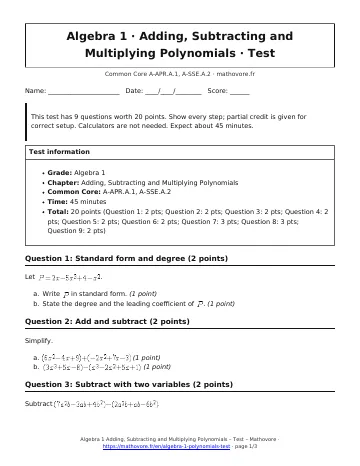
This test has 9 questions worth 20 points. Show every step; partial credit is given for correct setup. Calculators are not needed. Expect about 45 minutes.
- Grade: Algebra 1
- Chapter: Adding, Subtracting and Multiplying Polynomials
- Common Core: A-APR.A.1, A-SSE.A.2
- Time: 45 minutes
- Total: 20 points (Question 1: 2 pts; Question 2: 2 pts; Question 3: 2 pts; Question 4: 2 pts; Question 5: 2 pts; Question 6: 2 pts; Question 7: 3 pts; Question 8: 3 pts; Question 9: 2 pts)
Algebra 1 Polynomials Test: questions 1–5
1. Standard form and degree (2 points)
Let \(P=2x-5x^{3}+4-x^{2}\).
- Write \(P\) in standard form. (1 point)
- State the degree and the leading coefficient of \(P\). (1 point)
2. Add and subtract (2 points)
Simplify.
- \((6x^{2}-4x+9)+(-2x^{2}+7x-3)\) (1 point)
- \((3x^{3}+5x-8)-(x^{3}-2x^{2}+5x+1)\) (1 point)
3. Subtract with two variables (2 points)
Subtract \((7a^{2}b-3ab+4b^{2})-(2a^{2}b+ab-6b^{2})\).
4. Multiply polynomials (2 points)
Multiply.
- \(-4x(3x^{2}-2x+6)\) (1 point)
- \((x-6)(x^{2}+4x-2)\) (1 point)
5. Multiply two binomials (2 points)
Multiply \((3x+4)(x-5)\). Complete the area model first, then write the product in standard form.
Algebra 1 Polynomials Test: questions 6–9
6. Special products (2 points)
Expand.
- \((4x-3)^{2}\) (1 point)
- \((6x+5)(6x-5)\) (1 point)
7. Community garden (3 points)
A community garden is a rectangle that is \(2x+3\) feet long and \(x+5\) feet wide.
- Write a polynomial in standard form for the area. (1 point)
- Find the area when \(x=6\). (1 point)
- Write a polynomial in standard form for the perimeter. (1 point)
8. Bakery profit (3 points)
A bakery sells \(x\) boxes of muffins. Its revenue is \(R=-x^{2}+60x\) dollars and its cost is \(C=12x+150\) dollars. Profit is revenue minus cost.
- Write a simplified polynomial for the profit. (2 points)
- Find the profit when 10 boxes are sold. (1 point)
9. Explain the error (2 points)
Liam writes \((x+4)^{2}=x^{2}+16\).
- Show that his result is wrong by substituting \(x=1\). (1 point)
- Write the correct expansion. (1 point)

What does the algebra 1 polynomials test ask?
The first question rewrites \(2x-5x^{3}+4-x^{2}\) in standard form and names its degree and leading coefficient. Next, sums and differences appear, including one with two variables. Then you multiply a monomial by a trinomial, and a binomial by a trinomial.
After that, one question uses an area model for \((3x+4)(x-5)\), and another expands \((4x-3)^{2}\) and \((6x+5)(6x-5)\).
How are the last questions built?
A community garden is \(2x+3\) feet long and \(x+5\) feet wide, so you write and simplify its area. The bakery question gives revenue \(R=-x^{2}+60x\) and cost \(C=12x+150\), and you subtract to find profit. Finally, Liam claims that \((x+4)^{2}=x^{2}+16\), and you must prove him wrong with a number.
Therefore, practice substituting a value to test an identity.
What mistakes cost points?
Most lost points come from one of three slips. First, students forget to flip every sign in a subtraction. Next, they square a binomial by squaring each term only. Also, a few leave the answer unsimplified. As a result, always finish by combining like terms and ordering the powers.
How can you use your time well?
Scan the paper and start with the two-point questions. Then spend the saved minutes on the longer garden and bakery items. If a product looks long, draw a box. Meanwhile, keep thirty seconds per answer for a substitution check. Afterward, reread the error question, since it asks for a full explanation. Besides, write the substitution values clearly, because they count as evidence.
How should you prepare?
Expand three different products without looking at notes, then check each one at x equal to 2. Next, subtract two polynomials and circle every sign you flipped. After that, solve a profit problem of your own. Finally, rehearse a one-sentence explanation of why a binomial square has three terms.

See every chapter on the Algebra 1 math page.