Key takeaway: The algebra 1 linear inequalities test below gives you about 45 minutes to answer nine questions worth 20 points. It covers multi-step and compound inequalities, number lines, interval notation and models.
Show all work, because partial credit follows correct steps. Calculators are allowed for arithmetic. Teachers get a separate marking guide, hidden from students during the test.
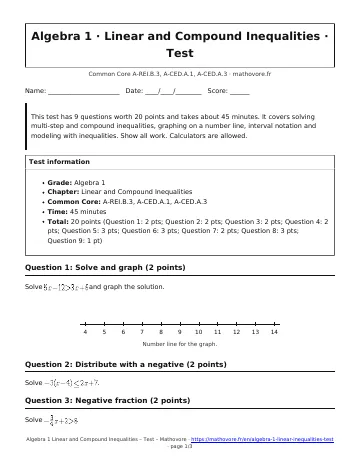
This test has 9 questions worth 20 points and takes about 45 minutes. It covers solving multi-step and compound inequalities, graphing on a number line, interval notation and modeling with inequalities. Show all work. Calculators are allowed.
- Grade: Algebra 1
- Chapter: Linear and Compound Inequalities
- Common Core: A-REI.B.3, A-CED.A.1, A-CED.A.3
- Time: 45 minutes
- Total: 20 points (Question 1: 2 pts; Question 2: 2 pts; Question 3: 2 pts; Question 4: 2 pts; Question 5: 3 pts; Question 6: 3 pts; Question 7: 2 pts; Question 8: 3 pts; Question 9: 1 pt)
Algebra 1 Linear Inequalities Test: questions 1–5
1. Solve and graph (2 points)
Solve \(5x-12>3x+6\) and graph the solution.
2. Distribute with a negative (2 points)
Solve \(-3(x-4)\le2x+7\).
3. Negative fraction (2 points)
Solve \(-\frac{3}{4}x+2>8\).
4. Read a compound graph (2 points)
Write the compound inequality shown by the graph and write it in interval notation.
5. Three-part inequality (3 points)
Solve \(-7\le3x-1< 11\) and graph the solution.
Algebra 1 Linear Inequalities Test: questions 6–9
6. Either-or inequality (3 points)
Solve \(3x+4\le-5\text{ or }2x-1>7\) and graph the solution.
7. Test a value (2 points)
Consider the inequality \(6-2x\ge10\).
- Determine whether \(x=-2\) is a solution. (1 point)
- Solve the inequality. (1 point)
8. County fair budget (3 points)
Jamal has \(\$40\) for the county fair. Entry costs \(\$12\) and each ride ticket costs \(\$2.50\).
- Write an inequality for the number of tickets \(t\). (1 point)
- Solve it. (1 point)
- State the greatest number of tickets he can buy. (1 point)
9. Special case (1 point)
Solve \(2(x+3)< 2x+4\) and describe the solution.

What does the algebra 1 linear inequalities test ask?
The opening questions solve and graph \(5x-12>3x+6\), then handle a negative in \(-3(x-4)\le 2x+7\) and a negative fraction in \(-\frac{3}{4}x+2>8\). Next, a graph question asks you to write the compound inequality and its interval notation.
Later items solve a three-part inequality and an either-or inequality, \(3x+4\le -5\) or \(2x-1>7\). Finally, one question tests whether \(x=-2\) satisfies \(6-2x\ge 10\).
How do the last questions work?
Jamal has $40 for the county fair. Entry costs $12 and each ride ticket costs $2.50, so you write \(12+2.50r\le 40\). Because rides come in whole numbers, the answer is 11. The final question is a special case, so decide whether the solution set is empty or all real numbers.
Therefore, practice translating words such as at most before test day.
Which mistakes lose points?
Forgetting the flip is the biggest one. Another is using a closed circle for a strict symbol. In addition, some students write an or answer as a single interval. For that reason, check each answer’s symbol, circle and shading against one another.
How can you pace yourself?
Start with the two-point questions, because they build momentum. Then move to the three-point compounds. When one step resists, jot down what is known and move forward. Meanwhile, keep two minutes for checks. For example, test a value in each solution. As a result, you will find slips before the paper leaves your desk. Besides, reread the story question once more, since rounding direction matters.
What is a good way to prepare?
Solve one inequality of each kind: one-step, negative divisor, compound with and, compound with or, and special case. Then graph each answer and write its interval. Afterward, rehearse the pace with three timed practice items.

See every chapter on the Algebra 1 math page.