Key takeaway: Use this algebra 1 linear worksheet answer key once you have tried all 22 inequality problems. Each solution shows every step, the graph or interval notation when requested, and a check. Whenever a problem divides by a negative number, notice the line where the sign reverses.
When your answer is different, trace the work back to the earliest line that departs from the printed solution, and redo it from that point. Then test a value.
Each solution shows every step, the graph or interval notation when requested, and a check. When a problem divides by a negative number, notice the line where the inequality sign reverses. If your answer differs, find the first line where your work and the key disagree.
Algebra 1 Linear Worksheet Answer Key: problems 1–5
1. One-step graph
Subtract 4: \(3x>15\). Divide by 3: \(x>5\). Interval notation: (5, ∞).
2. Closed circle
Add 7: \(5x\le35\). Divide by 5: \(x\le7\). Interval notation: (-∞, 7].
3. Divide by a negative
Subtract 9: \(-2x< 6\). Divide by \(-2\) and reverse the sign: \(x>-3\).
Check: \(x=0\) gives \(9< 15\), true.
4. Distribute and solve
Distribute: \(4x-12\ge2x+6\). Subtract \(2x\): \(2x-12\ge6\). Add 12: \(2x\ge18\). Divide by 2: \(x\ge9\).
5. Variables on both sides
Add \(3x\): \(7>5x-8\). Add 8: \(15>5x\). Divide by 5: \(3>x\), which is \(x< 3\).
Check: \(x=0\) gives \(7>-8\), true.
Algebra 1 Linear Worksheet Answer Key: problems 6–10
6. Fraction coefficient
Add 2: \(\frac{x}{3}\le6\). Multiply by 3: \(x\le18\).
7. Negative fraction
Multiply by \(-\frac{3}{2}\) and reverse the sign: \(x\le8\cdot(-\frac{3}{2})\), so \(x\le-12\).
Check: \(x=-12\) gives \(8\ge8\), true.
8. Negative outside parentheses
Distribute: \(-2x-8< 6\). Add 8: \(-2x< 14\). Divide by \(-2\) and reverse: \(x>-7\).
9. Fractions on both sides
Multiply by 6: \(3(x+1)\ge2(2x-1)\). Distribute: \(3x+3\ge4x-2\). Subtract \(3x\): \(3\ge x-2\). Add 2: \(5\ge x\), so \(x\le5\).
10. Decimal inequality
Subtract \(0.2x\): \(0.4x-1.5< 2.5\). Add 1.5: \(0.4x< 4\). Divide by 0.4: \(x< 10\).
Algebra 1 Linear Worksheet Answer Key: problems 11–15
11. All or none
- Distribute: \(3x+6>3x+1\). Subtract \(3x\): \(6>1\), always true: all real numbers.
- Subtract \(2x\): \(5<-1\), never true: no solution.
12. Read the graph
- \(x\ge-4\), interval [-4, ∞).
- \(x< 3\), interval (-∞, 3).
13. Compound with and
Subtract 1 from all three parts: \(-4< 2x\le8\). Divide by 2: \(-2< x\le4\). Interval notation: (-2, 4].
14. Compound with or
First part: \(2x<-4\), so \(x<-2\). Second part: \(3x\ge9\), so \(x\ge3\).
Solution: \(x<-2\text{ or }x\ge3\).
15. Three-part inequality
Add 2 to all parts: \(6\le3x< 15\). Divide by 3: \(2\le x< 5\). Interval notation: [2, 5).
Algebra 1 Linear Worksheet Answer Key: problems 16–20
16. Overlap of two conditions
First: \(x>-2\). Second: \(x\le5\). Both must hold, so the solution is \(-2< x\le5\).
17. School store budget
\(18.50+6.25t\le50\). Subtract 18.50: \(6.25t\le31.50\). Divide: \(t\le5.04\).
Diego can buy at most 5 T-shirts. Check: \(18.50+6.25(5)=49.75\), but 6 shirts cost \(\$56.00\).
18. Weekend job
\(12h-15\ge150\). Add 15: \(12h\ge165\). Divide: \(h\ge13.75\).
She must work at least 13.75 hours (13 hours 45 minutes). Check: \(12(13.75)-15=150\).
19. Elevator limit
\(180+35b\le1200\). Subtract 180: \(35b\le1020\). Divide: \(b\le29.14\).
At most 29 boxes. Check: \(180+35(29)=1195\), while 30 boxes give \(1230\).
20. Car rental
\(30+0.20m< 45\). Subtract 30: \(0.20m< 15\). Divide: \(m< 75\).
A is cheaper for fewer than 75 miles. At 75 miles both cost \(\$45\).
Algebra 1 Linear Worksheet Answer Key: problems 21–22
21. Test average
\(\frac{88+92+85+s}{4}\ge90\). Multiply by 4: \(265+s\ge360\). Subtract: \(s\ge95\).
With the maximum of 100: \(95\le s\le100\).
22. Saving up
\(100\le35+5w\le150\). Subtract 35: \(65\le5w\le115\). Divide by 5: \(13\le w\le23\).
From week 13 to week 23. Check: \(35+5(13)=100\) and \(35+5(23)=150\).
How does the algebra 1 linear worksheet answer key line up with your work?
Cover the printed steps and attempt each problem first. Afterward, reveal them one by one. Problem 1 gives \(x>5\) using an open circle, while problem 2 gives \(x\le 7\) with a closed circle. Problem 4 gives \(x\ge 9\), because \(4x-12\ge 2x+6\) leaves \(2x\ge 18\).
Which solutions deserve a second look?
For problem 5, the key collects variables on the right to avoid a negative divisor: \(15>5x\), so \(x<3\). Then problem 6 gives \(x\le 18\). Meanwhile, problem 7 gives \(x\le -12\), and the sign flips because you multiply by a negative reciprocal. Problem 9 gives \(x\le 5\), after multiplying by 6 and simplifying \(3x+3\ge 4x-2\).
Problem 11 gives all real numbers for \(3(x+2)>3x+1\), since \(6>1\) is true. In contrast, an inequality that ends in a false statement has no solution.
What do the compound and story answers look like?
In problem 16, the set is \(-2<x\le 5\), or \((-2,5]\) in interval notation. Problem 17 gives 5 shirts, because \(t\le 5.04\). Problem 18 gives at least 14 hours, and problem 19 gives at most 29 boxes. Mei’s problem 21 needs a fourth score of at least 95, since the total of 360 must be reached.
Therefore, check each story answer against the situation: a score above 100 would not be possible, and a fraction of a shirt would not make sense.
How can you turn a miss into practice?
Mark where your work left the key’s path. Then decide whether the slip involved a sign, a fraction or a graph. Next, write a twin problem with new numbers. Finally, solve it twice, once by the rules and once by testing values, so both methods agree.
Why does the key test values?
A test value proves the direction of the inequality. For instance, the solution \(x<3\) in problem 5 should accept 0 and reject 4. Because \(7-0>0-8\) holds, 0 works. In contrast, \(7-12>8-8\) fails, so 4 does not. Therefore, the key confirms the sign without trusting memory. Similarly, for a compound answer, test one value inside the overlap and one outside. As a result, both ends of the interval get checked. Besides, a test value reveals open or closed ends: plug in the endpoint itself. If it works, use a closed circle. Otherwise, use an open one.
What patterns do the answers share?
Most solutions follow the same arc. First, clear grouping and fractions. Next, collect variable terms. Then isolate the variable, flipping the sign when needed. After that, graph the set. Also, translate it into interval notation. Finally, state the meaning in the story. Because the arc repeats, you can build a personal checklist from it. Meanwhile, the special cases break the arc on purpose: the variable disappears, and the leftover statement decides everything.
What is the next step after the key?
Count how many misses involved the sign flip, how many involved fractions and how many involved graphs. Then rework from scratch the first problem of your biggest error group. When it goes smoothly, try the test and write the reversed symbol the moment you divide by a negative.

Printable PDF · Worksheet Answer Key
Algebra 1 Linear and Compound Inequalities worksheet answer key
Download the PDF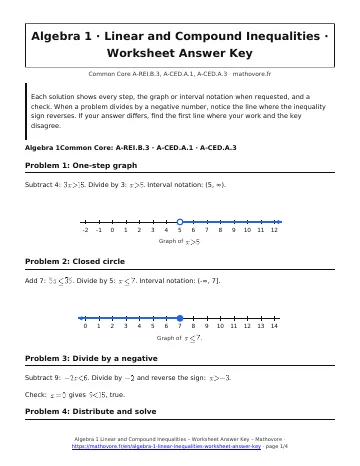
See every chapter on the Algebra 1 math page.