Key takeaway: This algebra 1 factoring worksheet gives you 24 printable problems, from \(6x^{2}+9x\) to a banner whose area is \(6x^{2}+13x+6\). The set covers the greatest common factor, trinomials, special patterns, grouping and zeros of quadratics.
The problems grow harder as you go, and the last six use patios, balls and consecutive integers. Check every answer by multiplying, because that single habit catches most sign errors. Solutions appear in a companion key. Work in pencil, because factoring invites erasing.
These 24 problems cover the factoring skills in Common Core A-SSE.A.2 and A-SSE.B.3a: the greatest common factor, trinomials, the difference of squares, perfect squares, grouping, and using factors to find zeros.
The problems begin with simple GCF and trinomial factoring and grow harder. The last six are word problems with areas, projectile height and number puzzles.
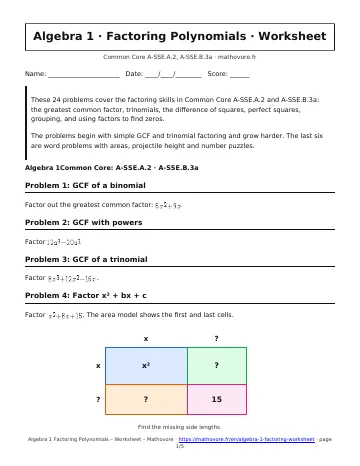
Algebra 1 Factoring Worksheet: problems 1–5
1. GCF of a binomial
Factor out the greatest common factor: \(6 x^{2} + 9 x\).
2. GCF with powers
Factor \(12 a^{3} – 20 a^{2}\).
3. GCF of a trinomial
Factor \(8 x^{3} + 12 x^{2} – 16 x\).
4. Factor x² + bx + c
Factor \(x^{2} + 8 x + 15\). The area model shows the first and last cells.
5. Both numbers negative
Factor \(x^{2} – 9 x + 20\).
Algebra 1 Factoring Worksheet: problems 6–10
6. Opposite signs
Factor \(x^{2} + 2 x – 35\).
7. Larger negative number
Factor \(x^{2} – 3 x – 28\).
8. Difference of squares
Factor \(x^{2} – 49\).
9. Difference of squares with a coefficient
Factor \(25 x^{2} – 16\).
10. Perfect square trinomial
Factor \(x^{2} + 12 x + 36\).
Algebra 1 Factoring Worksheet: problems 11–15
11. Perfect square with a coefficient
Factor \(4 x^{2} – 20 x + 25\).
12. Factor ax² + bx + c
Factor \(2 x^{2} + 7 x + 3\).
13. ax² + bx + c, negative middle
Factor \(3 x^{2} – 10 x + 8\).
14. ax² + bx + c, negative constant
Factor \(6 x^{2} + x – 15\).
15. Factor by grouping
Factor \(x^{3} + 4 x^{2} + 3 x + 12\) by grouping.
Algebra 1 Factoring Worksheet: problems 16–20
16. GCF then difference of squares
Factor \(2 x^{2} – 32\) completely.
17. GCF then perfect square
Factor \(3 x^{3} + 18 x^{2} + 27 x\) completely.
18. Zeros of a quadratic
Solve \(x^{2}-5x-14=0\) by factoring. The graph of \(y=x^{2}-5x-14\) is shown.
19. Zeros with a leading coefficient
Find the zeros of \(2x^{2}+x-6\).
20. Dimensions of a rectangle
The area of Sofia’s rectangular patio is \(x^{2}+9x+14\) square feet. Factor the area to find expressions for its length and width. If the width is 5 feet, find the length and the area.
Algebra 1 Factoring Worksheet: problems 21–24
21. When does the ball land?
Diego throws a ball upward from a platform. Its height in feet after \(t\) seconds is \(h=-16t^{2}+64t+80\). Factor the expression and find when the ball hits the ground (\(h=0\)).
22. Consecutive integers
The product of two consecutive positive integers is 156. Write an equation, solve it by factoring and find the integers.
23. Is it factored completely?
Mei factors \(4x^{2}-36\) as \((2x-6)(2x+6)\). Explain why this is not complete and write the complete factorization.
24. Banner dimensions
A banner for the Little League banquet has area \(6x^{2}+13x+6\) square inches. Find binomials for its length and width.

What is on this algebra 1 factoring worksheet?
Problems 1 to 3 pull out a GCF, such as \(12a^{3}-20a^{2}\). Next, problems 4 to 7 factor trinomials with a leading coefficient of 1, including \(x^{2}-3x-28\). Then problems 8 to 11 use squares, for instance \(x^{2}-49\) and \(4x^{2}-20x+25\).
After that, problems 12 to 14 handle \(ax^{2}+bx+c\), and problem 15 groups \(x^{3}+4x^{2}+3x+12\). Finally, problems 16 to 24 combine methods and solve real situations.
Which problems need extra care?
Problem 14, \(6x^{2}+x-15\), has many factor pairs of 90, so test them in an organized list. Problem 16 looks like a difference of squares, yet a 2 hides in front. Pull out the 2 first, or the factoring is incomplete. Problem 23 asks why \((2x-6)(2x+6)\) is not complete, because each factor still holds a 2.
Also, watch signs in problems 6 and 7. A negative constant means opposite signs in the two binomials.
How do the word problems use factoring?
Sofia’s patio has area \(x^{2}+9x+14\), so its sides are \(x+2\) and \(x+7\). Diego’s ball in problem 21 follows \(h=-16t^{2}+64t+80\), and the landing time is the positive zero. Meanwhile, problem 22 asks for two consecutive integers with product 156.
Therefore, write the equation first. Then bring all terms to one side, factor them and set each factor equal to zero.
What checking routine prevents mistakes?
First, multiply the outer terms. Next, multiply the inner terms. Then add them, because the middle term must match. Also, confirm the first and last terms. If any piece disagrees, swap the signs or try another pair. Afterward, ask whether another common factor remains. Finally, write the answer as a product, not a sum.
Where should you go after the worksheet?
Compare each factorization with the key, then multiply back any answer that differs. Mark misses as GCF, sign or pattern slips. Next, redo two problems of your most frequent type. Last, use the quiz as a speed check on the same methods.

See every chapter on the Algebra 1 math page.