


This ap calculus differential worksheet answer key solves all 24 problems of the differential equations worksheet step by step.
Every worked solution for the differential equations worksheet is below, with the constant of integration, the initial condition and the final answer in bold. Compare each step with your own work, not only the final result.
AP Calculus Differential Worksheet Answer Key: problems 1–5
Problem 1: Verify an exponential solution
Differentiate: \(\frac{dy}{dx}=3\cdot 2e^{2x}=6e^{2x}\).
Substitute: \(2y=2\cdot 3e^{2x}=6e^{2x}\).
Both sides equal \(6e^{2x}\), so \(y=3e^{2x}\) is a solution.
Problem 2: Verify a polynomial solution
\(\frac{dy}{dx}=2x\), which matches the equation.
Initial condition: \(y(1)=1^{2}+4=5\).
Both conditions hold.
Problem 3: Verify with a product of terms
\(\frac{dy}{dx}=-e^{-x}+2\).
\(2x-y=2x-(e^{-x}+2x-2)=-e^{-x}+2\).
The two sides agree, so the function is a solution.
Problem 4: Translate words into equations
- \(\frac{dP}{dt}=0.03P\)
- \(\frac{dV}{dt}=-k\sqrt{V}\), with \(k>0\) because \(V\) decreases.
- \(\frac{dT}{dt}=k(T-70)\)
(a) \(\frac{dP}{dt}=0.03P\); (b) \(\frac{dV}{dt}=-k\sqrt{V}\); (c) \(\frac{dT}{dt}=k(T-70)\).
Problem 5: Slopes at points
- \(0-0=0\)
- \(1-0=1\)
- \(2-2=0\)
- \(1-2(-1)=3\)
- \(-2-2(3)=-8\)
Slopes: \(0,\ 1,\ 0,\ 3,\ -8\).
AP Calculus Differential Worksheet Answer Key: problems 6–10
Problem 6: Match a slope field
Along each vertical column the segments are parallel, so the slope does not depend on \(y\). The slope is zero on the \(y\)-axis (\(x=0\)), negative for \(x<0\) and positive for \(x>0\).
Only \(\frac{dy}{dx}=x\) has these features.
\(\frac{dy}{dx}=x\)
Problem 7: Sketch and solve from a slope field
- The curve starts at \((0,1)\), rises more steeply as \(y\) grows, and flattens toward \(0\) as \(x\to-\infty\) (see figure).
- \(\frac{1}{y}\,dy=\frac{1}{2}\,dx\), so \(\ln|y|=\frac{x}{2}+C\) and \(y=Ae^{x/2}\). With \(y(0)=1\), \(A=1\).
\(y=e^{x/2}\)
Problem 8: Separable with a power
\(dy=4x^{3}\,dx\), so \(y=x^{4}+C\).
\(y(1)=1+C=3\), so \(C=2\).
\(y=x^{4}+2\)
Problem 9: Exponential initial value problem
\(\frac{1}{y}\,dy=3\,dx\), so \(\ln|y|=3x+C\) and \(y=Ae^{3x}\).
\(y(0)=A=5\).
\(y=5e^{3x}\)
Problem 10: Separable with a quotient
\(y\,dy=3x^{2}\,dx\), so \(\frac{y^{2}}{2}=x^{3}+C\), that is \(y^{2}=2x^{3}+2C\).
\(y(0)=2\) gives \(4=2C\), so \(y^{2}=2x^{3}+4\).
Since \(y(0)=2>0\), take the positive root.
\(y=\sqrt{2x^{3}+4}\)
AP Calculus Differential Worksheet Answer Key: problems 11–15
Problem 11: Separable with a product
\(\frac{1}{y}\,dy=x\,dx\), so \(\ln|y|=\frac{x^{2}}{2}+C\) and \(y=Ae^{x^{2}/2}\).
\(y(0)=A=3\).
\(y=3e^{x^{2}/2}\)
Problem 12: Solution with a restricted domain
\(y^{-2}\,dy=2x\,dx\), so \(-\frac{1}{y}=x^{2}+C\).
\(y(0)=1\): \(-1=C\), so \(-\frac{1}{y}=x^{2}-1\) and \(y=\frac{1}{1-x^{2}}\).
The denominator is zero at \(x=\pm 1\), so the interval is \(-1< x< 1\).
\(y=\frac{1}{1-x^{2}}\) on \((-1,1)\)
Problem 13: Separable with an exponential
\(y^{2}\,dy=e^{x}\,dx\), so \(\frac{y^{3}}{3}=e^{x}+C\).
\(y(0)=1\): \(\frac{1}{3}=1+C\), so \(C=-\frac{2}{3}\).
\(y^{3}=3e^{x}-2\).
\(y=(3e^{x}-2)^{1/3}\)
Problem 14: Exponential growth
\(P(t)=500e^{0.2t}\).
\(P(5)=500e^{1}\approx 500(2.71828)=1359.14\).
\(P(t)=500e^{0.2t}\); \(P(5)\approx 1359\) cells
Problem 15: Exponential decay and time
\(m=80e^{-0.05t}\).
Set \(80e^{-0.05t}=40\): \(e^{-0.05t}=\frac{1}{2}\), so \(-0.05t=-\ln 2\).
\(t=\frac{\ln 2}{0.05}\approx 13.86\).
About 13.86 years
AP Calculus Differential Worksheet Answer Key: problems 16–20
Problem 16: Half-life
- \(m=200e^{kt}\) and \(m(12)=100\): \(e^{12k}=\frac{1}{2}\), so \(k=-\frac{\ln 2}{12}\approx -0.0578\).
- \(m(30)=200e^{-0.0577623\cdot 30}=200\cdot 2^{-2.5}\approx 35.36\) mg.
(a) \(k\approx -0.0578\); (b) about 35.36 mg
Problem 17: Doubling time
\(P=1000\cdot 2^{t/8}\).
\(P(20)=1000\cdot 2^{2.5}\approx 1000(5.65685)\approx 5657\).
About 5,657 insects
Problem 18: Continuous compounding
\(A=2000e^{0.05t}\).
\(A(10)=2000e^{0.5}\approx 2000(1.648721)=3297.44\).
\$3,297.44
Problem 19: Newton cooling
Let \(u=T-70\). Then \(\frac{du}{dt}=-0.1u\), so \(u=u_{0}e^{-0.1t}\) with \(u_{0}=190-70=120\).
\(T(t)=70+120e^{-0.1t}\).
\(T(10)=70+120e^{-1}\approx 70+44.15=114.1\) (rounded to the nearest tenth).
\(T=70+120e^{-0.1t}\); \(T(10)\approx 114.1^{\circ}\text{F}\)
Problem 20: Tangent line and concavity
- Slope at \((0,1)\): \(0+1=1\). Tangent line: \(y=1+x\). Then \(f(0.2)\approx 1.2\).
- \(\frac{d^{2}y}{dx^{2}}=1+\frac{dy}{dx}=1+x+y\), which equals \(1+0+1=2>0\) at \((0,1)\). The graph is concave up, so the tangent line lies below it: the estimate is too small.
(a) \(1.2\); (b) \(2\), too small. (The exact value is \(f(0.2)=2e^{0.2}-1.2\approx 1.243\).)
AP Calculus Differential Worksheet Answer Key: problems 21–24
Problem 21: Homogeneous-style separation
\(\frac{1}{y}\,dy=\frac{1}{x}\,dx\), so \(\ln|y|=\ln x+C\) and \(y=Ax\).
\(y(2)=2A=6\), so \(A=3\).
\(y=3x\)
Problem 22: Draining tank
\(V^{-1/2}\,dV=-\frac{1}{2}\,dt\), so \(2\sqrt{V}=-\frac{t}{2}+C\).
\(V(0)=100\): \(2\cdot 10=C\), so \(C=20\) and \(\sqrt{V}=10-\frac{t}{4}\).
\(V(t)=(10-\frac{t}{4})^{2}\). It is empty when \(10-\frac{t}{4}=0\), so \(t=40\).
\(V=(10-\frac{t}{4})^{2}\); empty after 40 minutes
Problem 23: Population of a town
\(P=20000e^{kt}\) and \(P(4)=24000\): \(e^{4k}=1.2\), so \(k=\frac{\ln 1.2}{4}\approx 0.04558\).
\(P(10)=20000\cdot 1.2^{10/4}=20000\cdot 1.2^{2.5}\approx 20000(1.57744)=31548.8\).
About 31,550 residents
Problem 24: Medicine in the bloodstream
\(C=50e^{-0.2t}\). Set \(50e^{-0.2t}=10\): \(e^{-0.2t}=\frac{1}{5}\).
\(-0.2t=-\ln 5\), so \(t=\frac{\ln 5}{0.2}\approx 8.05\).
About 8.05 hours
How to use this ap calculus differential worksheet answer key
Read this ap calculus differential worksheet answer key after trying each problem yourself, and redo any problem you missed.

Printable PDF · Worksheet Answer Key
AP Calculus AB Differential Equations worksheet answer key
Download the PDF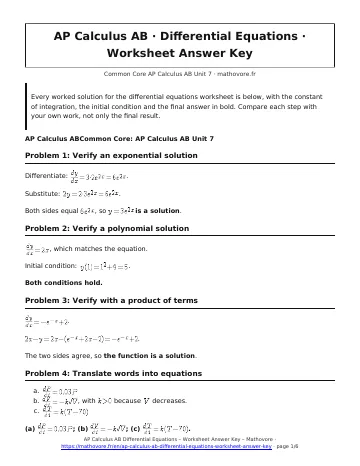
See every chapter on the AP Calculus AB math page.