



This ap calculus derivative rules lesson explains definition of the derivative and basic rules in one printable page, with definitions, a method and a worked example.
The derivative of a function at a point is its instantaneous rate of change: the limit of the difference quotient as h approaches 0, and the slope of the tangent line. The power, sum, product and quotient rules, plus the derivatives of sine, cosine, e^x and ln x, let you differentiate without computing limits.
AP Calculus Derivative Rules Lesson: key facts
- AP Calculus AB Unit 2: \(f^{\prime}(a)=\lim_{h\to 0}\frac{f(a+h)-f(a)}{h}\) is the slope of the tangent line at \(x=a\).
- Average rate of change on \([a,b]\) is \(\frac{f(b)-f(a)}{b-a}\), the slope of a secant line.
- Power rule: \(\frac{d}{dx}x^{n}=nx^{n-1}\). Product rule: \((fg)^{\prime}=f^{\prime}g+fg^{\prime}\). Quotient rule: \((\frac{f}{g})^{\prime}=\frac{f^{\prime}g-fg^{\prime}}{g^{2}}\).
- A function is not differentiable at a corner, cusp, vertical tangent or discontinuity; differentiable implies continuous.
- \(\frac{d}{dx}\sin x=\cos x\), \(\frac{d}{dx}\cos x=-\sin x\), \(\frac{d}{dx}e^{x}=e^{x}\), \(\frac{d}{dx}\ln x=\frac{1}{x}\).
What is the derivative?
The average rate of change of \(f\) on \([a,b]\) is the slope of the secant line, \(\frac{f(b)-f(a)}{b-a}\). Letting the second point slide toward the first gives the instantaneous rate of change, the slope of the tangent line:
\(f^{\prime}(a)=\lim_{h\to 0}\frac{f(a+h)-f(a)}{h}\)
Also written \(\frac{dy}{dx}\). For \(f(x)=x^{2}\) at \(a=1\): \(\frac{(1+h)^{2}-1}{h}=2+h\to 2\).
When is a function not differentiable?
A derivative needs a single tangent slope, so \(f\) fails to be differentiable at a corner, a cusp, a vertical tangent, or any discontinuity. Differentiable always implies continuous, but not the other way around: \(|x|\) is continuous at \(0\) with no derivative there.
What are the basic derivative rules?
| Function | Derivative |
|---|---|
| \(c\) | \(0\) |
| \(x^{n}\) | \(nx^{n-1}\) |
| \(\sin x\), \(\cos x\) | \(\cos x\), \(-\sin x\) |
| \(e^{x}\), \(\ln x\) | \(e^{x}\), \(\frac{1}{x}\) |
| \(\tan x\), \(\text{cot}\,x\) | \(\text{sec}^{2}\,x\), \(-\text{csc}^{2}\,x\) |
| \(\text{sec}\,x\), \(\text{csc}\,x\) | \(\text{sec}\,x\tan x\), \(-\text{csc}\,x\,\text{cot}\,x\) |
Constants factor out and sums split apart: \((cf\pm g)^{\prime}=cf^{\prime}\pm g^{\prime}\).
How do the product and quotient rules work?
Product: \((fg)^{\prime}=f^{\prime}g+fg^{\prime}\)
Quotient: \((\frac{f}{g})^{\prime}=\frac{f^{\prime}g-fg^{\prime}}{g^{2}}\)
Worked example: find the tangent line to \(f(x)=x^{2}e^{x}\) at \(x=1\).
- Product rule: \(f^{\prime}(x)=2xe^{x}+x^{2}e^{x}\).
- Evaluate: \(f(1)=e\) and \(f^{\prime}(1)=2e+e=3e\).
- Point-slope form: \(y-e=3e(x-1)\), so \(y=3ex-2e\).
How do you read a derivative from a graph or table?
Where \(f\) has a horizontal tangent, \(f^{\prime}\) is zero. From a table, estimate \(f^{\prime}(a)\) with the slope between the nearest points on each side. The figure shows \(f(x)=x^{3}-3x\) beside \(f^{\prime}(x)=3x^{2}-3\).
Definition of the Derivative and Basic Rules: frequently asked questions
What is the difference between average and instantaneous rate of change?
Average rate of change is the slope of a secant line over an interval, \(\frac{f(b)-f(a)}{b-a}\). Instantaneous rate of change is the slope of the tangent line at one point, found as the limit of those slopes as the interval shrinks.
How do you use the limit definition of the derivative?
Write \(\frac{f(x+h)-f(x)}{h}\), expand and simplify until \(h\) cancels from the numerator, then let \(h\to 0\). For \(f(x)=x^{2}\) the quotient simplifies to \(2x+h\), so \(f^{\prime}(x)=2x\).
When does a derivative not exist?
A derivative does not exist at a corner, cusp, vertical tangent, or discontinuity. At these points the left and right tangent slopes disagree or are infinite, so no single tangent slope exists.
What are the derivatives of sin x, cos x, e^x and ln x?
The derivative of \(\sin x\) is \(\cos x\), of \(\cos x\) is \(-\sin x\), of \(e^{x}\) is \(e^{x}\), and of \(\ln x\) is \(\frac{1}{x}\) for \(x > 0\).
When should you use the product rule instead of the power rule?
Use the product rule when two non-constant factors multiply, such as \(x^{2}\sin x\). The power rule alone handles a single power of \(x\). Multiplying out first is also fine for polynomials like \((x^{2}+1)(x^{3}-4x)\).
How to use this ap calculus derivative rules lesson
Use this ap calculus derivative rules lesson before the worksheet, then check what you learned with the quiz.

Printable PDF · Lesson
AP Calculus AB Definition of the Derivative and Basic Rules lesson
Download the PDF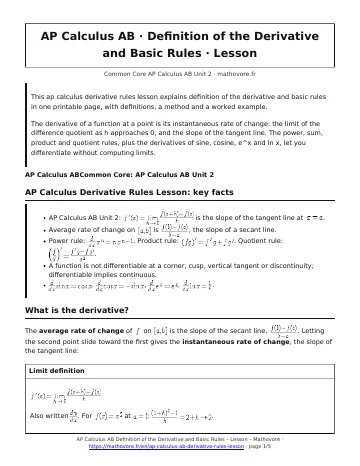
- Definition of the Derivative and Basic Rules worksheet (20 problems)
- Definition of the Derivative and Basic Rules quiz (10 questions)
- Definition of the Derivative and Basic Rules test (45 minutes)
- Previous lesson: Limits and Continuity
- Next lesson: Chain Rule, Implicit Differentiation and Inverse Functions
See every chapter on the AP Calculus AB math page.