
This grade 4 multiplicative comparison lesson explains multiplicative comparison and multi-step problems in one printable page, with definitions, a method and a worked example.
A multiplicative comparison tells how many times as large one amount is than another. The equation \(35 = 5 \times 7\) means 35 is 5 times as many as 7. To solve a comparison problem, multiply to find the larger amount or divide to find the smaller one. Multi-step problems use a letter and estimation.
Grade 4 Multiplicative Comparison Lesson: key facts
- A multiplication equation such as 35 = 5 x 7 can be read as 35 is 5 times as many as 7.
- Multiply to find a larger amount, and divide to find a smaller amount or the number of times .
- Times as many compares by multiplying; more than compares by adding.
- A letter stands for the unknown number in an equation.
- Estimate with rounding to check that an answer is reasonable.
What does “times as many” mean?
A multiplicative comparison says that one amount is made of equal groups, each as big as another amount. If Ava has 3 times as many marbles as Ben, her marbles make 3 equal groups, and each group is the size of Ben’s. When Ben has 4 marbles, Ava has \(3 \times 4 = 12\) marbles.
The equation \(35 = 5 \times 7\) can be read as a comparison. It says 35 is 5 times as many as 7. It also says 35 is 7 times as many as 5. In \(a = n \times b\), the number \(n\) tells how many times as many.
How do you solve a comparison problem?
First decide which amount is unknown. If the larger amount is unknown, multiply. If the smaller amount or the number of times is unknown, write a multiplication equation with a letter and solve it by dividing. Sofia has 24 stickers, which is 3 times as many as Noah has. Write \(3 \times n = 24\). Then \(n = 24 : 3 = 8\), so Noah has 8 stickers.
Is “times as many” the same as “more than”?
No. A phrase such as 3 more than 4 compares by adding, and 3 times as many as 4 compares by multiplying. The two phrases give different answers.
| Phrase | Operation | With 4 |
|---|---|---|
| 3 more than 4 | Add | \(4 + 3 = 7\) |
| 3 times as many as 4 | Multiply | \(3 \times 4 = 12\) |
How do you solve a multi-step problem?
- Read the problem and draw a tape diagram.
- Write an equation for the first step, using a letter for the unknown, and solve it.
- Use that answer in the next equation.
- Estimate with rounding to check that the answer is reasonable.
Maya has 29 baseball cards. Jamal has 4 times as many as Maya, and Ethan has 16 fewer than Jamal. Jamal: \(J = 4 \times 29 = 116\). Ethan: \(E = 116 – 16 = 100\). Estimate: \(4 \times 30 = 120\) and \(120 – 16 = 104\), which is close to 100.
Multiplicative Comparison and Multi-Step Problems: frequently asked questions
What does “times as many” mean?
It means one amount is made of equal groups that are each the size of the other amount. If Ava has 3 times as many marbles as Ben, and Ben has 4, then Ava has \(3 \times 4 = 12\).
How can I tell multiplicative and additive comparisons apart?
Look at the words. “Times as many” or “times as long” means multiply. “More than” or “fewer than” means add or subtract.
How do I find the unknown in “n times as many”?
Write a multiplication equation with a letter, such as \(6 \times n = 48\). Then divide the product by the known factor: \(n = 48 : 6 = 8\).
Why use a letter for the unknown?
A letter holds the place of the number you do not know yet. Writing the equation first shows how the numbers in the story are connected, so you can choose the correct operation.
How do I know if my answer to a multi-step problem is reasonable?
Round each number to a friendly value and compute quickly. The estimate should be close to your exact answer. If it is far away, recheck the steps.
How to use this grade 4 multiplicative comparison lesson
Use this grade 4 multiplicative comparison lesson before the worksheet, then check what you learned with the quiz.

Printable PDF · Lesson
Grade 4 Multiplicative Comparison and Multi-Step Problems lesson
Download the PDF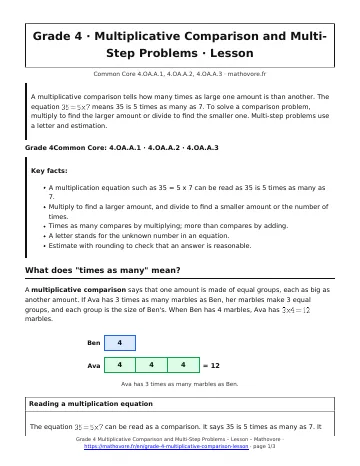
- Multiplicative Comparison and Multi-Step Problems worksheet (24 problems)
- Multiplicative Comparison and Multi-Step Problems quiz (10 questions)
- Multiplicative Comparison and Multi-Step Problems test (45 minutes)
- Previous lesson: Division with Remainders
- Next lesson: Factors, Multiples, Primes and Composites
See every chapter on the Grade 4 math page.