



These 22 problems practice interpreting and comparing functions: standards F-IF.B.4, F-IF.B.5, F-IF.B.6, F-IF.C.8a and F-IF.C.9. You will read key features from graphs and tables, decide on a domain from a context, find average rates of change, and rewrite quadratics to show zeros and extreme values.
The last six problems use real situations such as projectiles, Ferris wheels and savings plans. Include units in every answer.
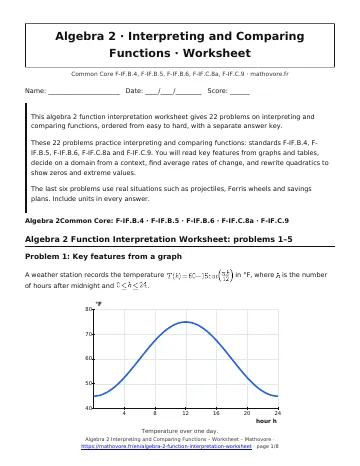
Problem 1: Key features from a graph
A weather station records the temperature \(T(h)=60-15\cos(\frac{\pi h}{12})\) in °F, where \(h\) is the number of hours after midnight and \(0\le h\le 24\).
- Find the maximum temperature and when it occurs.
- Find the minimum temperature and when it occurs.
- State the period and the midline value.
- On which intervals is the temperature increasing?
- Find the average rate of change from \(h=6\) to \(h=12\).
Problem 2: Domain from context
Jamal uses 80 feet of fencing to make a rectangular dog run. If the width is \(w\) feet, the area is \(A(w)=w(40-w)\) square feet.
- Explain why \(A(w)=w(40-w)\) is positive only for \(0 < w < 40\).
- State the domain of the model.
- Find the width that gives the greatest area, and that area.
Problem 3: Discrete domain
A community theater has 150 seats. Each ticket costs $8.50, so the revenue is \(C(n)=8.5n\) dollars for \(n\) tickets sold.
- State the domain of \(C\) in this context.
- Find \(C(40)\) and \(C(150)\).
- Would the graph be a line or a set of points? Explain.
Problem 4: Rational model in context
Mei’s club splits a $500 trip cost evenly among \(x\) members, so each pays \(C(x)=\frac{500}{x}\) dollars.
- Find \(C(8)\), \(C(20)\) and \(C(50)\).
- Is \(C\) increasing or decreasing as \(x\) grows?
- Describe the horizontal asymptote and what it means here.
- State a reasonable domain.
Problem 5: Exponential key features
The value of a laptop is \(V(t)=1200(0.8)^{t}\) dollars after \(t\) years.
- Find the vertical intercept and explain what it means.
- Is the function increasing or decreasing? Explain using the base.
- Name the horizontal asymptote and interpret it.
- Find the value after 3 years.
- Find the first whole year in which the value is below $500.
Problem 6: Logarithmic model
The pH of a solution is \(\text{pH}(c)=-\log c\), where \(c\) is the hydrogen ion concentration in moles per liter.
- Find the pH when \(c=10^{-7}\), \(c=10^{-3}\) and \(c=0.0001\).
- State the domain of the function.
- Is the function increasing or decreasing? What happens to the pH when the concentration is multiplied by 10?
Problem 7: Average rate of change from equations
Find the average rate of change of each function on the given interval.
- \(f(x)=x^{2}-3x\) on \([1,4]\)
- \(g(x)=x^{3}\) on \([-1,3]\)
- \(h(x)=2^{x}\) on \([1,4]\)
Problem 8: Average rate of change from a table
Sofia’s distance from the start of a training run is recorded below.
| Time t (minutes) | 0 | 2 | 4 | 6 | 8 |
|---|---|---|---|---|---|
| Distance d (miles) | 0 | 0.3 | 0.7 | 1.2 | 1.9 |
- Find the average rate of change on \([2,6]\) with units.
- Find it on \([0,4]\) and on \([4,8]\).
- What do the three answers say about her pace?
Problem 9: Rate of change and features from a graph
The graph shows \(g(x)=x^{3}-6x^{2}+9x\) with four labeled points.
- Find the average rate of change on \([0,1]\), \([1,3]\) and \([0,4]\).
- State the zeros and the intervals where \(g\) is increasing and decreasing.
- Identify the relative maximum and minimum.
Problem 10: Compare average rates
Let \(f(x)=2^{x}\) and \(g(x)=4x\).
- Find the average rate of change of each function on \([0,4]\).
- Find the average rate of change of each on \([4,6]\).
- What does the comparison show about exponential and linear growth?
Problem 11: Zeros from factored form
Let \(f(x)=x^{2}-7x+10\).
- Rewrite \(f\) in factored form and find its zeros.
- Find the axis of symmetry.
- Find the minimum value of \(f\).
Problem 12: Maximum from factored form
Let \(g(x)=-2x^{2}+8x+10\).
- Factor \(g\) completely and find its zeros.
- Find the axis of symmetry and the maximum value.
- Find the y-intercept.
Problem 13: Complete the square
Rewrite each function by completing the square. Then give the vertex and the zeros.
- \(f(x)=x^{2}+6x+5\)
- \(h(x)=x^{2}-10x+19\)
Problem 14: Complete the square with a leading coefficient
Rewrite each function in vertex form. State whether the vertex is a maximum or a minimum, and find the zeros.
- \(f(x)=2x^{2}-12x+7\)
- \(g(x)=-3x^{2}+6x+9\)
Problem 15: Profit from a quadratic model
The school drama club’s profit from a play is \(P(x)=-2x^{2}+60x-250\) dollars when tickets cost \(x\) dollars each.
- Factor \(P(x)\) and find the break-even prices.
- Rewrite \(P(x)\) in vertex form.
- What ticket price gives the greatest profit, and what is that profit?
- Interpret \(P(0)\).
Problem 16: Compare two quadratics
Function \(f\) is given by \(f(x)=x^{2}-6x+5\). Function \(g\) is shown in the graph.
- Complete the square to find the vertex of \(f\).
- Which function has the lesser minimum value? State both minimums.
- Which function has real zeros? Justify.
- Which function has the greater y-intercept?
Problem 17: Compare a table and an equation
Function \(A\) is described by the table. Function \(B\) is \(B(x)=5x+4\).
| x | 0 | 1 | 2 | 3 |
|---|---|---|---|---|
| A(x) | 3 | 6 | 12 | 24 |
- Describe the pattern in the table and predict \(A(4)\).
- Which function has the greater value at \(x=4\)?
- Find the average rate of change of each function on \([0,3]\). Which is greater?
Problem 18: Compare two projectiles
Ball A is thrown with height \(h_{A}(t)=-16t^{2}+32t+6\) feet. The table gives the height of Ball B in feet.
| t (s) | 0 | 0.5 | 1 | 1.5 | 2 | 2.5 | 3 |
|---|---|---|---|---|---|---|---|
| Ball B | 4 | 24 | 36 | 40 | 36 | 24 | 4 |
- Find the maximum height of Ball A and when it occurs.
- Estimate the maximum height of Ball B from the table. Which ball goes higher?
- Which ball starts higher?
- Find the average rate of change of each ball on \([0,1]\).
Problem 19: Average cost model
Aisha prints custom stickers. The total cost for \(n\) stickers is $200 plus $5 each, so the average cost per sticker is \(A(n)=\frac{200+5n}{n}\) dollars.
- Find \(A(10)\), \(A(40)\) and \(A(100)\).
- Find the average rate of change of \(A\) on \([10,100]\) and interpret it.
- Rewrite \(A(n)\) to show its horizontal asymptote and explain what it means.
- For how many stickers is the average cost exactly $6?
Problem 20: Ferris wheel heights
The height of a seat on a Ferris wheel is \(h(t)=25-20\cos(\frac{\pi t}{30})\) feet, where \(t\) is minutes after boarding at the bottom, for one full turn \(0\le t\le 60\).
- Find the lowest and highest heights and when they occur.
- State the period and explain it in the situation.
- Find the average rate of change on \([0,10]\) and on \([10,20]\). When is the seat rising faster?
Problem 21: Open box volume
Diego makes an open box from a 12-inch by 9-inch sheet by cutting a square of side \(x\) inches from each corner and folding up the sides. The volume is \(V(x)=x(12-2x)(9-2x)\) cubic inches.
| x (in) | 0.5 | 1 | 1.5 | 2 | 2.5 | 3 | 3.5 |
|---|---|---|---|---|---|---|---|
| V(x) | 44 | 70 | 81 | 80 | 70 | 54 | 35 |
- State the domain of \(V\) in this context.
- Which table value of \(x\) gives the greatest volume?
- Find the average rate of change on \([0.5,1.5]\) and on \([1.5,3]\). Interpret the signs.
Problem 22: Compare savings plans
Priya compares two savings plans. Plan A is \(S(t)=150+25t\) dollars after \(t\) weeks. Plan B is \(S(t)=100(1.2)^{t}\) dollars.
- Find the balance of each plan after 6 weeks and after 7 weeks.
- In which week does Plan B first have more money than Plan A?
- Find the average rate of change of each plan on \([0,6]\) (round to the nearest cent).

See every chapter on the Algebra 2 math page.