


This algebra 2 expressions worksheet answer key solves all 22 problems of the structure of expressions and modeling with equations worksheet step by step.
This answer key shows a full worked solution for each of the 22 problems on expressions and modeling. Compare every step, not only the final answer, and re-check any solution that fails the constraints of the situation.
Algebra 2 Expressions Worksheet Answer Key: problems 1–5
Problem 1: Parts of an exponential model
- The starting amount is the factor 800, so Priya opened the account with $800.
- The growth factor is 1.03. Since \(1.03=1+0.03\), the balance grows 3% each year.
- When \(t=0\), \((1.03)^{0}=1\) so \(B=800\): it is the opening deposit, $800.
Problem 2: Terms and coefficients
- The terms are \(5x^{3}\), \(-2x^{2}\), \(7x\) and \(-9\).
- The coefficients are 5, −2 and 7.
- The constant term is −9.
- The factors are 3, \((x+1)\) and \((x-4)\).
Problem 3: Meaning of a factor
- The factor \(p\) is the price per shirt, and \(500-20p\) is the number of shirts sold.
- At \(p=5\), \(500-20(5)=400\) shirts sell, so \(R=5(400)=2000\): $2,000.
- At \(p=10\), \(500-20(10)=300\) shirts sell, so \(R=10(300)=3000\): $3,000.
- The $10 price earns $1,000 more than the $5 price, so $10 is better.
Problem 4: Write and interpret a cost expression
- Notebooks cost \(2.5n\) and the backpack costs 18, so the total is \(1.08(2.5n+18)\).
- The factor \(1.08\) is \(1+0.08\): it multiplies the entire sum by the 8% tax.
- \(1.08(2.5\cdot 6+18)=1.08(33)=35.64\), so the cost is $35.64.
- \(1.08(2.5n)=2.7n\) and \(1.08(18)=19.44\), so the cost is \(2.7n+19.44\).
Problem 5: Fourth-power differences
- \(x^{4}-16=(x^{2}+4)(x^{2}-4)\), so \((x^{2}+4)(x+2)(x-2)\).
- \(x^{4}-81=(x^{2}+9)(x^{2}-9)\), so \((x^{2}+9)(x+3)(x-3)\).
- \(16x^{4}-1=(4x^{2}+1)(4x^{2}-1)\), so \((4x^{2}+1)(2x+1)(2x-1)\).
- \(m^{4}-n^{4}=(m^{2}+n^{2})(m^{2}-n^{2})\), so \((m^{2}+n^{2})(m+n)(m-n)\).
Algebra 2 Expressions Worksheet Answer Key: problems 6–10
Problem 6: Hidden squares
- With \(a=x+3\) and \(b=4\): \((x+3-4)(x+3+4)\) = \((x-1)(x+7)\).
- With \(a=2x-1\) and \(b=5\): \((2x-6)(2x+4)\) = \(4(x-3)(x+2)\).
- \(x^{4}-5x^{2}+4=(x^{2}-1)(x^{2}-4)\), so \((x-1)(x+1)(x-2)(x+2)\).
- \(x^{4}-13x^{2}+36=(x^{2}-4)(x^{2}-9)\), because \(4+9=13\) and \(4\cdot 9=36\). The result is \((x-2)(x+2)(x-3)(x+3)\).
Problem 7: Simplify with structure
- \(x^{4}-16=(x^{2}+4)(x^{2}-4)\), so the quotient is \(x^{2}-4\). The denominator \(x^{2}+4\) is never 0, so there are no excluded values.
- \(\frac{(x-7)(x+7)}{(x+7)^{2}}=\frac{x-7}{x+7}\), \(x\neq -7\).
- \(x^{4}-1=(x^{2}+1)(x^{2}-1)\), so the quotient is \(x^{2}+1\) with \(x\neq 1\) and \(x\neq -1\).
Problem 8: Factor over the complex numbers
- \(x^{2}-(3i)^{2}\) since \((3i)^{2}=-9\): \((x+3i)(x-3i)\).
- \((5i)^{2}=-25\), so \((x+5i)(x-5i)\).
- \((2x)^{2}-i^{2}=4x^{2}+1\), so \((2x+i)(2x-i)\).
- \(x^{4}-16=(x+2)(x-2)(x^{2}+4)\) and \(x^{2}+4=(x+2i)(x-2i)\), so \((x+2)(x-2)(x+2i)(x-2i)\).
Problem 9: Quadratic zeros and the Fundamental Theorem
- \(x=\frac{6\pm\sqrt{36-52}}{2}=\frac{6\pm 4i}{2}=3\pm 2i\). Factored: \((x-3-2i)(x-3+2i)\).
- \(x=\frac{-2\pm\sqrt{4-40}}{2}=\frac{-2\pm 6i}{2}=-1\pm 3i\). Factored: \((x+1-3i)(x+1+3i)\).
Every quadratic has exactly two complex zeros, counting a repeated zero twice.
Problem 10: Pascal's triangle rows
- Each number is the sum of the two above it. Row 5 is 1, 5, 10, 10, 5, 1 and row 6 is 1, 6, 15, 20, 15, 6, 1.
- The coefficients of \((a+b)^{5}\) come from row 5, in order for \(a^{5},a^{4}b,a^{3}b^{2}\), so the coefficient is 10.
- \(1+6+15+20+15+6+1=64\), which is \(2^{6}\). Each row sums to a power of 2: 64.
Algebra 2 Expressions Worksheet Answer Key: problems 11–15
Problem 11: Expand binomials
- Row 4 is 1, 4, 6, 4, 1: \(x^{4}+4x^{3}(2)+6x^{2}(4)+4x(8)+16\) = \(x^{4}+8x^{3}+24x^{2}+32x+16\).
- Row 3 is 1, 3, 3, 1: \(x^{3}+3x^{2}(-3)+3x(9)+(-27)\) = \(x^{3}-9x^{2}+27x-27\).
- Row 5 is 1, 5, 10, 10, 5, 1 with \(a=2x\) and \(b=-1\): \(32x^{5}-80x^{4}+80x^{3}-40x^{2}+10x-1\). Check at \(x=1\): \(32-80+80-40+10-1=1=1^{5}\). The expansion is \(32x^{5}-80x^{4}+80x^{3}-40x^{2}+10x-1\).
Problem 12: Rearrange common formulas
- Multiply by 2, then divide by \(h\): \(b=\frac{2A}{h}\).
- \(2w=P-2l\), so \(w=\frac{P-2l}{2}\).
- Divide both sides by \(\pi r^{2}\): \(h=\frac{V}{\pi r^{2}}\).
- \(F-32=\frac{9}{5}C\), so \(C=\frac{5}{9}(F-32)\).
Problem 13: Rearrange formulas with fractions
- \(\frac{1}{q}=\frac{1}{f}-\frac{1}{p}=\frac{p-f}{fp}\), so \(q=\frac{fp}{p-f}\).
- \(S(1-r)=a\) gives \(1-r=\frac{a}{S}\), so \(r=1-\frac{a}{S}=\frac{S-a}{S}\).
- Divide by \((1+r)^{t}\): \(P=\frac{A}{(1+r)^{t}}\).
- \(y(x-3)=2x+1\), then \(xy-3y=2x+1\), then \(x(y-2)=3y+1\). So \(x=\frac{3y+1}{y-2}\). (Check: \(x=4\) gives \(y=9\) and \(\frac{28}{7}=4\).)
Problem 14: Solve f(x) = g(x) from a graph
- The graphs cross at \(x=-1\) and \(x=4\).
- \(x^{2}-2x-3=x+1\) gives \(x^{2}-3x-4=0\), so \((x-4)(x+1)=0\). The solutions are \(x=-1\) and \(x=4\). At \(x=4\) both functions equal 5; at \(x=-1\) both equal 0.
Problem 15: Solve f(x) = g(x) from a table
| x | 1 | 2 | 3 | 4 | 5 |
|---|---|---|---|---|---|
| f(x) | 2 | 4 | 8 | 16 | 32 |
| g(x) | 10 | 9 | 8 | 7 | 6 |
The two rows match at \(x=3\) where both equal 8, so the solution is \(x=3\). The function \(f\) always increases while \(g\) always decreases, so they can meet only once.
Algebra 2 Expressions Worksheet Answer Key: problems 16–20
Problem 16: Solve a rational equation by graphing
- The graphs cross near \(x=3\) and \(x=-2\).
- Multiply both sides by \(x\): \(6=x(x-1)\), so \(x^{2}-x-6=0\) and \((x-3)(x+2)=0\). The solutions are \(x=3\) and \(x=-2\). Check: \(\frac{6}{3}=2=3-1\) and \(\frac{6}{-2}=-3=-2-1\).
Problem 17: Garden area model
- \(w(w+3)=270\), or \(w^{2}+3w-270=0\).
- \((w+18)(w-15)=0\) gives \(w=-18\) or \(w=15\). A width cannot be negative, so reject \(-18\). The garden is 15 ft by 18 ft, and \(15\cdot 18=270\).
- The perimeter is \(2(15+18)=66\) ft, and \(66\cdot 4.50=297\). The fence costs $297.
Problem 18: Speed and time model
- Time is distance divided by speed: \(\frac{60}{r}+\frac{60}{r+20}=2.5\).
- Multiply by \(r(r+20)\): \(60(r+20)+60r=2.5r(r+20)\), so \(120r+1200=2.5r^{2}+50r\) and \(2.5r^{2}-70r-1200=0\). Dividing by 2.5 gives \(r^{2}-28r-480=0\), so \((r-40)(r+12)=0\). A speed cannot be negative, so \(r=40\).
- The country road speed is 40 mph and the interstate speed is 60 mph. Check: \(1.5+1=2.5\) hours.
Problem 19: Bacteria growth model
- Doubling every 3 hours gives \(N(t)=500\cdot 2^{t/3}\).
- \(N(6)=500\cdot 2^{2}=2000\) bacteria.
- \(500\cdot 2^{t/3}=16000\) gives \(2^{t/3}=32=2^{5}\), so \(t/3=5\) and \(t=15\) hours.
Problem 20: Budget inequality
- \(30+6.5n\le 120\).
- \(6.5n\le 90\), so \(n\le 13.85\) (rounded).
- Shirts come in whole numbers, so \(n\) must be a nonnegative integer. The greatest value is 13 shirts: they cost \(30+6.5(13)=114.50\), but 14 shirts cost $121.
Algebra 2 Expressions Worksheet Answer Key: problems 21–22
Problem 21: Farmers market equation
- \(2a+3p=30\).
- Since \(p=\frac{30-2a}{3}\) must be a whole number, \(a\) must be a multiple of 3. The pairs are (0, 10), (3, 8), (6, 6), (9, 4), (12, 2), (15, 0). Check (6, 6): \(12+18=30\).
- Neither amount can be negative: \(a\ge 0\) and \(p\ge 0\).
Problem 22: Cookie box constraints
- \(x+y\le 25\), \(4x+7y\ge 140\), \(x\ge 0\), \(y\ge 0\).
- A: \(10+15=25\) and \(40+105=145\) work. B: \(5+20=25\) and \(20+140=160\) work. C: \(20+5=25\) but \(80+35=115 < 140\) fails. So A and B are possible.
- With \(x=25-y\): \(4(25-y)+7y\ge 140\) gives \(100+3y\ge 140\), so \(y\ge 13.33\). Whole boxes force \(y=14\): \(4(11)+7(14)=142\), while 13 large boxes give \(4(12)+7(13)=139\).
How to use this algebra 2 expressions worksheet answer key
Read this algebra 2 expressions worksheet answer key after trying each problem yourself, and redo any problem you missed.

Printable PDF · Worksheet Answer Key
Algebra 2 Structure of Expressions and Modeling with Equations worksheet answer key
Download the PDF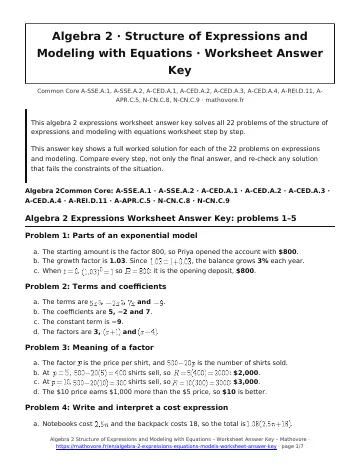
See every chapter on the Algebra 2 math page.