

This algebra 2 logarithms worksheet gives 23 problems on logarithms and logarithmic functions, ordered from easy to hard, with a separate answer key.
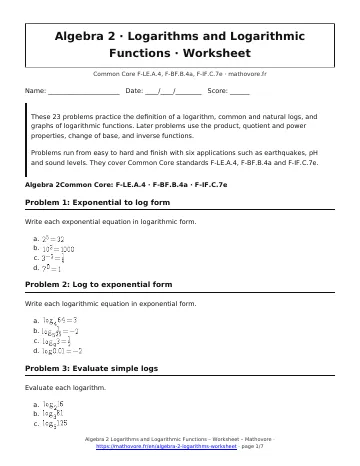
These 23 problems practice the definition of a logarithm, common and natural logs, and graphs of logarithmic functions. Later problems use the product, quotient and power properties, change of base, and inverse functions.
Problems run from easy to hard and finish with six applications such as earthquakes, pH and sound levels. They cover Common Core standards F-LE.A.4, F-BF.B.4a and F-IF.C.7e.
Algebra 2 Logarithms Worksheet: problems 1–5
Problem 1: Exponential to log form
Write each exponential equation in logarithmic form.
- \(2^{5}=32\)
- \(10^{3}=1000\)
- \(3^{-2}=\frac{1}{9}\)
- \(7^{0}=1\)
Problem 2: Log to exponential form
Write each logarithmic equation in exponential form.
- \(\log_{4} 64=3\)
- \(\log_{5}\frac{1}{25}=-2\)
- \(\log_{9} 3=\frac{1}{2}\)
- \(\log 0.01=-2\)
Problem 3: Evaluate simple logs
Evaluate each logarithm.
- \(\log_{2} 16\)
- \(\log_{3} 81\)
- \(\log_{5} 125\)
- \(\log_{10} 100000\)
Problem 4: Evaluate fractions and roots
Evaluate each logarithm.
- \(\log_{2}\frac{1}{8}\)
- \(\log_{4} 2\)
- \(\log_{8} 4\)
- \(\log_{1/2} 8\)
Problem 5: Special values
Evaluate each expression.
- \(\log_{9} 1\)
- \(\log_{12} 12\)
- \(\log_{7} 7^{5}\)
- \(3^{\log_{3} 11}\)
Algebra 2 Logarithms Worksheet: problems 6–10
Problem 6: Find the base or the value
Find the unknown in each equation.
- \(\log_{b} 49=2\)
- \(\log_{b} 64=3\)
- \(\log_{3} x=4\)
- \(\log_{2} x=-5\)
Problem 7: Common logarithms
Evaluate without a calculator. Then state which two consecutive integers \(\log 450\) lies between.
- \(\log 1000\)
- \(\log 0.001\)
- \(\log \sqrt{10}\)
- \(\log 450\)
Problem 8: Natural logarithms
Evaluate each expression.
- \(\ln e^{4}\)
- \(\ln 1\)
- \(\ln e\)
- \(\ln \frac{1}{e^{3}}\)
- \(e^{\ln 9}\)
Problem 9: Use a calculator
Round each value to four decimal places.
- \(\ln 7\)
- \(\log 56\)
- \(\ln 0.5\)
Problem 10: Read a log graph
The graph shows \(y=\log_{3} x\). Use it to answer each part.
- State the x-intercept.
- State the domain and the range.
- Write the equation of the vertical asymptote.
- Find \(\log_{3} 9\) and \(\log_{3}\frac{1}{3}\).
Algebra 2 Logarithms Worksheet: problems 11–15
Problem 11: Domain of a log function
Find the domain of each function.
- \(f(x)=\log_{2}(x-3)\)
- \(g(x)=\log(5-x)\)
- \(h(x)=\ln(2x+6)\)
- \(k(x)=\log_{4}(x^{2}-9)\)
Problem 12: Transformations of a log graph
The graph of \(g(x)=\log_{2}(x+1)-3\) is shown. State the asymptote, the domain, the y-intercept and the x-intercept.
Problem 13: Expand a logarithm
Expand each expression using the properties of logarithms.
- \(\log_{3}(9x)\)
- \(\log_{2}\frac{x^{3}}{y}\)
- \(\log_{5}(25\sqrt{x})\)
- \(\ln\frac{e^{2}x^{4}}{y^{3}}\)
Problem 14: Condense a logarithm
Write each expression as a single logarithm.
- \(\log_{2} 5+\log_{2} 6\)
- \(3\log 2+\log 5\)
- \(\ln 12-\ln 4\)
- \(2\log_{3} x+\log_{3}(x+1)\)
- \(\frac{1}{2}\log_{7} x-3\log_{7} y\)
Problem 15: Evaluate with properties
Use the properties of logarithms to find each value exactly.
- \(\log_{6} 4+\log_{6} 9\)
- \(\log_{2} 96-\log_{2} 3\)
- \(3\log_{8} 2\)
- \(2\log_{3} 6-\log_{3} 4\)
Algebra 2 Logarithms Worksheet: problems 16–20
Problem 16: Change of base
Use the change of base formula to evaluate each logarithm. Round to four decimal places.
- \(\log_{3} 20\)
- \(\log_{5} 8\)
- \(\log_{12} 500\)
Problem 17: Find an inverse function
The graph of \(f(x)=3^{x}\) is shown with the line \(y=x\).
- Write the inverse function \(f^{-1}(x)\).
- Give the points on the graph of \(f^{-1}\) that match \((0,1)\), \((1,3)\) and \((2,9)\).
- Find the inverse of \(g(x)=2\cdot 4^{x}\).
- Find the inverse of \(h(x)=\log_{2} x+3\).
Problem 18: Earthquake magnitudes
The Richter magnitude of an earthquake is \(M=\log\frac{I}{I_{0}}\), where \(I\) is its intensity. Maya reads about a magnitude 5 quake and a magnitude 7 quake.
- How many times as intense is the magnitude 7 quake?
- A quake has magnitude 6.4. Find \(\frac{I}{I_{0}}\) to three significant digits.
Problem 19: Acidity and pH
The pH of a liquid is \(\text{pH}=-\log[H^{+}]\), where \([H^{+}]\) is in moles per liter. Jamal tests lemon juice, coffee and water.
- Lemon juice has \([H^{+}]=0.01\). Find its pH.
- Coffee has pH 5. Find \([H^{+}]\).
- How many times as large is \([H^{+}]\) in lemon juice as in coffee?
- Tomato juice has \([H^{+}]=3.2\times 10^{-5}\). Find its pH to the nearest hundredth.
Problem 20: Sound levels
Sound level in decibels is \(L=10\log\frac{I}{I_{0}}\). Mei compares everyday sounds.
- Find \(\frac{I}{I_{0}}\) for a conversation at 60 dB.
- Find \(\frac{I}{I_{0}}\) for a hair dryer at 90 dB.
- How many times as intense is the hair dryer as the conversation?
- Two identical hair dryers run together, so the intensity doubles. Find the new level to the nearest hundredth of a decibel.
Algebra 2 Logarithms Worksheet: problems 21–23
Problem 21: Digits of a large number
Diego wants to know how many digits \(2^{50}\) has without writing it out. Use \(\log 2\approx 0.30103\) to find the number of digits.
Problem 22: Invert a growth model
A bacteria population is \(P(t)=500\cdot 2^{t/3}\), where \(t\) is in hours. Write \(t\) as a function of \(P\), then find \(t\) when \(P=4000\).
Problem 23: Find the error
Ethan writes \(\log_{2}(x+3)=\log_{2} x+\log_{2} 3\). Explain his error and use \(x=5\) to show that the statement is false.

How to use this algebra 2 logarithms worksheet
Print this algebra 2 logarithms worksheet as a PDF, solve every problem on paper, then compare with the answer key.

See every chapter on the Algebra 2 math page.